The AO is digitising battlefield evacuations after its founder learned the problem in Ukraine
Howard Hunt built The AO in Berlin around a hard lesson from Donetsk Oblast: drones have turned casualty evacuation into a data problem.
By Ryan Merket · Published
Primary source: Tech.eu
Why it matters
The AO shows how Ukraine's war is forcing a new class of founder-led defence startups: teams built from frontline experience, aiming first at ugly operational gaps rather than polished procurement briefs.
Howard Hunt is building The AO around a problem he learned in the back of ambulances in Ukraine: modern battlefield medicine still runs on cuffs, paper cards and memory while drone warfare pushes evacuation crews farther from the wounded.
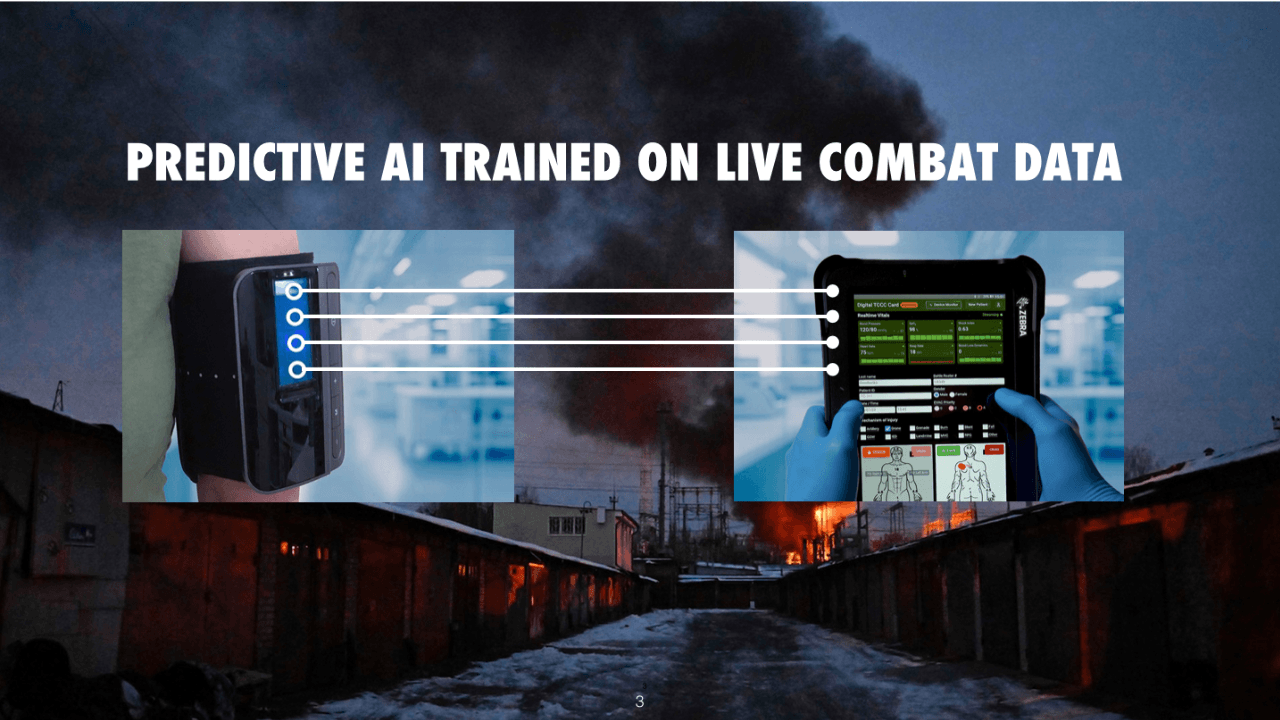
In a Tech.eu profile published July 8th, 2026, Hunt, who uses the callsign Hunter, described The AO as a Berlin startup developing a patient-monitoring system for combat casualty evacuation. The platform combines wearable sensors, ruggedised software and digital patient records to continuously track pulse, blood pressure, respiration and blood oxygen saturation during transport.
Hunt did four medical rotations with the Hospitallers Medical Battalion in Ukraine's Donetsk Oblast, according to Tech.eu. He entered evacuation work without military or medical experience, after hosting Ukrainian refugees in his apartment in Germany from March 2022 and then working his way toward the front by showing up with medical supplies. That experience explains why The AO is aiming at a workflow most healthtech founders would never see. The company grew from a field workaround created under drone-saturated conditions, built around a founder who learned the workflow in ambulances rather than a lab.
The workflow The AO wants to replace
Tech.eu reports that early in Russia's full-scale invasion, evacuation teams could often drive closer to the front line. Hunt said that changed as drones made daylight extraction too dangerous. Wounded soldiers are now stabilised near the zero line by combat medics and combat lifesavers, moved to casualty collection points outside the drone kill zone, and collected later by evacuation crews that may be moving several wounded soldiers at once.
The current process is still largely manual. In moving ambulances on damaged roads, medics take blood pressure with a cuff, count respirations by hand and fill out paper Tactical Combat Casualty Care records. Those records follow patients through the evacuation chain before hospital systems ingest them, which creates obvious failure points: illegible notes, delayed transcription and missing trend data.
The AO is developing ruggedised tablet software and a wearable sensor to digitise patient records and continuously capture those vital signs during evacuation, with data following the patient across handoffs.
Hunt is selling data, starting with survival
Hunt's larger bet is that a battlefield monitoring system becomes more valuable as a data asset. He told Tech.eu: "Every evacuation becomes another data point." The immediate purpose is to reduce manual recording during transport. The longer-term ambition is to build predictive models that can warn medics before a casualty deteriorates.
No clinical validation, regulatory clearance, revenue, paying customers or a deployed production fleet are established in the sources provided. The sources describe a system in development, with data collection a prerequisite for any predictive models.
The Hospitallers tie and the road to deployment
Tech.eu reports that after Hospitallers told him, "If you bring your own ambulance, you can have your own crew," Hunt returned to Germany and raised money to buy three ambulances. Hospitallers is a Ukrainian volunteer medical battalion.
Deployment is the hard part. In battlefield medicine, a tool has to survive mud, darkness, vibration, radio constraints, rushed handoffs and medics who have no patience for another device that slows care. Digitising the existing TCCC workflow asks medics to change less, but any extra device, sensor or data step still has to earn its place in an ambulance already carrying more patients than it should.
Funding details (round size, valuation, investors, paying customers) are not disclosed in the materials referenced here. Hunt started by driving wounded soldiers through Donbas at night, then returned to Berlin with a narrow conviction: the data created during evacuation was too important to leave on paper. The AO's challenge is turning that conviction into a system medics use when they have no time to think about software.