Applied Intuition moves its Nissan work from simulation into vehicle software
The October 5th agreement expands a relationship dating to 2020, putting Applied Intuition's Vehicle OS and development tools alongside Nissan's engineering teams.
By RuntimeWire Staff · Published
Primary source: PR Newswire
Why it matters
Applied Intuition is extending a six-year Nissan relationship from simulation into vehicle software, testing whether its tools can become part of automakers' core development stack.
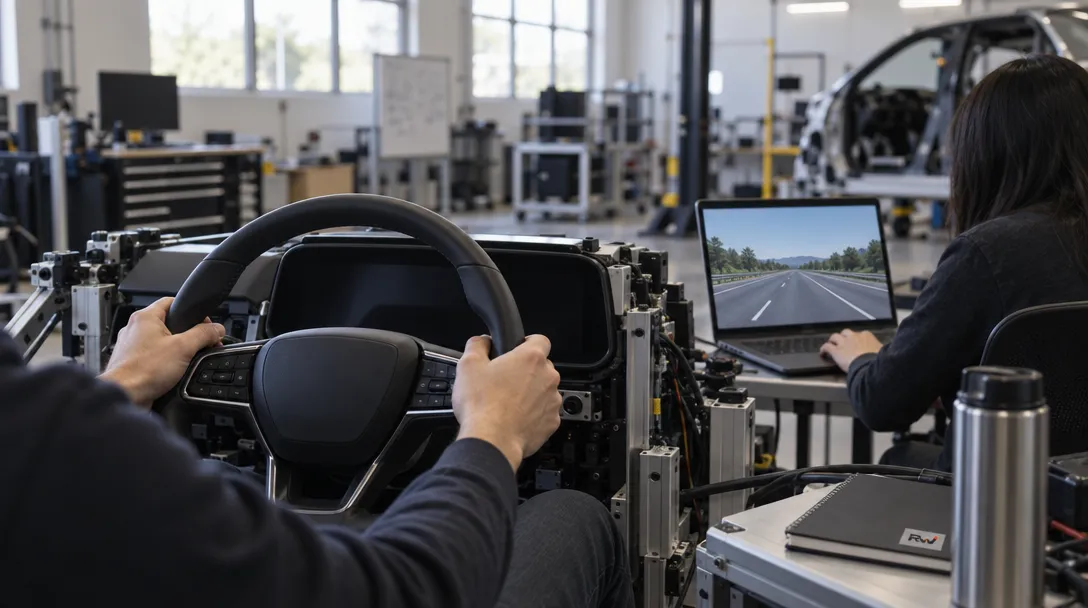
On October 5th, Applied Intuition said in its announcement with Nissan that it would bring its Vehicle OS and AI-powered development tools into work on Nissan's next-generation vehicle software platform, extending a relationship that began with simulation in 2020. For co-founder and CEO Qasar Younis, the agreement pushes Applied deeper into the systems automakers use to build vehicles, beyond the tools used to simulate them.
The announcement describes a collaboration, with Applied Intuition's teams in Japan and Silicon Valley working alongside Nissan engineers in Japan. Applied says its software is intended to support a common platform across multiple powertrains, simplify the mix of legacy and newer development workflows, and abstract differences in vehicle hardware. The companies have not tied the work to a named Nissan production model or a vehicle launch date.
A founder's bet on the infrastructure
Younis arrived at this market with experience on both sides of the problem. Before Applied Intuition, he worked as an automotive engineer at General Motors and Bosch, founded a technology company acquired by Google, and served as COO of Y Combinator. His co-founder, CTO Peter Ludwig, worked at Google on Google Maps and Android Automotive. That combination of automotive and software experience now sits behind a product pitch aimed at the engineering processes that connect code to a working vehicle.
Younis has described choosing infrastructure over building a robotaxi company. In a First Round Review interview, he said the founders saw a more durable business in selling tools to vehicle makers and autonomy companies than in taking on the expense and long timeline of operating vehicles themselves. The Nissan collaboration fits that original thesis: Applied supplies software that automakers can use in their own development and vehicle programs, rather than competing to build the cars.
Applied's work with Nissan began in 2020 with simulation technology. The expanded collaboration brings Vehicle OS and AI-native development tools into scope, moving the relationship closer to the software platform inside future vehicles. Applied CEO Qasar Younis described the goal as helping Nissan develop vehicles that can be "continuously updated over time," according to the announcement.
Software embedded in an automaker's development process and vehicle platform could give Applied a role beyond pre-production simulation. The announcement establishes the direction of the work, but not a production deployment or recurring revenue stream. A development collaboration does not establish how far the business has advanced.
A demo is not a production metric
The companies have already demonstrated part of the workflow. At AWS Summit Japan on June 30th, 2026, Nissan showed a test vehicle based on Nissan LEAF architecture. In the demonstration, attendees selected a change to the car's welcome-light sequence; engineers used Applied Intuition's tools to update, validate, and deploy the software over the air, then showed the change live. Applied Intuition's account of the demonstration says a task that could take weeks or months was completed in real time. That is a company-described demonstration, not evidence of a production vehicle's development time or a measured reduction across Nissan's programs.
The demonstration shows a visible software change, while a vehicle program must handle many more functions, hardware configurations, testing requirements, and safety considerations. The Nissan announcement says the software is intended to reduce complexity and speed development, but gives no measured savings, validation results, or production timetable.
In June 2025, Applied Intuition announced a $600 million Series F and tender offer at a $15 billion valuation, co-led by funds managed by BlackRock and Kleiner Perkins. That figure dates to the 2025 financing and is not a current valuation; the Nissan release names no new investment or contract value.
Younis said the collaboration would combine Applied's AI-native development software with Nissan's vehicle engineering expertise. The agreement moves Applied from helping Nissan model and test vehicle behavior toward supporting the software platform and workflows used to develop future vehicles. Whether that software reaches production on a specific Nissan model is the next concrete measure of the partnership.