ASI wins a five-year Army contract with a $99M ceiling for command software
Founded by Phillip Buckendorf after he saw how flight dispatchers worked, ASI says the first Army order will support Corps-level fires deconfliction.
By RuntimeWire Staff · Published
Primary source: SAM.gov
Why it matters
The award extends ASI co-founder Phillip Buckendorf's airline-born prediction thesis into Army operations, while the $99 million figure remains a contract ceiling. The first task order and measured field performance will show whether the software can scale beyond prototypes.
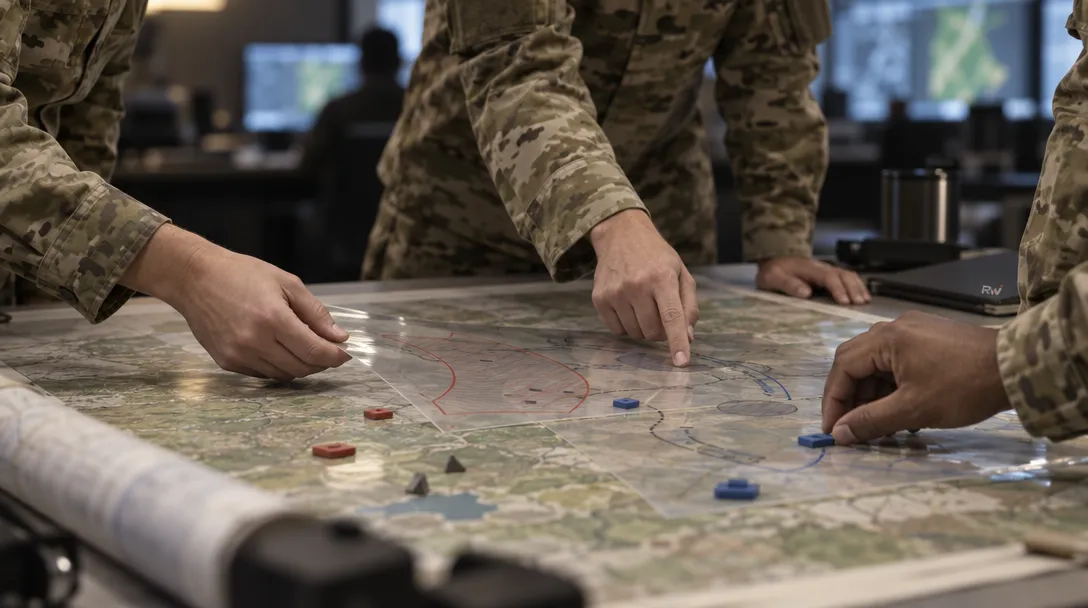
Air Space Intelligence (ASI), the predictive-software company co-founded by Phillip Buckendorf, won a five-year U.S. Army contract with a $99 million ceiling on September 29th. The Army award notice appeared on SAM.gov on September 30th; ASI announced it on October 8th, saying its software will support command-and-control work across the service.
Buckendorf's original product idea came from watching airline dispatchers work. In 2021, he told TIME that he expected to find sophisticated systems at a flight dispatch center and instead saw staff working with paper printouts and aging screens. He spent months alongside Alaska Airlines dispatchers developing Flyways, ASI's early flight-operations product. The Army award extends that founding premise - using software to anticipate changing operational conditions - from commercial aviation to military command and control.
A ceiling, not a check
The Army award is a single-award indefinite-delivery, indefinite-quantity contract, or IDIQ. The official award notice lists $99 million as the maximum value across a five-year ordering period that began September 29th. That is a spending ceiling, not $99 million in committed revenue. The government places orders under an IDIQ as needs arise; the award record gives the maximum value, while the public announcement does not state the first task order's dollar amount.

ASI says the first order will expand its work on fires deconfliction at Corps level, where its software is meant to consolidate multiple data sources into a predictive operating picture. ASI says workflows that once took minutes can be completed in seconds. It has not published supporting performance metrics for this Army deployment, so the speed claim remains the company's account rather than an independently measured result.
The Army selected ASI after a competitive solicitation and earlier prototyping with its Next Generation Command and Control effort, according to ASI's announcement. Whether other units adopt the software, and how much they order, will determine whether the contract's maximum translates into a substantial business line.
From airline dispatch to Army operations
ASI's thesis has stayed consistent as its customers have changed: operators need a forecast of what could happen next, not another screen that reports what is happening now. Its current platform, PRESCIENCE, is described by ASI as software for combining data, modeling operational environments, predicting future conditions and comparing possible actions. ASI is applying that approach across transportation, energy and defense.
Alaska Airlines' use of Flyways offers a comparison, though the Army use case is different. TIME reported that Alaska Airlines used the early Flyways system in flight planning, with human dispatchers retaining control over whether to accept recommendations. ASI describes the initial Army task as a tool for fires coordination, not a system making decisions for commanders. The announcement does not specify the Army units involved, deployment schedule or operational measures by which the software will be judged.
Buckendorf's partners bring technical and operational experience. ASI's company page says co-founder and CTO Kris Dorosz holds a computer science Ph.D. and previously worked in academia, at Samsung R&D and at startups. ASI Federal president Mark Lepczyk, who described the Army work in the announcement, served for more than a decade as a U.S. Air Force pilot, including in Air Force Special Operations Command and Air Force Materiel Command. Lepczyk said the software uses live simulation to help soldiers understand current conditions and anticipate what comes next.
In June, the FAA awarded ASI a 12-year contract for air-traffic modernization; the FAA confirmed the selection on June 22nd, while ASI put the value at $875 million in its own announcement. The Army award gives ASI another federal operating domain for its predictive-software strategy, but the two contracts are not evidence of interchangeable deployments or proven performance in each setting.
ASI raised a $34 million Series B in December 2023, led by Andreessen Horowitz, with Bloomberg Beta, Renegade Partners and Spark Capital participating, according to the financing announcement. The federal contracts now put ASI's premise in front of customers with far larger operating systems and stricter consequences for bad forecasts. The near-term evidence will come from task orders and the Army's results in the field, not the $99 million ceiling printed on the award.