Atomic Machines ships its first Matter Compiler relay for evaluation
The 150-amp PrimeSwitch PS-150 is designed for power distribution, including 800-volt DC systems in AI data centers. Atomic Machines says it has raised $250 million to date and spent six years developing its manufacturing system.
By RuntimeWire Staff · Published
Primary source: The New York Times
Why it matters
Atomic Machines is using a power relay to test whether digital instructions can replace device-specific tooling in manufacturing. The claim will matter to hardware founders and operators if the same system can produce other devices reliably; one product shipping for evaluation does not establish that range or production scale.
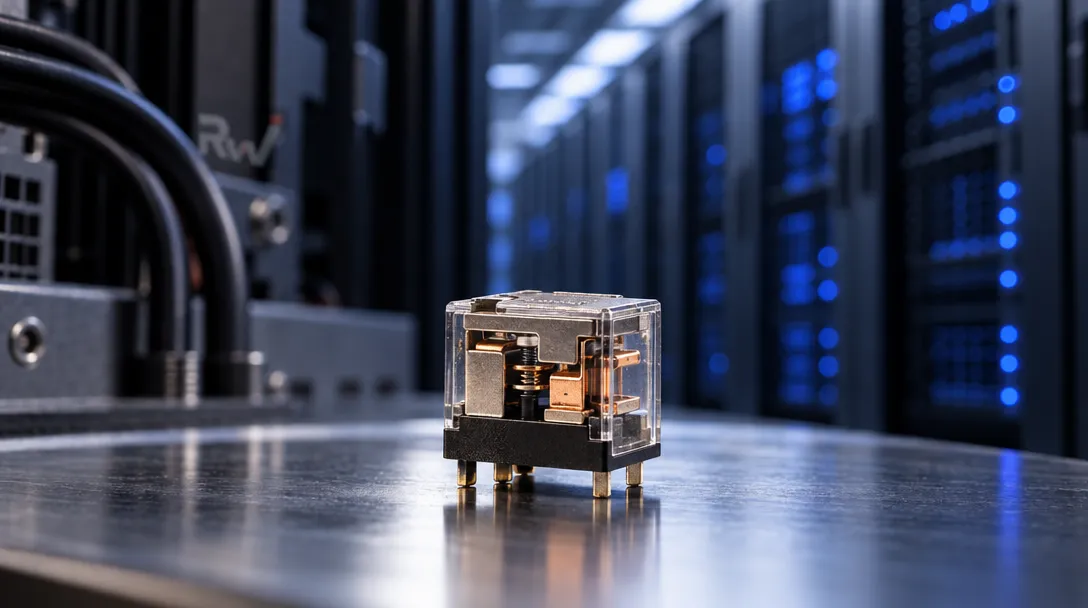
Jeff Holden, founder and CEO of Atomic Machines, introduced PrimeSwitch PS-150 on October 7th, 2026, as the first device produced with Atomic Machines' Matter Compiler. The San Francisco Bay Area company says the 150-amp relay is shipping to early-access customers for evaluation, according to its product page. Atomic Machines has not published a price or production-volume figure.
The launch gives Atomic Machines a physical product with which to test its larger manufacturing claim: that digital instructions can produce working devices without device-specific tooling. Atomic Machines says its Matter Compiler designs, fabricates and measures devices, then carries information from each build into later designs. Its system description describes an all-digital process without masks or production-line retooling; Holden's origin story says the system uses no molds, masks or fixtures. The public materials do not include independent test results or evidence of repeatability at commercial volumes.
The Business Wire announcement says Atomic Machines emerged from six years in stealth and has raised $250 million to date. It names OneIM, Gigafund, XTX Ventures, KAS Venture Partners, Valor Equity Partners, Tru Arrow Partners, Construct Capital, Sozo Ventures and the Regents of the University of California as investors. The announcement describes cumulative funding, not a newly announced financing round. Atomic Machines says it will show PrimeSwitch publicly for the first time at the Open Compute Project Global Summit in San Jose, October 12th-15th.
Holden's route to factory automation ran through software and consumer products. He worked as a software engineer and vice president at D. E. Shaw, co-founded social-discovery startup Pelago, held senior product roles at Amazon and Groupon, and became Uber's chief product officer, according to his Crunchbase profile. Crunchbase dates his founding of Atomic Machines to May 2019. In his account of why he started the company, Holden argues that manufacturing remains constrained by designs embodied in physical tooling: molds, masks, dies, fixtures and retooled lines.
Atomic Machines' proposed alternative is to store device designs as software instructions and measure production operations, allowing a design to change without rebuilding dedicated tooling. The Matter Compiler page describes a system that builds, measures and learns from each device, with the aim of carrying those measurements into the next design. Atomic Machines says the process could support different devices on the same manufacturing system. One product in evaluation does not establish that the system can produce a broad range of devices reliably or at commercial scale. Atomic Machines has not published revenue figures.
A relay for data-center power
PrimeSwitch is a bistable electromechanical relay, meaning it holds its state without power, according to Atomic Machines' published specifications. Atomic Machines rates it for 150 amps of continuous AC or DC current and lists an opening time of 50 microseconds, an on-resistance of 200 micro-ohms and galvanic isolation to 1,500 volts. The surface-mount package measures 9.5 millimeters in diameter and 3 millimeters high. Atomic Machines says the device needs no active cooling. The product page lists sampling availability but no price.
Atomic Machines is targeting power distribution in AI data centers. Holden points to the move toward 800-volt DC systems as a reason the switching trade-off has become more pressing. In Atomic Machines' account, conventional electromechanical relays offer metal-to-metal conduction but take milliseconds to open. Solid-state switches can open in microseconds, while conducting through semiconductors that Atomic Machines says bring higher losses and heat. PrimeSwitch is intended to combine metal contacts with faster switching.
Atomic Machines also describes a hybrid-breaker configuration for PrimeSwitch. In that setup, a small solid-state bypass carries current during the microseconds the relay takes to open; the company says this pairs fast interruption with the relay's conduction efficiency and galvanic isolation. This is Atomic Machines' proposed deployment approach, not independently validated performance. The launch materials do not report outside testing of the configuration.
The claimed performance and proposed use remain company-reported. Atomic Machines says PrimeSwitch is shipping to early-access customers for evaluation; its public materials do not state production volumes or a price. Evaluation samples do not establish that the relay has passed qualification for data-center use or that Atomic Machines can manufacture it at scale.
The relay also gives a concrete example of what Atomic Machines means by a micro-machine. In an essay published alongside the launch, Holden argues that semiconductor fabrication is highly capable within a narrow category: information-processing devices built largely in silicon. He says other small devices involving motion, fluid flow, heat, optics or magnetic materials are harder to make because they require different materials and three-dimensional structures. The essay cites MEMS devices such as accelerometers, gyroscopes, micro-mirrors and inkjet nozzles as existing manufacturing footholds, while arguing that many other device types still need custom processes.
Atomic Machines says PrimeSwitch combines micron-scale features, multiple materials and moving parts in three-dimensional assembly. It presents the relay as a component conventional semiconductor fabs are not designed to produce. Those claims come from Atomic Machines; its launch materials do not include a manufacturing demonstration or an outside assessment of the process.
The platform behind the component
The Matter Compiler page describes a system that designs, builds and measures micro-machines, then carries measurements into subsequent designs. Atomic Machines says it uses composable manufacturing operations and symbolic instructions, with the long-term goal of taking a prompt through design and fabrication. Holden calls that destination "prompt-to-product manufacturing". The public evidence so far is one named device shipping to early-access customers for evaluation, rather than a range of devices made through a demonstrated general-purpose process.
Holden's earlier product roles gave him experience building software-led products. A factory faces a different test: whether the same process can reliably turn varied designs into working hardware. The PrimeSwitch announcement does not disclose production capacity or commercial revenue. Its evaluation samples give prospective users a chance to assess the relay; they do not yet show that Atomic Machines can manufacture a broader catalog of devices.
The $250 million raised to date gives Atomic Machines substantial disclosed backing for a manufacturing system still at its first named product. The nearer test is whether early-access evaluations support the relay's proposed role in data-center power, and whether the Matter Compiler can reproduce it reliably. The public materials establish a product and a sampling program, not commercial production or a general-purpose factory.