Aurora gets five-year federal exemption for driverless-truck warning beacons
The Transportation Department approved the exemption late on October 7th, Reuters reported the next day; it lets Aurora and other autonomous trucking companies use cab-mounted beacons instead of roadside warning devices.
By Ryan Merket · Published
Primary source: Reuters
Why it matters
Aurora has secured a reported five-year federal exemption for a roadside procedure written around a human driver. That gives driverless freight operators a longer period to use cab-mounted warnings, while leaving the safety performance of those warnings and Aurora's commercial scaling to prove themselves.
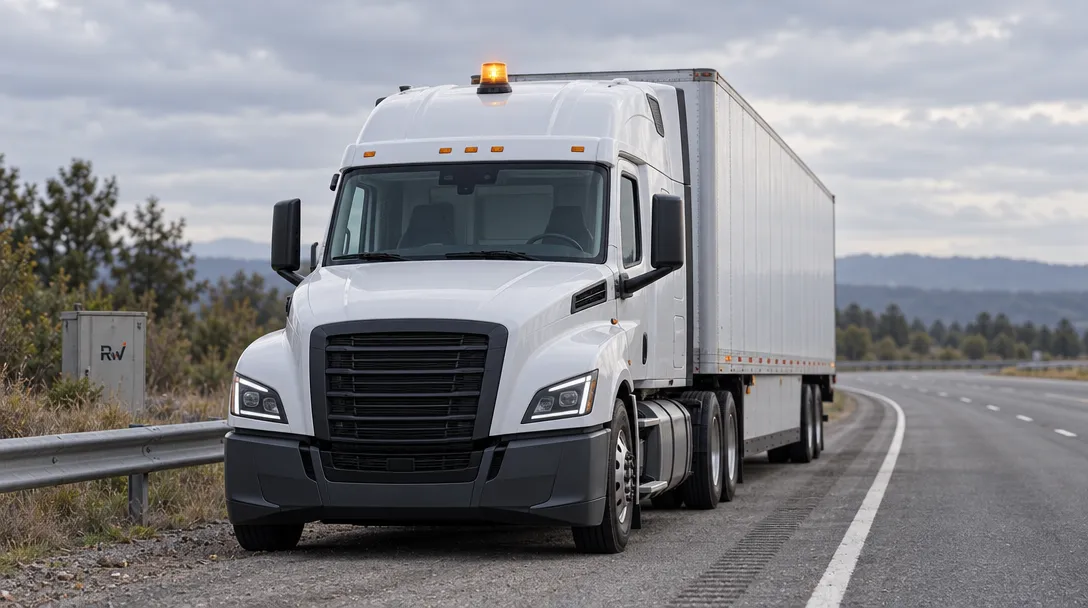
Aurora, led by co-founder and CEO Chris Urmson, received a five-year exemption from the U.S. Transportation Department late on October 7th, Reuters reported the next day. The report says the approval covers Aurora and other self-driving trucking companies, which can use warning beacons mounted on truck cabs instead of requiring a driver to place warning devices around a stopped truck. The Pittsburgh Business Times also reported the grant on October 7th, describing it as a follow-on to an earlier waiver.
For Aurora co-founder Chris Urmson, the exemption addresses an operational constraint: federal rules require a driver to deploy warning devices when a commercial truck stops on a highway. A Level 4 truck operating without a person onboard cannot perform that task. The five-year exemption gives driverless freight operators a longer period to use a cab-mounted alternative.
Urmson helped build Google's self-driving program and served as its chief technology officer. He earned a robotics Ph.D. at Carnegie Mellon University and directed the school's DARPA Grand and Urban Challenge teams. He co-founded Aurora in 2017; commercial trucking has become one of Aurora's first markets. Aurora's leadership biography identifies him as its co-founder, chairman and CEO.
A rule built around a person in the cab
The federal requirement applies when a commercial truck stops on a highway shoulder or traveled lane for a reason other than a traffic stop. The standard procedure requires a driver to activate hazard lights and place warning devices around the vehicle. Aurora's beacon system instead uses flashing lights mounted on the truck to warn approaching motorists.
The exemption follows a narrower regulatory path than Aurora and Waymo initially sought. In December 2024, the Federal Motor Carrier Safety Administration denied their application for an exemption covering a broad class of autonomous carriers. The agency said the application did not establish that the proposed system would provide an equivalent or greater level of safety across the industry. It also raised questions about beacon visibility near curves and rises, and about whether the application specified the equipment and operators closely enough. The agency's denial said the application lacked evidence and controls to support the requested safety exception.
FMCSA later issued Aurora a temporary waiver, effective October 10th, 2025. Its terms let other Level 4 carriers use the same framework after notifying the agency and certifying compliance. The waiver specified amber, forward- and rear-facing lights mounted at least 100 inches above ground, redundant power, and activation within 10 minutes of a qualifying stop. It also required carriers to report crashes and provide operational data, including beacon activations, reliability and miles traveled. Those requirements appear in the 2025 waiver terms.
FMCSA separately published technical conditions for its warning-device waiver, including operating restrictions, beacon mounting and performance standards, redundant power, and reporting obligations. Those waiver conditions should not be treated as the terms of the newly reported five-year exemption.
Fleet plans and safety questions
For Aurora, the longer term reduces uncertainty around a roadside procedure that matters when a driverless truck stops unexpectedly. Aurora's fleet plans give the exemption a direct commercial context. In a July shareholder letter, Aurora said it was fully allocated to exit 2026 with 200 driverless trucks in operation. That is a company target, not an independently confirmed fleet count, and the exemption does not establish that Aurora can meet its deployment or revenue plans.
The safety argument remains central. Aurora has said cab-mounted lights can alert road users without sending a person onto an active roadway to place warning triangles. The earlier denial explains why regulators treated that case cautiously: lights fixed high on a truck may provide less advance warning than devices placed behind it when visibility is obstructed. The 2024 decision cited limited testing and uncertainty about beacon performance in varied road conditions.
Urmson's X profile describes his aim as delivering the benefits of self-driving technology safely, quickly and broadly. The exemption advances the commercial side of that goal by giving driverless freight a more workable roadside procedure. Aurora still has to demonstrate that the warning system performs safely across real operating conditions and turn regulatory permission into a reliable trucking service.