Austin studies eVTOLs for EMS as traffic blocks responders
City officials are weighing aircraft-assisted emergency response; Austin was not selected for the FAA pilot, though Texas is testing routes and future medical logistics.
By Ryan Merket · Published · Updated
Primary source: KXAN
Why it matters
Austin is evaluating whether eVTOLs can help reach patients when roads fail, while Texas' federal pilot is still gathering route data before planned medical-logistics tests. The city has identified a use case, but the meeting established no aircraft purchase, response target or operational service.
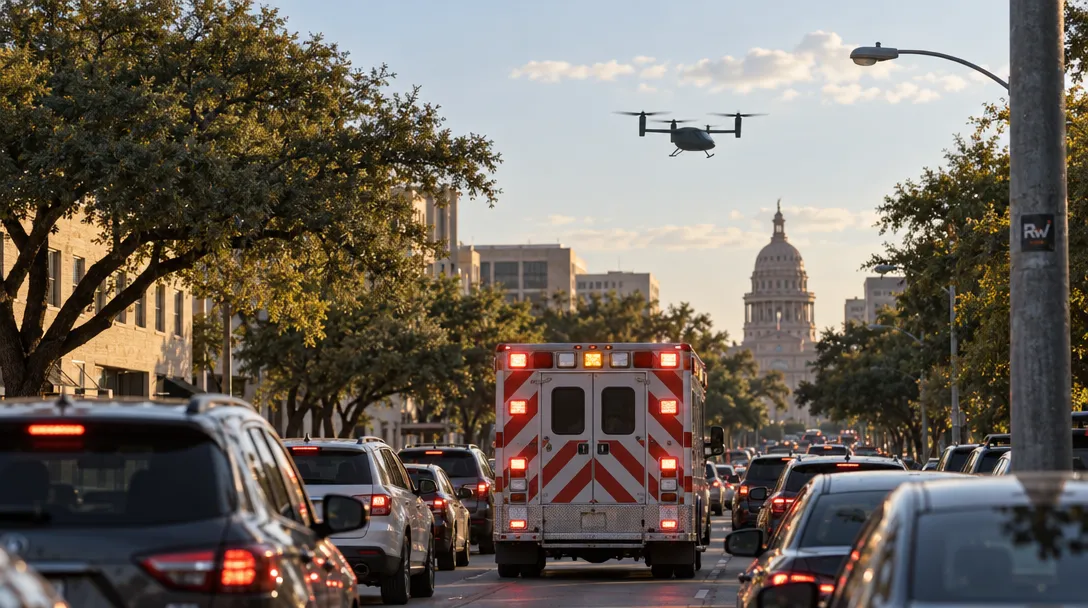
Austin officials are exploring whether electric vertical-takeoff-and-landing aircraft could help paramedics reach patients during severe traffic congestion. EMS leaders described responders carrying stretchers by hand when vehicles could not get through downtown. The proposal remains an early study, not a purchase or a launch of an emergency air service.
At an October 1st meeting of Austin's Mobility Committee, Assistant City Manager Mike Rogers said faster access to people experiencing heart attacks, car crashes and other emergencies could help first responders begin treatment sooner. Austin-Travis County EMS Division Chief Christopher Lester pointed to a University of Texas football game when downtown streets were so blocked that even EMS utility vehicles could not reach some patients. Responders hauled stretchers along the road, he said.
The city is considering aircraft as an addition to its existing response system, which includes ambulances and STAR Flight. Lester described the idea as a way to augment the 911 system. He also said the city is working toward a memorandum of understanding for medical transport. Officials raised questions about operating plans, safety procedures and how to coordinate with federal aviation rules.
Austin is not one of the local partners selected for the Federal Aviation Administration's eVTOL Integration Pilot Program. The FAA selected the Texas Department of Transportation as a partner. TxDOT's Project Nexus covers testing across Texas and neighboring states. Austin is exploring its own emergency-response use; the state-led pilot is the federally selected program.
The Texas effort is proceeding in stages. TxDOT says the first flights, launched on September 10th, are gathering data and validating routes without passengers. Later phases are planned to test medical and cargo logistics, including moving supplies or organs between rural facilities and medical centers in Austin and San Antonio. Passenger air-taxi operations are described as a later phase of the three-year pilot. These plans do not amount to an operating EMS aircraft service in Austin.

One aircraft discussed at the city meeting was HEXA, built by Austin-based LIFT Aircraft. HEXA is a single-seat aircraft, a key constraint for medical response: it could potentially carry a responder to a scene, but the city discussion did not establish that it could transport a patient. City officials cited a maximum speed of 60 miles per hour and a cruising speed of 50 for the aircraft under discussion. UT aerospace professor Puneet Singh told KXAN that eVTOLs could use existing helipads and, depending on the aircraft, flat spaces such as parks or parking lots.
LIFT founder Matt Chasen came to aviation after founding online freight marketplace uShip. He started LIFT to make personal flight more accessible, according to a University of Texas profile. LIFT's consumer flight experience and Austin's proposed EMS use are different applications. The aircraft's existing presence in the city does not show that it has been selected, funded or approved for emergency missions.
Certification and operating limits remain central. The FAA describes aircraft certification as a multi-phase process that applies to eVTOLs as well as conventional aircraft. At the committee meeting, city officials also raised questions about where aircraft might fly, noise, charging infrastructure, land use and the city's role when federal rules govern airspace. The technology's potential speed advantage does not resolve those questions or show how much time an aircraft would save once dispatch, launch, landing and handoff are included.
Austin's case for exploring aircraft rests on a specific access problem: during large events, ground crews can struggle to get through crowded streets. The scale of that need is less clear from the available figures. During the most recent Austin City Limits weekend, EMS transported eight patients from the festival grounds to hospitals, while the event recorded its lowest 911-call volume within the festival footprint in about a decade, KXAN reported. Most festival medical incidents were handled by a private provider contracted by organizer C3 Presents.
The festival record does not by itself show that festivals justify a new aircraft program. Austin officials will have to determine which emergencies warrant flight, what aircraft and crews can safely do, and how an air response would fit into dispatch and existing ground operations. The committee discussion began that policy work; it did not establish a fleet, a response-time target or a program budget.