Authors First raises $10M+ to give novelists final cut on AI-assisted TV
Founder Robert Hamwee is betting lower production costs can bring ambitious books to screen, with Conn Iggulden's six-episode Genghis adaptation as the first test.
By Ryan Merket · Published
Primary source: Forbes
Why it matters
Iggulden has creative authority and final-cut approval on the forthcoming Genghis season. The series will test whether lower AI-assisted production costs can translate into enough paid demand to support direct-to-consumer adaptations.
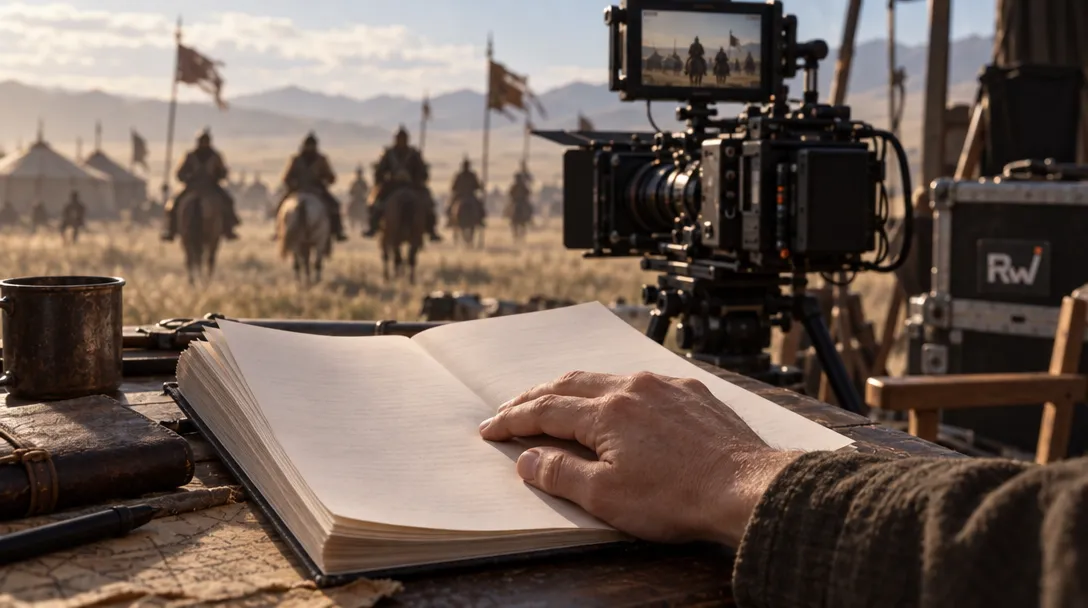
On October 6th, Authors First emerged from stealth with more than $10 million in seed funding and a six-episode adaptation of Conn Iggulden's Genghis: Birth of an Empire. Founder and CEO Robert Hamwee is building the New York studio around a simple reversal of Hollywood's usual arrangement: the author keeps final-cut approval, while AI-enabled production tools are meant to make expensive stories affordable to produce.
Hamwee comes to the project after roughly three decades in private equity and institutional finance, including 18 years at New Mountain Capital, where he remains a senior adviser. A lifelong reader of historical fiction, science fiction and fantasy, he says he started Authors First after making a list of books he wanted to see adapted and finding that many could not clear traditional production budgets. His first bet is a story whose scale made that problem tangible: during one of several Hollywood options on the books, a producer told Iggulden they needed to find half a billion dollars to make it work.
The round was led by Brand Foundry and Hamwee, with participation from Bolt Ventures, the family office of David Blitzer, as well as Andy Mills, Mike Duggal and John Kline, according to the launch announcement. Authors First said the seed totaled more than $10 million. Its valuation and the investors' individual checks were not reported.
The author stays in the edit
Iggulden is involved well beyond licensing the book. He worked with Authors First on screenplay, casting, storyboards, editing and rough cuts, and has final-cut approval on the forthcoming series, which Authors First lists as coming soon. In one example reported by Forbes, he pushed back on a character design that made a young woman look too physically frail, because it changed how viewers might read Bekter, her young antagonist.
That degree of author input is central to Hamwee's model. Authors First describes its process as human-led and AI-enabled: people develop the script, characters and storyboards, then use technology in production. The Authors First process description says human screenwriters adapt the book and artists draw the storyboards before scenes are brought to motion. The pitch is a workflow built around the author's interpretation, rather than a prompt generating a finished episode.

For Iggulden, the arrangement offers a chance to see the world of his novels on screen after earlier adaptations failed to get past the cost and scale. For Hamwee, the author retains creative authority while Authors First retains a business that can sell the finished season directly. Those interests align on creative decisions; whether they align at enough purchases to support the economics is the harder test.
A lower budget still needs an audience
Authors First says production costs about $4,000 per finished minute and Hamwee expects the figure to fall to $3,000. The six episodes total roughly 200 minutes, putting Authors First's current estimate near $800,000 for production, or about $600,000 at the lower target. Forbes reported that Authors First recovers production costs at $2,000 per minute, capped at about $400,000 for the season, before sharing remaining revenue with Iggulden. That recovery cap excludes marketing.

Hamwee puts the sales threshold at roughly 100,000 purchases. The season is planned to sell for $14.99 through the Authors First app, with a $9.99 founding preorder price, and to reach other digital storefronts through distributor Filmhub. At those prices, 100,000 purchases would mean roughly $1 million to $1.5 million in gross sales before platform fees, marketing and other expenses. Authors First has not reported preorder totals or conversion data, so the purchase target remains a forecast rather than demonstrated demand.
That leaves Authors First with two linked tests. Lower-cost production must still deliver a series that book fans will pay to watch, and a direct-sales model must reach enough of them without the established distribution machinery of a traditional studio. A single adaptation can prove that the workflow works; it cannot yet show that the same audience economics carry over to another author or title.
Hamwee's financing background gives him experience weighing capital against a path to return. This seed round funds a different kind of calculation: whether reducing the price of production can make stories that were once too expensive to film commercially viable, while giving the person who wrote them a meaningful say in the result. The Genghis adaptation is still listed as coming soon, leaving the purchase count, rather than the production claim, as Authors First's first public measure of whether the model can pay.