Boston Dynamics names former Amazon AI leader Rohit Prasad CEO as Atlas targets factories
Prasad takes over on October 7th after months of interim leadership, with Atlas deployments planned for 2026 and Hyundai's Georgia plant in 2028.
By RuntimeWire Staff · Published
Primary source: Bloomberg Technology
Why it matters
Prasad's hire puts an AI product executive in charge just as Boston Dynamics moves Atlas toward factory deployments. The test is whether technical performance becomes reliable, repeatable work that customers will pay to scale.
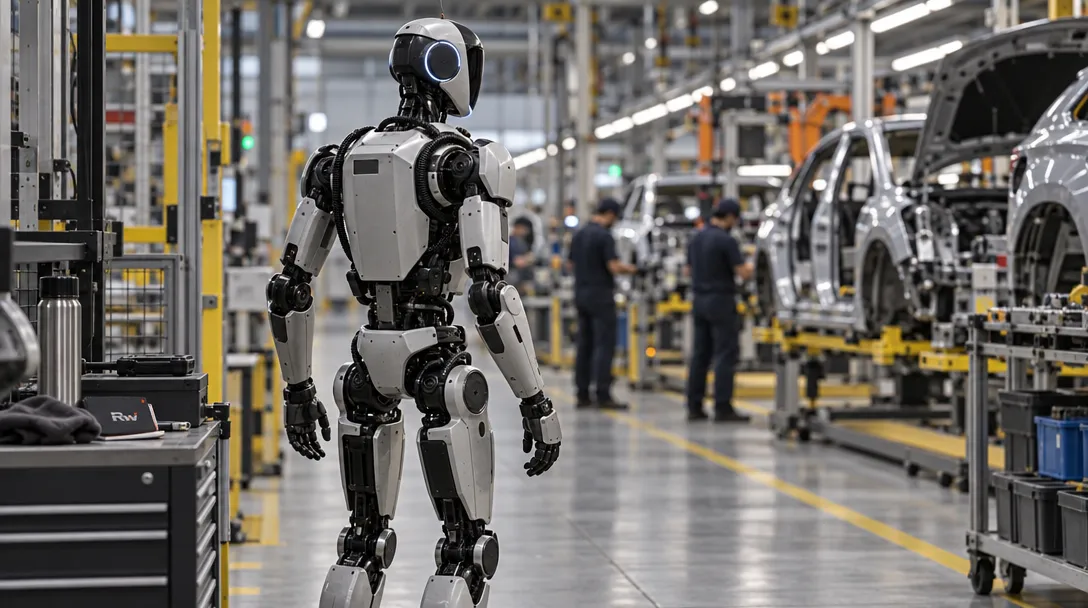
Boston Dynamics named former Amazon AI leader Rohit Prasad chief executive on October 6th, putting an executive who helped build Alexa and led Amazon's Nova model family in charge as Boston Dynamics pushes Atlas toward industrial work. The appointment takes effect October 7th, Bloomberg Technology reported.
Prasad's route into AI started with a familiar piece of science fiction: the talking computer on Star Trek. He has said that image helped steer him toward speech processing and conversational AI. Before Amazon, he spent nearly 14 years at Raytheon BBN Technologies leading machine-learning research; at Amazon, he spent 12 years working on Alexa and artificial intelligence. Amazon's profile of Prasad recounts that early inspiration, while the Boston Globe's profile documents his engineering degrees and research career.
The appointment puts a product builder from consumer AI in charge of Boston Dynamics, whose work has long been judged by what its machines can do in motion. Boston Dynamics founder Marc Raibert founded the company after research into dynamic, legged robots. Prasad's challenge is to help turn that kind of technical performance into machines customers can deploy, maintain and justify buying. Boston Dynamics describes that effort as Physical AI: systems that perceive and act in real environments.
From demonstrations to factory shifts
The timing tracks Atlas's move toward production. Boston Dynamics says the electric humanoid is in development for industrial tasks and that Atlas deployments with Hyundai and Google DeepMind are scheduled for 2026. Hyundai has separately said it plans to deploy Atlas at its Georgia plant beginning in 2028 and build capacity to produce as many as 30,000 humanoid robots annually, Bloomberg reported. That figure is a capacity target, not a report of current production or sales.
Boston Dynamics already has products outside the lab: Spot is used for inspection, and Stretch handles boxes in warehouse settings. Atlas faces a harder commercial test. A robot that can perform a task in a controlled demonstration still has to work safely and reliably across shifts, fit into factory workflows and earn its place against existing automation. Boston Dynamics' account of Atlas's development describes the transition toward a production-ready platform and planned customer deployments.
RuntimeWire covered an earlier, telling step in that shift: Atlas carrying a mini fridge. The demonstration put emphasis on whole-body manipulation and moving an awkward object, rather than on acrobatics alone. It showed what the robot could do in that moment; customer deployments will show whether the capability holds up as repeatable work.
Prasad's background maps to one piece of the problem. Alexa required Amazon to package speech and machine learning into a product used across many households. Boston Dynamics says Alexa reached hundreds of millions of households and that Prasad later led the development of Nova, its foundation-model family. Those are company-reported measures of scale and responsibility. Robotics adds hardware, safety, service and integration demands that a voice assistant does not face. His consumer AI experience offers a route to product discipline, while the factory will supply the less forgiving test.
A leadership change with a commercial deadline
Prasad also arrives after a prolonged CEO transition. Robert Playter stepped down in February, and chief financial officer Amanda McMaster became interim CEO while the board searched for a successor, TechCrunch reported at the time. Playter had led Boston Dynamics through its shift from research lab toward commercial robotics. Prasad's appointment gives Hyundai-controlled Boston Dynamics a permanent CEO as its manufacturing ambitions get more specific.
Hyundai completed its acquisition of a controlling 80% stake in Boston Dynamics in 2021, with the deal valuing the business at $1.1 billion, according to Boston Dynamics' announcement. Hyundai's manufacturing and logistics operations give Atlas a potential first customer and a place to test industrial use. Hyundai's relationship gives Atlas a potential test site, while demand beyond Hyundai and economical production at scale remain unproven.
Prasad's mandate, then, is unusually concrete for an AI executive hire: turn Boston Dynamics, famous for robots that move impressively, into a maker of robots that do useful work consistently. Boston Dynamics has a production roadmap and an industrial owner willing to host early deployments. The next measures are less cinematic: uptime, maintenance, task completion and whether factories keep ordering robots after the pilots.