Clicks shows its keyboard phone actually working
Adrian Li Mow Ching and his co-founders are moving the $499 Communicator from CES concept toward a late-2026 shipment.
By Ryan Merket · Published
Primary source: 9to5Google
Why it matters
Clicks is testing whether founder-led hardware can carve out a durable niche by rejecting the all-screen phone playbook instead of copying it.
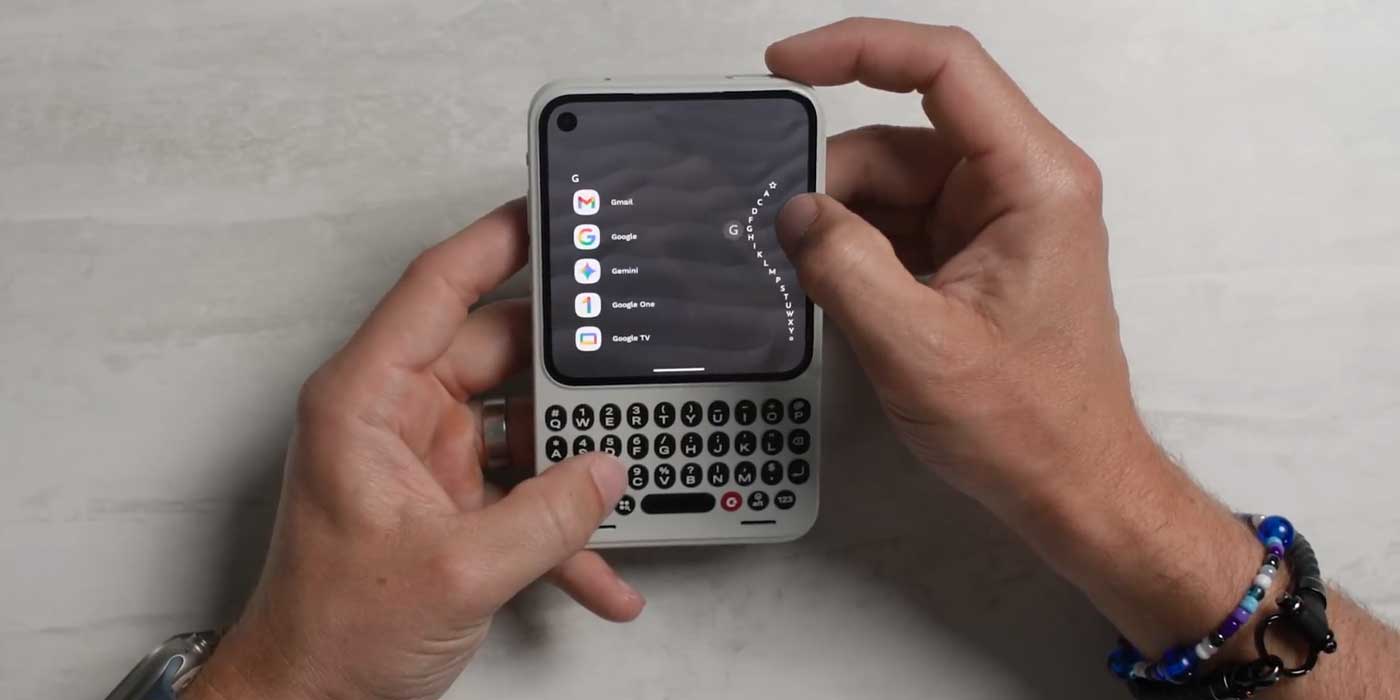
Adrian Li Mow Ching and the Clicks team released the first working look at the Clicks Communicator on June 30th, showing a compact Android phone with a physical keyboard running real software months after Clicks introduced the device at CES.
The update matters because Clicks is no longer selling only the idea of a modern BlackBerry-style phone. In the video covered by 9to5Google, the Communicator is shown with operational hardware and software, including a custom Niagara Launcher setup, keyboard-driven search, home-screen app shortcuts, and notification previews that avoid taking over the phone's small display. Clicks still has not given a final ship date beyond later this year.
That is the honest line between progress and proof. The Communicator is working. It is not finished.
Li Mow Ching, Clicks' CEO and co-founder, is building this from a more specific place than most phone founders. Clicks started with physical keyboard cases for iPhones, then moved into a standalone handset after Clicks says it shipped more than 100,000 keyboard products to customers in more than 100 countries. His co-founders give the project its sharper edge: Kevin Michaluk built the CrackBerry community around BlackBerry users, Michael Fisher is the creator behind MrMobile, and Jeff Gadway spent years in BlackBerry product marketing before joining Clicks. This is not a nostalgia side project from outsiders. It is a phone built by people who spent years studying what tactile mobile users would not give up.
The demo is about software as much as keys
The new first-look video shows the Communicator's pitch more clearly than the CES mockups did. Clicks is not simply bolting a keyboard under a small Android display. Clicks is trying to make the keyboard the main navigation layer.
Clicks Communicator: First Look
The home screen uses a user-defined list of favorite apps, with an alphabetical app ribbon along the side. Search starts by typing. Notifications from favorite apps are meant to appear on the home screen instead of as large banners, with a swipe opening a larger preview and actions such as reply.
That design choice is the whole product strategy. A $499 phone that merely recreates Android on a smaller screen would be a hard sell. A $499 phone that turns messaging, search, triage, and shortcuts into muscle memory has a clearer customer: the person who believes a modern smartphone is too optimized for consuming and not optimized enough for responding.
Clicks has been explicit about that positioning since the January launch. In Clicks' own January 2nd announcement, Gadway framed the Communicator as a companion device, saying, "Communicator is to a smartphone what a Kindle is to an iPad." Fisher's version of the thesis was that some users need a second phone for work while others want a more intentional way to use technology.
That framing also exposes the risk. Clicks is not asking buyers to replace an iPhone, Galaxy, or Pixel with a cheaper Android phone. Clicks is asking them to believe there is room for another device in their pocket.
A hardware founder's hardest stretch
The working demo puts Clicks into the most expensive part of a hardware cycle: turning a compelling prototype into a repeatable product.
The current product page lists a $499 full reservation option and a $199 deposit option, with the deposit applied toward the final purchase price. Clicks says the deposit is refundable before the reservation converts into an order. Clicks also says reservation holders will configure colors, covers, and keyboard layouts closer to shipping.
The spec sheet is now more concrete than it was at CES. Clicks lists a 4.03-inch AMOLED display, a 4,450 mAh silicon-carbon battery, 256GB of storage with microSD expansion up to 2TB, nanoSIM plus eSIM, Qi2 wireless charging, a 3.5mm headphone jack, a 50MP rear camera with optical image stabilization, and a 24MP front camera. Clicks also says the Communicator uses MediaTek's Dimensity 8300, identified on the product page as MT8883, a 4-nanometer 5G IoT platform.
The software story is less tidy. The product page's spec section says Android 17, while the FAQ says the Communicator will launch on Android 16 with support through at least Android 20, including at least four years of Android version updates and five years of security updates. That discrepancy may be a documentation issue, but it is exactly the kind of detail buyers watch when a small hardware brand asks for deposits before shipment.
Clicks has also avoided locking itself into a public battery-life claim. The FAQ says battery life is still too early to project, even as Clicks says the battery, display, and SoC were selected for efficiency. That is the right kind of caution for a device still in development.
The BlackBerry comparison helps and hurts
Every story about the Communicator gets pulled toward BlackBerry. Clicks invites that comparison by design, but the founders are also trying to escape its limits.
The keyboard-phone niche has active competition. Unihertz has kept QWERTY Android phones alive through the Titan line, while Minimal Phone has pursued a more digital-minimalism angle with an E Ink display. The Clicks bet is different: full Android, a compact color screen, tactile typing, and software surfaces such as Message Hub, Signal Light, touch-sensitive keyboard gestures, and the Prompt Key.
TechCrunch's January hands-on with a nonfunctional prototype captured how deep the keyboard focus goes, noting that Gadway, Fisher, and Michaluk were even debating keyboard actuation force in grams.
That debate is the best explanation of why Clicks has a shot in a category larger phone makers abandoned. Apple, Samsung, and Google optimize for mass-market screens, cameras, and AI surfaces. Clicks is optimizing for a minority of users who care exactly how the keys feel under their thumbs.
Small minorities can still build real hardware businesses if the product ships and support holds. Clicks has already shown demand for keyboard accessories. The Communicator is the harder test: not whether people miss buttons, but whether enough of them will pay for a second Android phone built around them.
The June 30th demo answers one question. The Communicator is no longer only a rendering or a shell on a CES table. The next question is whether Clicks can turn that working device into a finished product that ships on time, behaves like a reliable phone, and justifies being carried next to the slab it is trying not to become.