Cowboy Space puts its first satellite in orbit for a power-beaming test
Baiju Bhatt says Reason-1 is communicating daily after its October 1st launch; its power-beaming demonstration and Cowboy Space's orbital data-center plan are still ahead.
By RuntimeWire Staff · Published
Primary source: Bloomberg Technology
Why it matters
Reason-1 gives Baiju Bhatt's space-infrastructure thesis its first hardware milestone. Its communications don't demonstrate power delivery; the energy-grid and orbital-computing plans still need further proof.
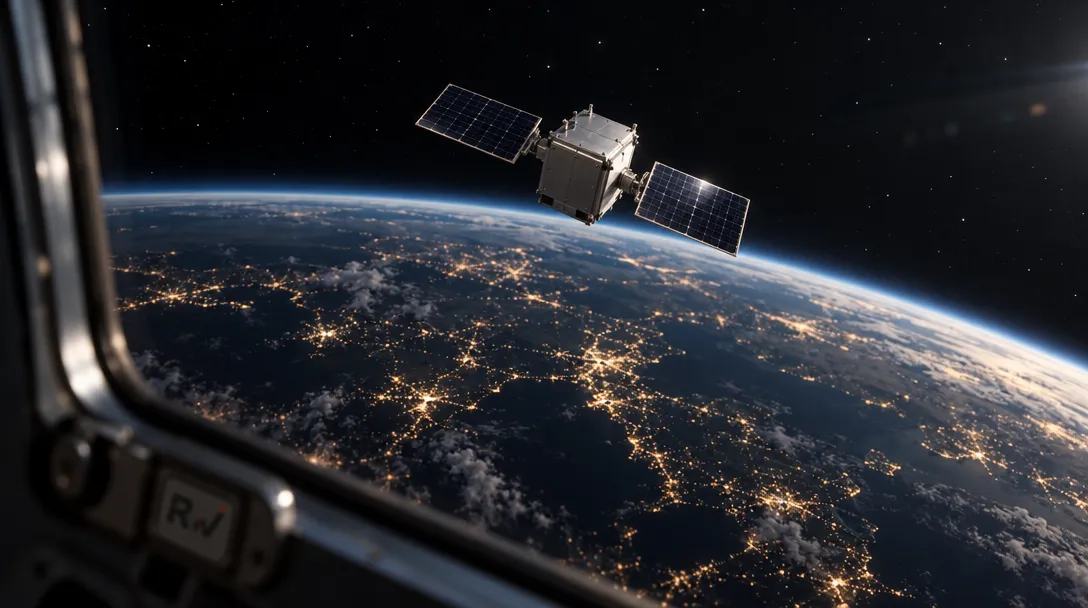
Baiju Bhatt (@BaijuBhatt), the Robinhood co-founder who once set out to make investing easier to access, has put Cowboy Space's first satellite in orbit as the opening test of a much larger bet: building power and computing infrastructure above Earth. In a Bloomberg Technology interview on October 8th, Bhatt said the satellite, Reason-1, had made contact and the team was communicating with it daily. The spacecraft launched on October 1st aboard a SpaceX Transporter-18 rideshare.
Reason-1's daily contact is an early milestone for Bhatt's young space venture, founded in 2024 as Aetherflux and rebranded as Cowboy Space in May 2026. It confirms the satellite is communicating with the ground team; it does not establish that Reason-1 has beamed usable power to Earth or that Cowboy Space can operate a data center in orbit. The company's launch announcement describes power beaming as the mission's goal: collecting solar energy in low Earth orbit and using a high-power laser to send it to a receiver on the ground. SpaceX's mission listing confirms Reason-1's deployment from the rideshare.
From accessible finance to orbital infrastructure
Bhatt's pivot is a founder's second platform bet. He co-founded Robinhood with Vlad Tenev in 2013, served as co-CEO and co-president through November 2020, and later was the company's chief creative officer until March 2024, according to Robinhood's official biography. He studied physics and mathematics at Stanford. At Robinhood, the product thesis centered on widening access to financial markets. At Cowboy Space, Bhatt is arguing that low Earth orbit can become a platform for power delivery and computing.
The company's initial focus was space-based solar power: gather energy in orbit and transmit it to Earth. The plan has widened to include orbital computing, optical communications and, ultimately, launch vehicles. In May, Bhatt told TechCrunch that limited launch capacity and the cost of getting large data centers into orbit had pushed Cowboy Space toward developing its own rocket program. He said then that the company expected its first launch before the end of 2028. The strategy gives Cowboy Space more control over how its hardware reaches orbit, while adding rocket development to an already demanding engineering program. TechCrunch's May report also described a proposed design that would integrate a data center into a rocket's upper stage.
That ambition has attracted substantial financing. Cowboy Space raised a $275 million Series B in May at a reported $2 billion valuation, led by Index Ventures, with IVP, Blossom Capital and SAIC among the new investors and Breakthrough Energy Ventures, Construct Capital, Andreessen Horowitz, NEA, Interlagos and Bhatt also participating, according to Fenwick, which represented the company in the financing. That capital backs a long build: a satellite power demonstration, orbital computing systems and a rocket program. The round and valuation measure investor commitment; neither demonstrates a working commercial service.
The first test is narrower than the vision
Reason-1's specific job is to test a link between solar collection in orbit and a receiver on the ground. Cowboy Space has described the satellite as carrying a kilowatt-class laser. Bhatt's October 8th account of daily communications is a company-reported operational update; the Bloomberg interview does not establish that the laser has delivered usable power. Daily contact establishes communication with the ground team. The power-beaming test and the economics of operating data centers in space remain unresolved, even as the company's public ambition extends to an orbital energy grid and AI data centers.
Cowboy Space is entering a field where other teams are already testing pieces of the computing proposition. Starcloud says its Starcloud-1 satellite launched in November 2025 with an Nvidia H100 GPU and later ran AI workloads in orbit. Google's Project Suncatcher and Star Catcher's Protostar also flew on the October 1st Transporter-18 mission, according to Axios. Those efforts test different parts of the problem: compute in orbit, solar-powered systems, and power transfer between spacecraft. Starcloud's own account describes its orbital GPU work, while Axios's report on the rideshare outlines the three experiments.
Bhatt's version is unusually broad. Cowboy Space wants to connect power generation, transmission, computing and launch into one system. That could give the company control over how its infrastructure is designed and deployed; it also means success depends on several difficult technologies working together. For now, the evidence is concrete but limited: Reason-1 reached orbit, and Bhatt says it is communicating with the ground team. The power-beaming test and the economics of operating data centers in space remain the work ahead.