Deft Robotics launches a factory robot stack built around human intervention
Shane Lee and Jason Shin are pairing a $34,900 wheeled humanoid with teleoperation, edge-case labeling and fleet observability.
By RuntimeWire Staff · Published
Primary source: X
Why it matters
Deft is betting dependable deployment is the scarce product in robotics. Its stack packages intervention, data cleanup and fleet recovery around a purchasable robot.
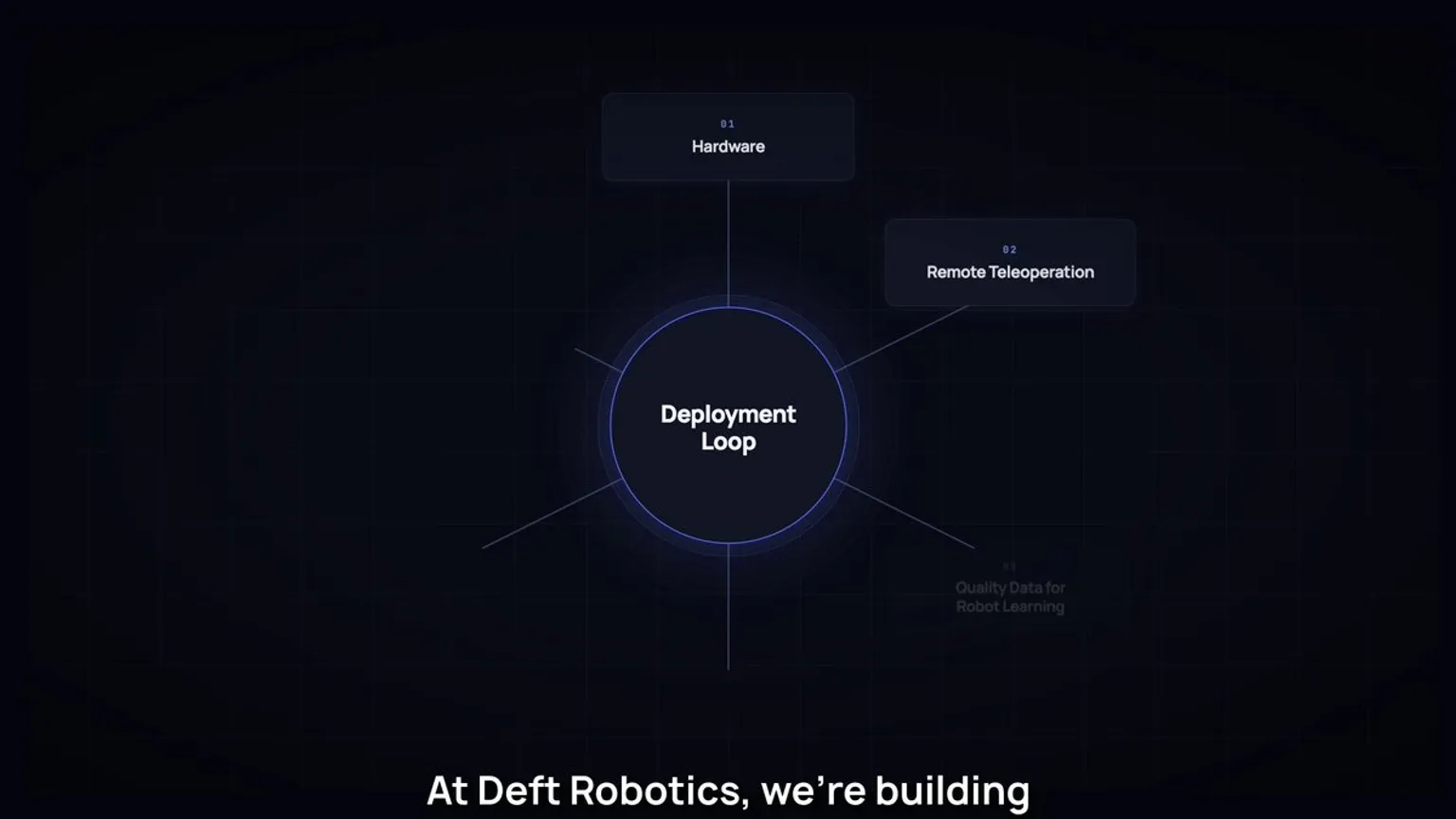
[Deft Robotics] co-founder and CEO Shinhee "Shane" Lee (@shinheeshanelee) introduced a unified deployment platform on September 8 that assumes factory robots will fail and makes those failures useful. Built with co-founder and CTO Jung Won "Jason" Shin, the system packages a wheeled humanoid with the human intervention, data and monitoring tools needed to keep it working after the demonstration ends.
Lee laid out the products in a thread on X. Simba is Deft's dual-arm wheeled humanoid. Tether lets remote operators take control when autonomy encounters an edge case. Eigen manages the resulting training data, Canary detects and labels failures, and Colloid pulls logs, metrics, alerts and robot state into a fleet observability layer.
Five product names later, the thesis is straightforward: autonomy improves only if someone catches the failures, records what happened and feeds the useful examples back into the model. "Edge cases that improve autonomy only show up after you deploy," Lee wrote on X.
The founders started with the factory floor
Lee studied at the University of California, Berkeley, and Shin also attended the university, according to Deft investor Founders, Inc.. They founded Deft in 2025, bringing experience from opposite sides of the robot: Lee had worked on physical products and manufacturing at Tesla, while Shin had worked on autonomous vehicle controls.
Lee graduated from Berkeley's College of Engineering in December 2023 after seven semesters. In a post recounting his 20 months at Tesla, he said he worked across electric motor design, charging hardware and vehicle electronics. His projects included designing and releasing the Magic Dock charging mechanism, evaluating lower-cost rotor components and coordinating Model Y electronics changes across Tesla factories during chip shortages.
Shin said in a 2023 LinkedIn post that he joined Motional as an autonomous vehicle controls engineer. Founders, Inc. describes Deft's founding mix as ex-Tesla hardware and Hyundai self-driving experience.
That background explains Deft's emphasis on deployment mechanics. Lee has seen hardware move through production lines, and Shin has worked on software controlling machines in uncontrolled environments. Their product treats model performance as one part of an operating system that also has to recover from bad grasps, dropped parts, changed lighting and unfamiliar objects without stopping production for an engineer.
A $34,900 robot, plus the machinery around it
Deft lists the Simba medium-payload unit for $34,900 with a two-week lead time. The package includes the humanoid, hard-tip grippers, a software development kit and charger. Simba has two six-degree-of-freedom arms, a wheeled base, hot-swappable batteries and an Nvidia Jetson AGX Orin computer. Deft says the hardware is available for purchase, while the deployment software remains in beta.
The storefront price does not capture the full deployment cost. Deft's ROI calculator uses a $40,000 one-time unit investment and $30,000 in annual maintenance. Deft claims a typical payback period of six to nine months, 75% to 95% of human operating speed from the first day and a 99.9% success rate. Those are Deft's figures, and prospective customers will have to judge them against task-level production results rather than a single headline percentage.
One example on Deft's technology page reports a 96.77% placement success rate, a 54.2-second cycle time and four auto-recovered failures. The company's cross-cowl-bar line-feeding case study documents the underlying factory task, while a separate compressor-housing case study describes deployment at a South Korean automotive supplier.
Deft's standard process starts with a dummy workstation at its San Francisco office. Deft then configures and ships the robot, collects fewer than 25 hours of data from the customer's task, fine-tunes the model and deploys it with human oversight. Deft says updated models are distributed over the air as new edge cases enter the training set.
The new product names carve that workflow into sellable components. Tether supplies the human save. Eigen governs the growing data set. Canary identifies the incidents worth learning from. Colloid gives operators a place to diagnose what went wrong.
Deployment software is becoming its own market
Deft is entering a field where robot makers increasingly face the same unglamorous bottlenecks: remote intervention, data collection, model updates and fleet support. Proxy Robotics sells cross-robot teleoperation, data and deployment infrastructure. Viam offers software for building, deploying and managing machines, including fleet monitoring and over-the-air updates. Alphabet's Intrinsic is building an industrial robotics platform spanning development and deployment.
Deft's narrower bet is automotive manufacturing, with Simba providing a standard embodiment for the software. Lee argues that the robot and model must be developed together because the hardware determines what a model can sense and control, while deployment reveals which mechanical capabilities matter. Deft also says it is working with Physical Intelligence to run general-purpose robot models on automotive line-feeding tasks.
Deft says it has two paid contracts with global enterprises. Deft raised an undisclosed seed round in February 2026 led by Rainfall Ventures and Springcamp, with Founders, Inc. also backing Lee and Shin. The round size and valuation were not announced.
The platform gives those investors a clearer version of the bet. Deft can sell the robot once, then charge for the intervention, retraining and maintenance work that keeps each deployment productive. That recurring layer will matter if Lee and Shin can reduce the amount of custom engineering required for every new factory and make lessons from one installation carry into the next.