femtoAI opens its sparse AI chip and software stack to developers
Sam Fok's Stanford spinout is expanding beyond customer projects with an evaluation kit, model tools and a forum; its 10x efficiency figures remain company claims.
By Ryan Merket · Published
Primary source: PR Newswire
Why it matters
femtoAI is trying to make its custom edge-AI silicon easier to evaluate before a product design is locked. The developer portal could widen its customer pipeline, but its 10x efficiency claims still lack public, independent benchmarks.
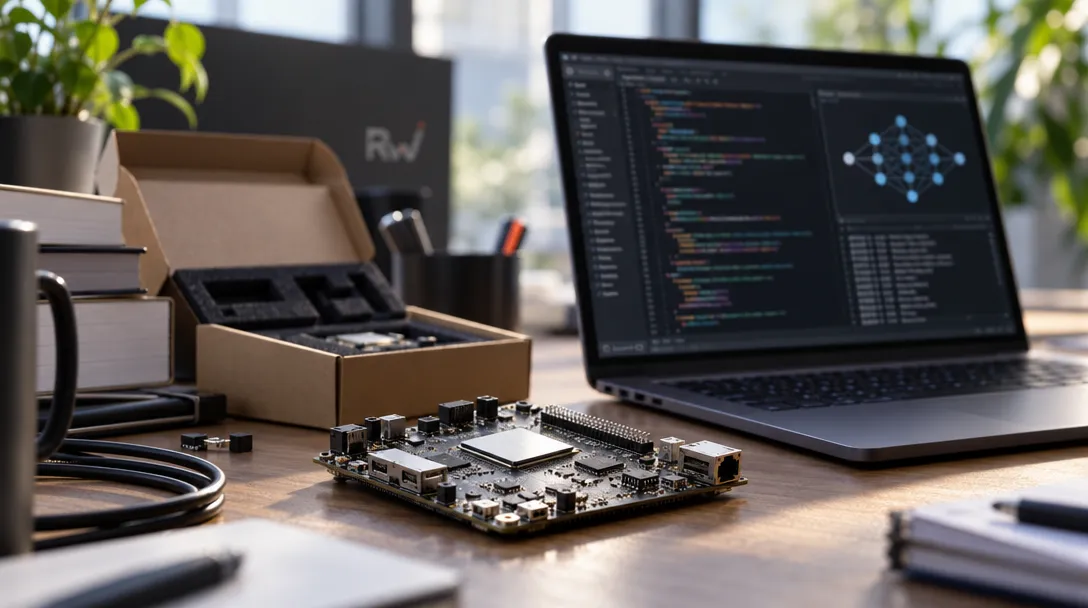
Sam Fok, the Stanford researcher who built femtoAI around energy-efficient neural networks, is opening the company's hardware and software stack to a wider group of developers. In an October 6th release, femtoAI said its developer community would offer access to an evaluation kit for its Sparse Processing Unit (SPU), compressed models, a compiler, Sparsity Studio and a developer forum.
Fok co-founded femtoAI, originally Femtosense, in 2018 with fellow researchers from Stanford's Brains in Silicon Lab. The lab studied low-power circuits and neural systems inspired by the brain; femtoAI's commercial bet is that the same instinct to avoid unnecessary computation can make AI practical in devices with tight limits on battery, memory and heat. Stanford's profile of Fok describes his research on low-power subthreshold circuits and spiking neural networks.
Opening the tools is a distribution move for a company whose product combines custom silicon with the software needed to run models on it. femtoAI says dozens of companies participated in its beta program. Its chief business officer, Bill Hoppin, named Legato and Marshall as customers that used the tools to develop and deploy products. The release also points to NewSound as a customer in audio applications.
From customer projects to a developer funnel
The newly available community is designed to let developers bring their own model, start with one of femtoAI's prebuilt models or develop from scratch. Developers can request an SPU evaluation kit, use the company's compiler and documentation, and run measurements in Sparsity Studio. The developer portal lists SDKs, pretrained models and documentation; femtoAI's announcement does not state kit pricing or shipping terms.
For Fok, the tools give prospective customers a way to test femtoAI's central efficiency proposition before committing to a device design. Hardware teams need to evaluate a chip against its actual workload and product constraints. A forum and self-service tools can also put femtoAI in front of teams earlier, before a specific audio or sensor project turns into a commercial integration.
The company's SPU-001 specifications list 1 MB of on-chip SRAM, a 22-nanometer process and sub-milliwatt operation for speech, audio and other one-dimensional data. femtoAI says sparsity can make that memory equivalent to 10 MB for supported workloads. Its stack aims to compress models in software and skip unnecessary operations in hardware, so a smaller model file can translate into lower memory use and power draw on the device.

That technical approach is also the company's sales pitch. femtoAI says its platform can cut memory use and energy consumption by 10 times without sacrificing accuracy. Its release cites a compressed version of OpenAI Whisper, claiming a 10-fold reduction in memory use. These are company-reported results. The announcement provides no independent benchmark, baseline chip, workload details or accuracy methodology to show how broadly the gains apply.
A longer route from silicon to adoption
The developer launch builds on femtoAI's existing commercial push. RuntimeWire reported in July that femtoAI said more than 200,000 SPU chips were in market, as Marshall and other partners expanded its reach into audio devices, smart glasses and appliances. The new portal gives developers a route to explore the same platform beyond those named customer programs; the announcement does not disclose the number of beta users who converted to paid deployments.
The expansion comes as femtoAI continues to finance a hardware business with a long path from research to volume. In its December 2023 financing release, the company said it had raised $12 million across seed, Series A and strategic funding through that year. Its current investor list includes Fine Structure Ventures, J2 Ventures, Kleiner Perkins, Quest Venture Partners, Vanedge Capital, Gaingels, Amino Capital, SV Pacific Ventures and Calm Ventures.
A September 18th SEC filing by Femtosense, Inc., the company's legal name, disclosed a $22.32 million equity offering, with $21.62 million sold to 22 investors as of the filing. The notice does not name those investors or establish that this is the company's cumulative funding. It is a separate financing data point, not a basis for adding a verified total to the $12 million reported through 2023.
The test for Fok's strategy is whether developers can turn femtoAI's efficiency proposition into products beyond its early audio and sensor work. The open community may help more engineering teams evaluate the silicon and its tools. Evidence of wider adoption will come from deployed products and disclosed customer activity, while the advertised efficiency gains still need workload-specific comparisons to be independently assessed.