Startup Spotlight: Flywheel AI turns excavators into remote-operated robots
Flywheel AI's Jash Mota and Mahimana Bhatt are using teleoperation to put existing machines to work while gathering data for future autonomy.
By Ryan Merket · Published
Primary source: Y Combinator
Why it matters
Flywheel's near-term case rests on remote operation of machines contractors already own. Its public dataset also gives the autonomy pitch something tangible to build on, while exposing the difference between hours of camera footage and hours of unique machine operation.
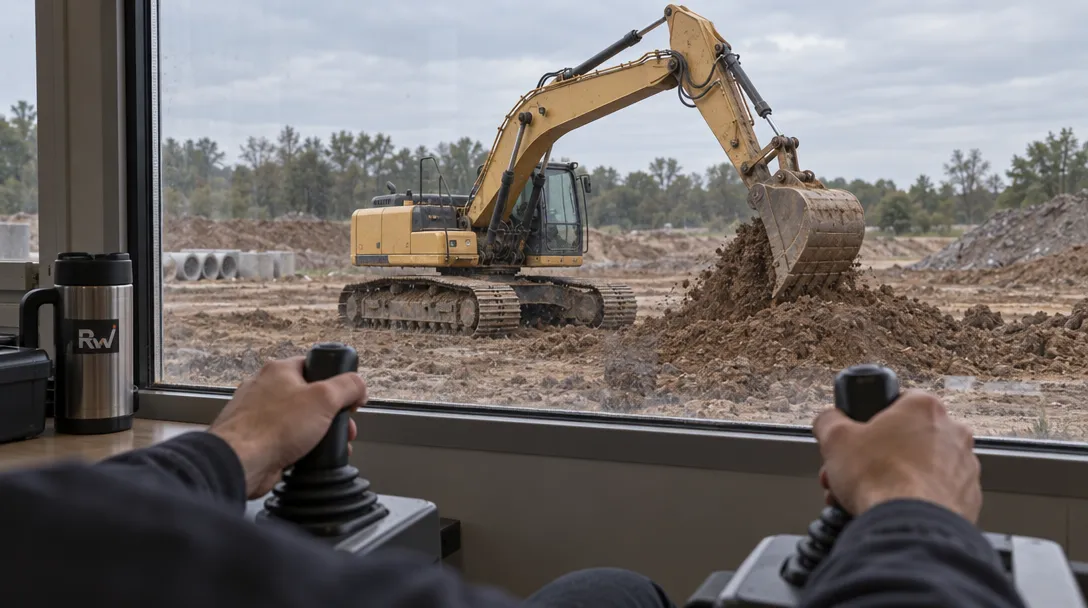
Flywheel AI is building a remote-control system for construction excavators, with a longer-term plan to turn work by human operators into training data for machine autonomy. Founded by Jash Mota (@jash_mota) and Mahimana Bhatt, the San Francisco startup joined Y Combinator's Summer 2025 batch. Its YC launch profile describes a retrofit kit, remote operation from a laptop and joysticks, and a data-collection system tied to real jobsites.
That profile documents Flywheel's 2025 pitch; it is not a product announcement dated October 5th, 2026. Flywheel AI's current website continues to market remote excavator operation, control of multiple machines or sites, and operator-performance monitoring. The public record documents a teleoperation and data-collection product; it does not establish that Flywheel's excavators work autonomously on commercial jobs.
A robotics thesis written before the startup
Mota's central idea predates Flywheel. In a January 12th, 2023 post, he argued that robotics startups could put a remotely operated version of a product in customers' hands while they gathered the real-world data needed to automate it. He wrote that teleoperation could help a robotics company validate customer needs and earn revenue earlier, while human operators handle tasks the software cannot yet perform. Flywheel's sequence follows that thesis: install on existing equipment, operate it remotely, record demonstrations, then attempt to automate selected workflows.
Mota's earlier work also helps explain why he chose a retrofit-first approach. His project archive describes building Nubot, a home robot, and software for remote control and monitoring. The YC launch post says he previously built a remote teleoperation tool used by companies including Accenture. Those experiences show that remote control was a product direction he had explored before applying it to heavy equipment; they do not establish that an excavator retrofit will be easy to sell.
Bhatt brings a complementary background in robotics and autonomous-vehicle data systems. His resume lists a master's degree in Robotics Engineering from Worcester Polytechnic Institute, earlier embedded-software work at warehouse-automation company Addverb, and research at the Institute for Human and Machine Cognition. Flywheel AI's launch post says Bhatt built data and machine-learning pipelines at Motional and that the system ran more than 50,000 simulations a day. That figure describes his prior work as presented in the founders' launch material; it is not a Flywheel performance metric.
Mota's prior work centers on deploying robots and remote operation; Bhatt's experience centers on the datasets and evaluation systems used to develop autonomous vehicles. Flywheel is applying both to a machine that works in changing outdoor conditions, where digging, trenching and grading vary with the terrain, the task and the operator's decisions.
Sell remote operation first
Flywheel says its system can be installed on existing hydraulic equipment, takes a few hours to fit, and leaves the machine available for manual operation. Its remote-control setup is designed around a laptop and joysticks, with a supervisor able to take over when needed. That approach can give a contractor a use for the retrofit before any autonomy model is ready: an operator can control equipment remotely, and the system can collect video and control data during the work. These are company descriptions, not independently measured installation times or productivity results.
Flywheel also has a public dataset, but its existence alone does not establish how much unique machine operation it represents.
Remote operation must work reliably on a worksite, be useful to a contractor, and be safe under real operating conditions. Autonomy requires a model to perform specific tasks reliably across machine types and jobsite conditions, with a clear plan for intervention when it fails. Flywheel's public materials describe the first capability and the development path toward the second. They do not establish operator-free excavation.