Ghost raises $11M to sell a $3,499 computer for personal AI
Founded by former quant Zain Javaid, Ghost says its screenless Core runs AI models and personal memory locally.
By Ryan Merket · Published
Primary source: X
Why it matters
Ghost is testing whether consumers will pay $3,499 for an always-on personal agent, and whether local AI can earn trust when useful actions still depend on connected accounts and some outside services.
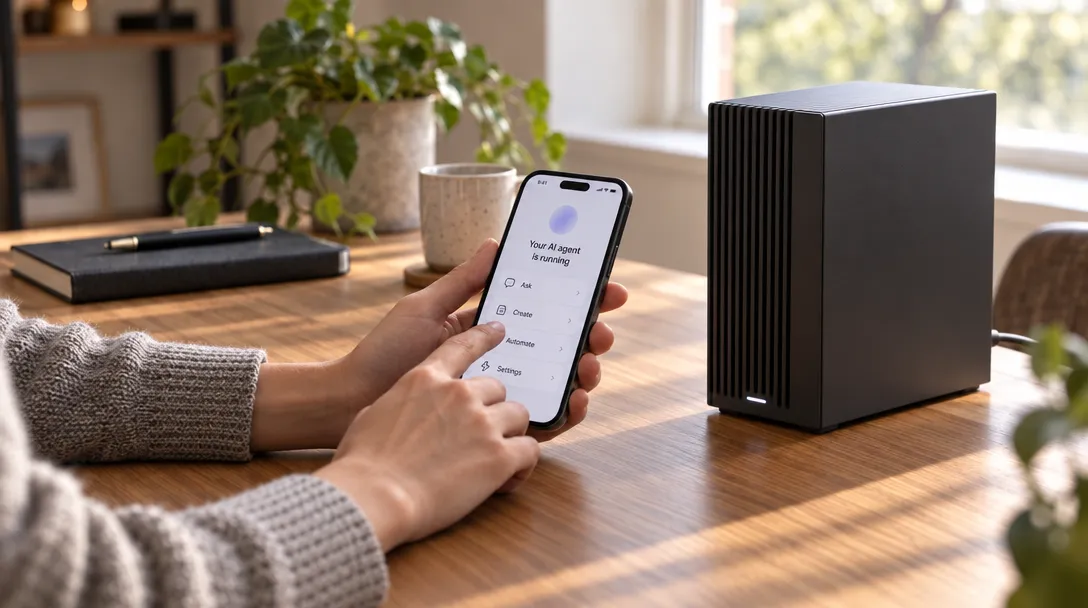
Zain Javaid, a former quant who says ChatGPT changed the course of his career, launched Ghost's first product, Core, on October 5th alongside an $11 million seed round led by Andreessen Horowitz. The San Francisco startup is selling the screenless computer for $3,499, pitching it as a dedicated home for an AI agent that can continuously learn from a user's digital life and act on their behalf.
https://x.com/zainmfj/status/2107146556176798081
Javaid told TechCrunch he had worked as a quant before getting bored with the job. ChatGPT's release in 2022 drew him toward personal AI, and he started Ghost around the premise that an agent with deep access to someone's private information should run on hardware that person controls. Javaid is 19. Ghost spent about a year building Core before emerging from stealth.
Core is a computer without a display. Users access it through a phone or app, and voice input runs through the app rather than a microphone on the device. Its hardware includes an Nvidia RTX PRO 4000 Blackwell SFF GPU with 24GB of memory, an AMD Ryzen 5 7600 processor, 64GB of RAM and a 1TB SSD, according to Ghost's product page. The price includes the GPU, which Javaid told TechCrunch customers otherwise might have to source and configure themselves.
Ghost preinstalls Qwen 3.8-Next, Qwen 3.8-27B and Gemma 4-31B; its site also lists Muse-Glimmer-30B. Owners can install other models or load their own weights, Javaid said. Ghost says Core has its own software layer, browser and file system, and can run agents continuously without waiting for a prompt. The company says the first batch is open for orders, with shipping scheduled for the last week of October. Its site lists the price at $3,499 and says there is no subscription.
Ghost describes connections to apps, files, screen history, wearables and smart-home devices. Javaid's example to TechCrunch was an agent connecting a user's elevated resting heart rate with a late night at the computer and seasonal information to suggest that the person might be getting sick. That kind of proactive advice depends on sustained access to personal and potentially sensitive data, including health records and account credentials.
The product page says data stays on-device, but Ghost's privacy policy describes some exceptions. The policy says conversations, files, connected-app content and memories are processed locally, with no remote AI model used as a fallback for those functions. It also says some online features, such as web search or phone calls, can send task information through Ghost's service gateway to outside providers, which then process that information under their own policies. Ghost says it does not retain the content it forwards; the third-party provider may. Users can instead connect some services using their own API keys.
Local inference can reduce reliance on cloud AI providers, but an agent that acts across a person's accounts still needs permissions, and some tasks require online services. Javaid told TechCrunch that Ghost is building a firewall to monitor outgoing network requests and flag actions it considers unsafe. The company describes that safeguard as work in progress, while the product's intended capabilities already involve access to logins, files and connected services.
Andreessen Horowitz led the seed round. Abstract, Audacious Ventures, SV Angel and Nova also participated, along with individual investors Cory Levy, Max Mullen, Vincent Weisser, Zach Sims and Maria Davidson, according to TechCrunch. Ghost must deliver the convenience of an always-available agent while persuading customers to spend workstation-level money on a computer whose value depends on how well its software understands and acts on their lives.
Javaid argues that a general-purpose computer such as Apple's Mac mini can be configured for AI, while Core arrives with a GPU, models and agent-focused software already installed. At $3,499, Core asks buyers to pay for setup and ongoing context, then trust a young company with a computer designed to know them unusually well.