Ginkgo offers its autonomous lab to NSF's $1.5B X-Labs program
The in-kind contribution gives research teams remote access to Ginkgo's Boston robotics and protein-testing services; Ginkgo has not put a dollar value on the capacity.
By RuntimeWire Staff · Published
Primary source: Financial Times / Business Wire
Why it matters
Ginkgo is extending its autonomous-lab strategy into federally funded research. The offer could put its equipment and protein services in front of new teams, but its scale and any path from in-kind access to paid work remain unspecified.
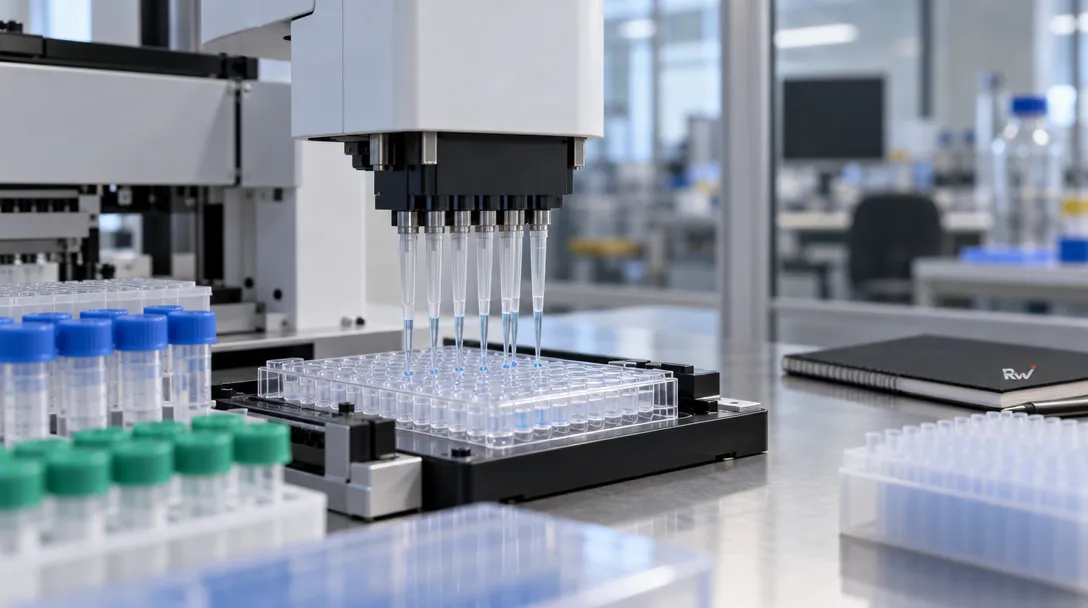
Ginkgo Bioworks is offering researchers in the National Science Foundation's X-Labs program remote access to its autonomous laboratory and protein-testing services, putting founder Jason Kelly's long-running bet on lab automation inside a federal science initiative designed to back independent research teams.
Kelly, who co-founded Ginkgo in 2008 after completing degrees and a Ph.D. at MIT, has described engineering biology as programming without a debugger, manufacturing without computer-aided design, and construction without cranes. The goal he set out for Ginkgo was to build the tools biology lacked. The X-Labs arrangement puts those tools in front of teams that may not have the budget or expertise to build a robotic wet lab of their own.
Ginkgo said the in-kind contribution was announced on October 8th by White House Office of Science and Technology Policy Director Michael Kratsios at the Science: A New Golden Age Summit in Washington. Ginkgo will provide cloud-lab time at its Boston facility and protein testing intended to help researchers express and characterize designs, including proteins generated by AI models.
A lab that researchers can use remotely
Ginkgo says its Boston lab runs on Reconfigurable Automation Carts, modular robotic systems that combine robotic arms, maglev sample transport and Ginkgo's Catalyst software. Through Ginkgo Cloud Lab, researchers can remotely access more than 70 instruments for work including sample preparation, liquid handling, analysis, storage and incubation. The offer also includes protein testing, which could let a research team test a design without first building the equipment and capabilities required for that work in-house.

NSF X-Labs is a decade-long initiative the agency says could invest up to $1.5 billion in independent teams pursuing technical breakthroughs. The program uses milestone-based awards and gives selected teams operational autonomy. Its May 2026 round invited proposals on Scientific Instrumentation for Sensing and Imaging and Quantum Systems: Interconnects and Integrated Photonics. In September, NSF announced Artificial Intelligence for Physical Systems as a new topic and previewed From Sequence to Function and Computation at the Limit of Physics, according to the agency's announcement and topic overview. Ginkgo's lab access is therefore a contribution to a broad science program, with protein design among the research areas that could make direct use of the service.
For Kelly, the offer extends a Ginkgo thesis into a public research setting. Ginkgo already works with NSF's Programmable Cloud Laboratories Test Bed program, where the announcement says Ginkgo is expected to provide robotic carts and software for nodes at Caltech, the University of Maryland and Northwestern University. Those efforts position Ginkgo's infrastructure as something other institutions can access or deploy, rather than equipment confined to Ginkgo's own projects.
The arrangement could also introduce Ginkgo's services to research teams that might later need commercial lab capacity. That is a possible business benefit, not a disclosed term of the offer: Ginkgo has not said how many teams can use its lab, how much lab time or testing it will contribute, or what the contribution is worth. The announcement does not describe a paid contract or promise that participating teams will become customers.
The bet behind the contribution
Ginkgo has been putting more emphasis on autonomous labs as it reshapes its business. Its SEC-filed results show 2025 revenue of $170.2 million, down 25% from $227 million in 2024. Ginkgo attributed the decline to a shift toward larger enterprise customers and commercial changes tied to restructuring; both years also included non-cash revenue from releases of deferred revenue. In announcing its 2025 results, Kelly said Ginkgo would focus investment on autonomous-lab offerings. The X-Labs contribution fits that stated direction, although Ginkgo has not disclosed whether it expects the arrangement to generate sales. Ginkgo's filing provides the financial context; the contribution itself is in-kind, not a reported cash investment.
Researchers need to know which protocols they can submit, how quickly the lab can run them and whether protein testing covers the kinds of designs their projects produce. The announcement describes the infrastructure and the intended use, but does not quantify capacity or spell out those operating terms.
RuntimeWire reported on October 7th that National Compute planned a separate $100 million compute-credit contribution for federal science. The compute-credit plan and Ginkgo's lab offer point to different layers of research infrastructure: computing for scientific work and physical capacity to run experiments. Their value will depend on how researchers gain access and whether the donated resources solve bottlenecks teams could not otherwise afford to address.
Kelly's argument has always been that better tools make biology easier to engineer. X-Labs gives Ginkgo a chance to put that argument to work beyond its own facility. Whether the contribution becomes a repeatable route to customers or mainly a public demonstration of the lab's capabilities will depend on the volume and terms of access - details that have not been specified.