GitHub adds xAI's Grok 4.6 to Copilot for long-running coding agents
xAI's Grok 4.6 is entering GitHub's IDE, command-line and enterprise workflows two days after launch, under usage-based billing.
By RuntimeWire Staff · Published
Primary source: GitHub Changelog
Why it matters
Grok 4.6 reached GitHub Copilot two days after launch, giving xAI a route into established developer and enterprise workflows. The integration makes distribution, cost and agent reliability as important as provider-published benchmark scores.
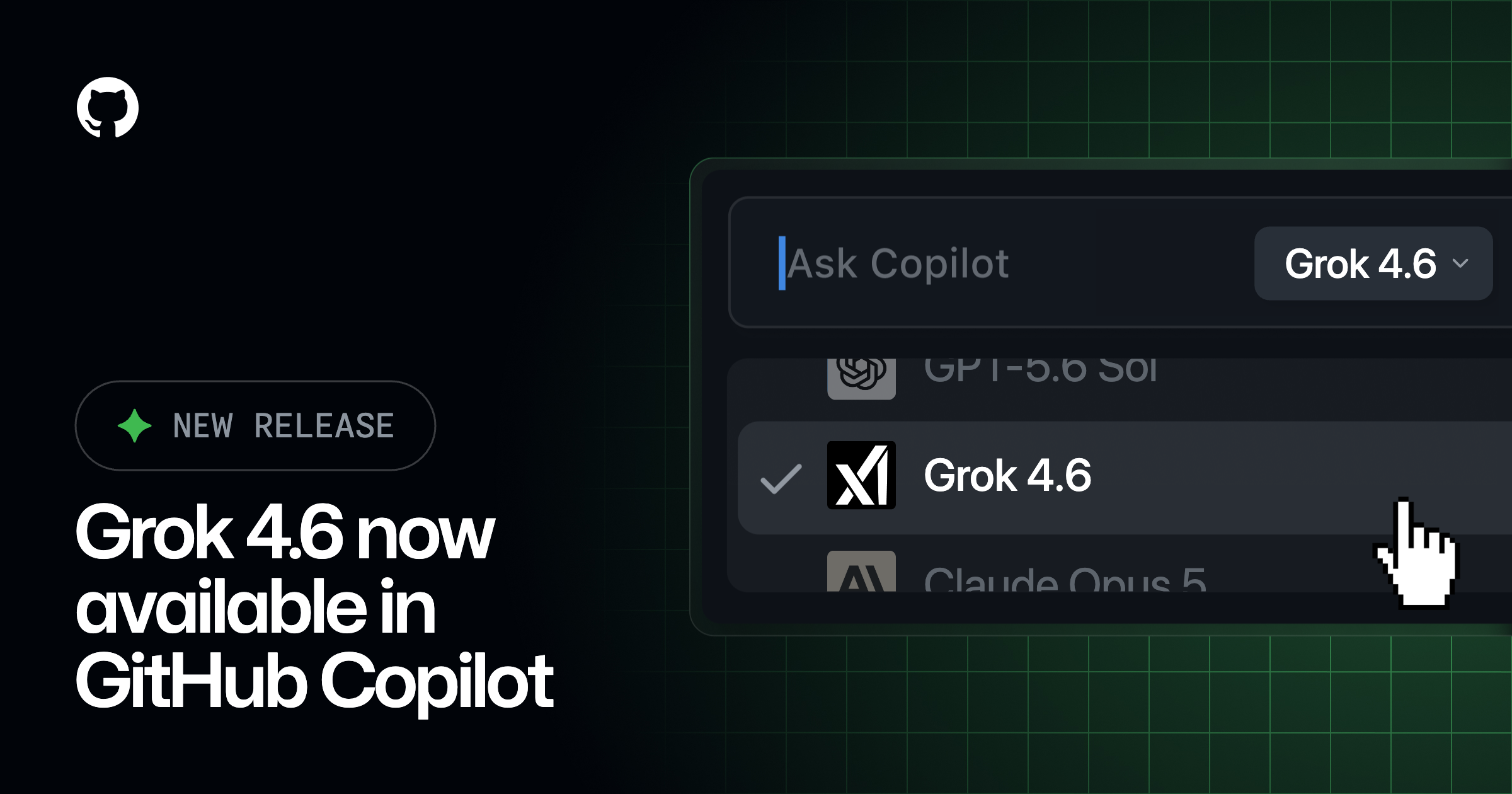
Elon Musk (@elonmusk)'s xAI put Grok 4.6 into GitHub Copilot on August 14th, extending the two-day-old reasoning model into GitHub's editors, command-line tools and cloud coding agent.
GitHub is rolling out Grok 4.6 to Copilot Pro, Pro+, Max, Business and Enterprise subscribers. Developers will be able to select it in Visual Studio Code, Visual Studio, Copilot CLI, the Copilot cloud agent, the Copilot app, JetBrains IDEs, Xcode and Eclipse. GitHub said availability will expand gradually rather than reach every eligible account immediately.
For Musk, the Copilot integration gives xAI a direct route into established development environments. Musk founded xAI in 2023 around a stated mission to build AI that advances scientific discovery and understanding of the universe. SpaceX acquired xAI on February 2nd, 2026, and xAI's official site now uses the SpaceXAI brand while continuing to release models under the Grok name.
GitHub's leadership page lists Mario Rodriguez as its chief product officer. Microsoft acquired GitHub for $7.5 billion in 2018, giving Copilot a distribution base tied to the code hosting, review and deployment workflows developers already use.
xAI is shipping through other people's workflows
xAI released Grok 4.6 on August 12th with an emphasis on long-running agents, coding and multi-step knowledge work. At launch, Grok 4.6 was available through Cursor, Grok Build, xAI's API, OpenRouter, Vercel and Cloudflare. GitHub Copilot followed two days later.
The release sequence shows how Musk is approaching developer adoption. xAI is placing Grok inside independent tools that already own developer relationships, including GitHub's IDE, command-line, cloud-agent and enterprise products.
GitHub's model catalog has also become a distribution market of its own. Its supported-model documentation lists models from OpenAI, Anthropic, Google, Microsoft, Moonshot AI and xAI. Developers can choose among them, while GitHub controls the interface, billing and policy settings.
Grok 4.6 therefore enters Copilot as one option in a crowded picker. xAI gets access to GitHub's customers without having to replace their development environment. GitHub gets another provider competing on capability and price inside Copilot.
The benchmark case is mixed
GitHub said its internal testing produced strong results on terminal-based coding tasks in Visual Studio Code and Copilot CLI, particularly during longer workflows that required sustained reasoning and tool use. GitHub did not publish the task set, error rates, sample size or direct comparisons behind that assessment.
xAI's own release offers a more detailed set of provider-published scores. xAI reported that Grok 4.6 scored 69.9% on CursorBench v3.2, ahead of the 67.2% figure it listed for GPT-5.6 Sol and behind the 70.5% listed for Claude Fable 5. On DeepSWE v1.1, xAI reported 65.9% for Grok 4.6, compared with 73% for GPT-5.6 Sol and 70% for Fable 5.
The terminal result is especially relevant to GitHub's announcement. xAI reported a 26% score for Grok 4.6 on Terminal-Bench v3.0, below the 34.6% and 34.1% figures it published for GPT-5.6 Sol and Fable 5. On the Artificial Analysis Intelligence Index, xAI reported a score of 61 for Grok 4.6, matching its published GPT-5.6 Sol result and trailing Fable 5 by one point. xAI said third-party model scores in its tables came from developer-published system cards or public benchmark leaderboards.
Those provider-published results place Grok 4.6 among competitive coding models without independently establishing it as the category leader. GitHub's rollout gives developers a practical way to test whether xAI's reported strengths transfer from benchmark environments into repository work, debugging sessions and tool-heavy agent runs.
xAI says Grok 4.6 received a longer supplemental training run than Grok 4.5, using model-generated reasoning data, engineering data and reinforcement-learning tasks spanning general coding, kernel optimization, web development and computer-aided design. xAI also says it observed more self-testing and verification during longer trajectories. Both claims come from xAI's own evaluation process.
Token use will determine the real cost
GitHub is rolling out Grok 4.6 to Copilot Pro, Pro+, Max, Business and Enterprise subscribers. The model is billed at provider list pricing under Copilot's usage-based system.
GitHub's current pricing table sets the applicable model and request rates. The table lists identical rates for Grok 4.5 and Grok 4.6, making the newer model a direct replacement candidate where its performance improves without a higher listed token price.
Long-running coding agents can still generate large bills because they repeatedly read files, call tools, consume test output and revise code. The model's listed price reveals less than the length and behavior of the agent loop.
Business and Enterprise administrators must explicitly enable the Grok 4.6 policy, which is off by default. That gate gives organizations a chance to evaluate cost, data handling and model behavior before developers send repository context through a new provider.
Musk's distribution bet
xAI said in January 2026 that it raised a $20 billion Series E from Valor Equity Partners, StepStone Group, Fidelity Management & Research, Qatar Investment Authority, MGX and Baron Capital, with NVIDIA and Cisco Investments participating as strategic investors. xAI said the financing would support compute infrastructure and product deployment. SpaceX acquired xAI less than a month later.
Grok 4.6's arrival in Copilot puts that capital behind a straightforward product strategy: train models with enough reasoning capacity for longer agent runs, then place them where developers already work. GitHub supplies the customer access and enterprise controls. xAI supplies another model for GitHub's multi-provider coding layer.
The next test will happen in usage data GitHub and xAI have not published: how often developers choose Grok 4.6, how long its agent runs last, what those runs cost and whether teams keep it enabled after comparing its code and tool use with the other models in Copilot.