Google Antigravity is testing Concierge, a voice activated coding assistant and bot wrangler
The dev-only interface proposes reviewing agent conversations and code changes, with finalized speech sent automatically to a dedicated agent.
By Ryan Merket · Published
RUNTIMEWIRE INVESTIGATION — Scoop
Original reporting by RuntimeWire, based on reverse engineering.
Why it matters
Concierge points to Google building a supervisory layer above coding agents, using conversation history and automatically submitted voice commands to manage work across sessions.
Reporting record
Finding
Google’s Antigravity desktop software contains an internal prototype called Concierge that would let developers issue spoken instructions to an agent intended to help manage their other agent conversations.
How we verified
Methods: reverse engineering.
E1 — Four proposed Concierge workflows and exact welcome-screen component. Recovered `main.js`, lines 9928–9932; UTF-8 byte offsets 5589701–5591847 (end exclusive). E2 — Dedicated Concierge session and internal executable dependency. Recovered `main.js`, lines 9938–9940; UTF-8 byte offsets 5595033–5596165 (end exclusive). E3 — Feature gate requires enable-concierge-agent and dev mode. Recovered `main.js`, lines 11182–11182; UTF-8 byte offsets 6330685–6330821 (end exclusive). E4 — Continuous voice provider, automatic message submission, and window keyboard controls. Recovered `main.js`, lines 10861–10866; UTF-8 byte offsets 6128162–6130596 (end exclusive). E5 — Development-only sidebar label, mic toggle, and listening indicator. Recovered `main.js`, lines 10888–10891; UTF-8 byte offsets 6147014–6149021 (end exclusive). E6 — Complete shared transcription hook, final-transcript callback, and 30-minute continuous-session cap. Recovered `main.js`, lines 4639–4654; UTF-8 byte offsets 2942335–2950186 (end exclusive). E7 — Public-build feature provider omits Best of N, thought steering, and ABFS provider implementations. Recovered `main.js`, lines 12354–12358; UTF-8 byte offsets 8576499–8578737 (end exclusive). E8 — Internal-only Labs sharing description and required x20 export destination. Recovered `main.js`, lines 3099–3100; UTF-8 byte offsets 2501005–2501709 (end exclusive).
The investigation used read-only extraction, byte comparison, JavaScript control-flow inspection, and protocol-schema decoding. It did not call authenticated agent endpoints or internal Google services. No successful Concierge backend run is claimed.
Tested versions: Antigravity v2.12.2.
Reproduction
RuntimeWire partially reproduced the finding.
The investigation used read-only extraction, byte comparison, JavaScript control-flow inspection, and protocol-schema decoding. It did not call authenticated agent endpoints or internal Google services. No successful Concierge backend run is claimed.
File hashes
Uploaded app ASAR, package version 2.12.2 4,526,397 `a75535fec1f039be8e78c6a66f3e41f15969101fcf44a0690b7dce4d998b875b`Uploaded language_server.zip 48,280,729 `eead3e6d640dead6d9795cdee5a1cfa9af1a9e125fdfd8d5c6e62af9c27aa00a`
Company response
RuntimeWire requested comment; the company had not responded by publication time.
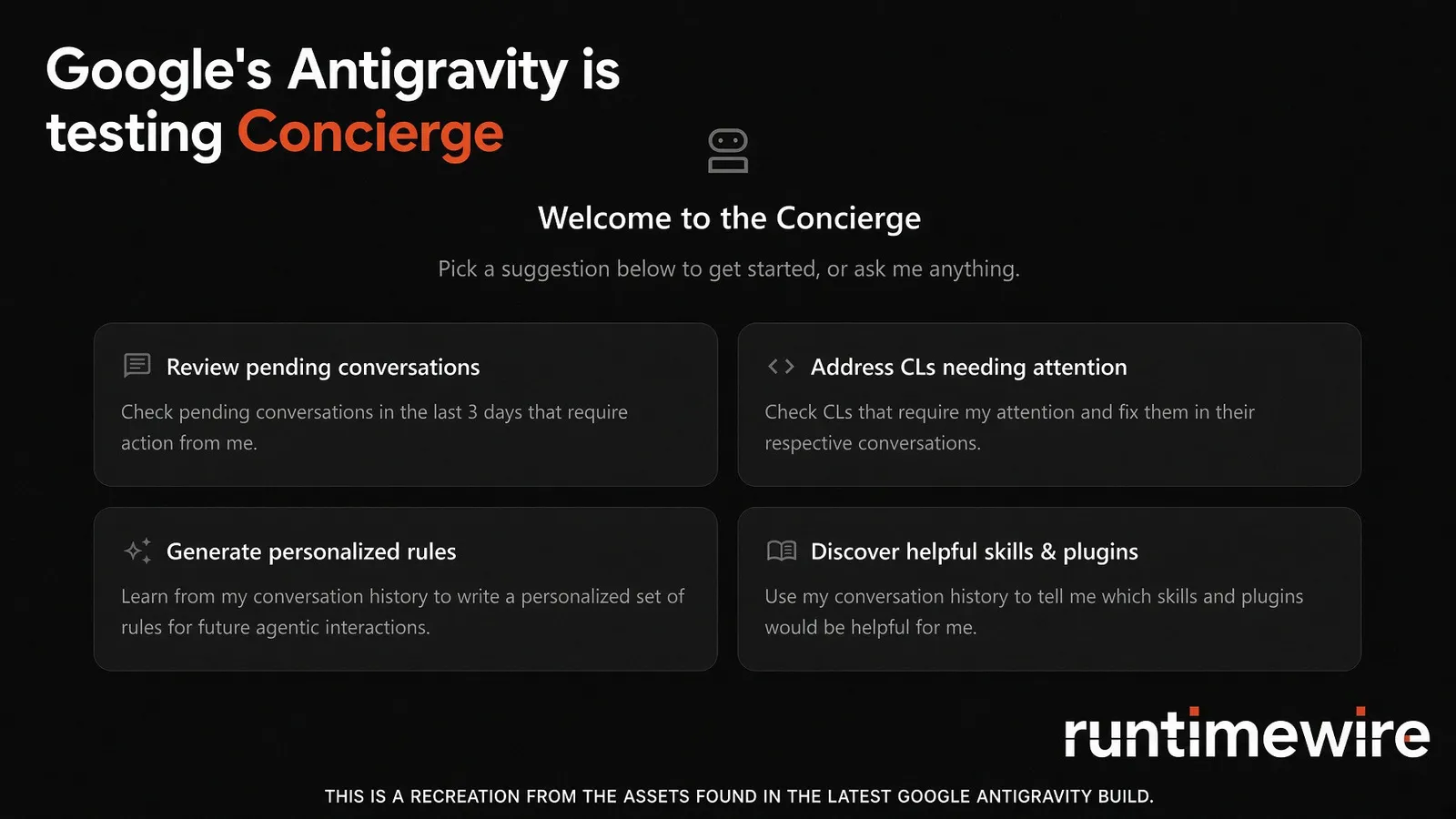
Google's Antigravity 2.12.2 desktop software contains a development-only prototype called Concierge that would let developers give spoken instructions to a dedicated agent responsible for managing work across other agent conversations. RuntimeWire recovered the interface and its microphone controls from the version Google released on September 3rd, 2026.

The welcome screen proposes four jobs for Concierge: reviewing conversations from the previous three days that need the user's attention, addressing code changes described internally as "CLs," generating personalized rules from conversation history, and recommending skills and plugins based on that history.
Those starter prompts describe Google's intended workflows. They do not establish that Concierge successfully completed any of them. The specialized agent relies on an internal executable ending in concierge_main.par, which was not bundled with the inspected public release. Without that component, the prototype's tools, permissions and ability to carry out the proposed tasks could not be tested.
Google's code also makes the interface difficult to mistake for a customer launch. The sidebar labels it "Concierge (Dev only)," and the feature is disabled by default. Enabling the entry requires both an enable-concierge-agent override and a development-mode setting. The evidence establishes that Google distributed the client-side prototype inside a public download, not that ordinary Antigravity accounts can access it.
A spoken command goes straight to the agent
Concierge's voice path differs from Antigravity's documented voice dictation. The existing CLI feature transcribes speech into the prompt box and waits for the user to edit or submit it. Concierge is designed to send each finalized, nonempty transcript automatically to its dedicated agent conversation.
After the user activates the microphone, the client opens a continuous transcription stream. Finalized text is passed to sendUserCascadeMessage using a WHEN_IDLE delivery strategy, meaning the instruction is queued for delivery when the Concierge conversation can accept it. The interface plays a confirmation chime, displays a notification and briefly changes the sidebar status to "Sent!"
The dedicated conversation is stored under the identifier concierge_cascade_id. If no Concierge conversation exists when a transcript is finalized, the client first creates one and then submits the spoken turn.
The microphone starts switched off. Users can toggle it through the interface or with Ctrl+Shift+M. Pressing and holding that shortcut for longer than one second, starting while the microphone is off, creates a push-to-talk interaction that stops recording when the keys are released. The continuous session automatically ends after 30 minutes.
One tooltip calls the feature an "always-on listener," but the implementation does not show the microphone activating by itself. The user must first turn it on, and the ordinary voice-recording control becomes unavailable while Concierge is listening. The inspected client code also does not establish spoken responses or a full speech-to-speech assistant. It shows speech being converted into automatically submitted text instructions.
A supervisor for Google's coding agents
The prototype extends the direction Google has already set for Antigravity. Google publicly supports multiple parallel agent conversations, while Custom Agents give developers specialized instructions and restricted sets of tools, skills and permissions. Its Boost and Teamwork systems distribute larger tasks among multiple agents.
Concierge occupies a different position in that structure. Its proposed job is to watch the user's existing conversations, identify unfinished work and route attention back to the relevant sessions. The prompt about fixing CLs goes further, suggesting the agent could act within the conversations associated with specific changelists. The interface does not identify a code-hosting service or demonstrate working support for pull requests.
The other two prompts make conversation history an input for configuring future agents. One asks Concierge to derive a personalized ruleset from prior interactions. Another asks it to recommend skills and plugins. If implemented, that would turn accumulated chat history into an operating profile for subsequent coding sessions rather than leaving each conversation as an isolated record.
That design raises concrete product questions for any external release. A useful supervisory agent would need enough access to inspect conversations, recognize pending decisions, connect code changes to the correct sessions and understand which actions require user approval. The recovered interface does not establish the scope of that access or which of the four workflows has a functioning backend.
Added sometime after Antigravity 2.5.0
The recovered application package declares version 2.12.2. RuntimeWire compared it with Google's official Linux archive for the same release and found the application packages byte-identical. The embedded main.js also matched the copy recovered from the Windows language server, tying the interface to Google's distributed September 3rd build rather than an independently modified client.
Google's official Antigravity 2.5.0 release, dated July 31st, provided the baseline. Its recovered interface bundle contained no occurrences of either Concierge or concierge. Version 2.12.2 contained 24 capitalized occurrences and 23 lowercase occurrences, along with the development gate, internal executable reference and microphone controls.
The comparison places the addition between July 31st and September 3rd. It cannot establish which intervening build introduced the code, whether Google still considers the experiment active, or whether Google intends to expose it to customers.
The timing is notable because Google's public September 3rd changelog describes Antigravity 2.12.2 as an enterprise model-access update. It lists Gemini 3.8 Flash access through Application Default Credentials, with no mention of Concierge. Public release notes are not an inventory of every internal component bundled into desktop software, and the explicit development gate shows this interface was not presented as part of the release.
The strongest finding remains narrower: Google built a client-side interface for a voice-controlled agent that would review other Antigravity conversations, address code changes and learn from a developer's history. Google then shipped that interface inside Antigravity 2.12.2 with the switch turned off and the agent executable left inside its own environment.