Higgsfield shows GPT-6 Astra turning artwork into an editable Blender scene
Alex Mashrabov is extending Higgsfield from AI video into agent-run creative software weeks after a $400M Series B.
By RuntimeWire Staff · Published
Primary source: Higgsfield on X
Why it matters
Higgsfield is using GPT-6 Astra as an operator across specialized creative models, a strategy that could let Mashrabov own the workflow while underlying model providers compete.
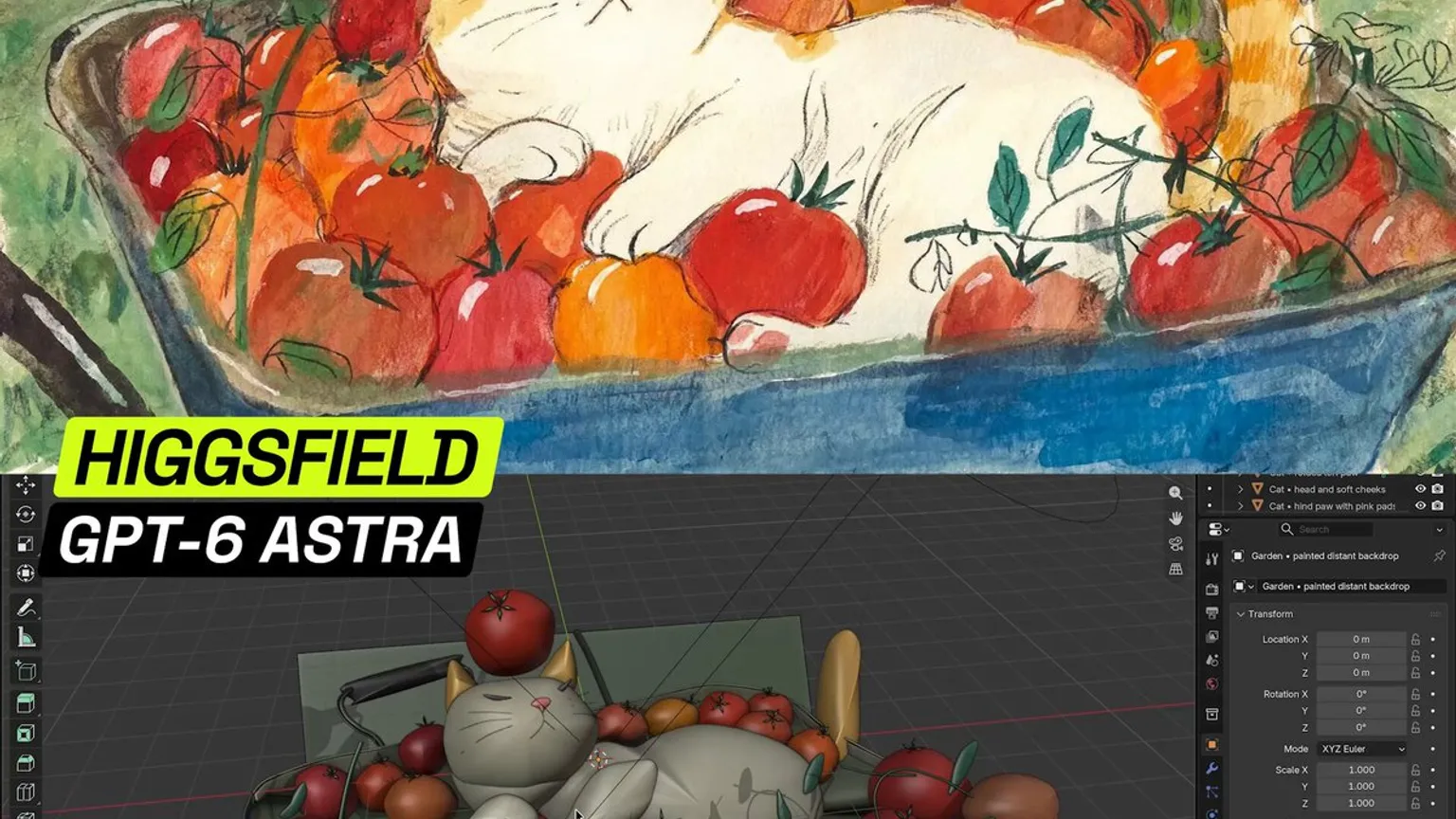
Alex Mashrabov (@alexmashrabov)'s Higgsfield showed in a September 11th post on X what it says is GPT-6 Astra converting a piece of 2D artwork into a styled, editable 3D model inside Blender.
Higgsfield's controlled demonstration places Astra at the controls of Higgsfield's Blender integration. A visual reference goes in, and a textured 3D scene resembling the source artwork comes out. Higgsfield says the workflow preserves the original style and texture, though the showcase does not publish the mesh, polygon count, topology, prompt history or amount of manual cleanup behind the result.
Mashrabov, Higgsfield's chief executive and co-founder, previously co-founded computer-vision developer AI Factory. Snap later acquired AI Factory, after which Mashrabov led generative AI work at Snap. He founded Higgsfield with technical co-founder Yerzat Dulat in 2023 and has built around a familiar lesson from consumer visual software: model quality matters, while usable controls and distribution decide which technology reaches production.
The Blender demonstration pushes that thesis beyond generated clips. Mashrabov is betting that creative AI will become an operating layer inside the software where artists already work, with an agent coordinating specialized generation systems and leaving behind assets that can still be edited.
Astra is directing a stack of creative tools
Higgsfield's Blender add-on places a prompt bar over the 3D viewport and can insert generated meshes, images and video directly into an open project. Higgsfield says its Scene Builder produces editable geometry, object layouts and lighting, while image-to-3D results arrive at Blender's 3D cursor with materials attached.
The distinction between agent and generator is central to understanding the demo. Higgsfield's Astra integration guide assigns coding, reasoning and multi-step orchestration to GPT-6 Astra. Higgsfield handles creative assets and deployment, while its Model Context Protocol bridge connects Astra to those tools.
The documentation describes a multi-model workflow rather than a single system responsible for every output. The supplied material does not establish which underlying generator produced the specific artwork conversion shown on X.
That architecture is Mashrabov's commercial opportunity. Foundation-model providers can supply reasoning and computer use, specialized models can generate media, and Higgsfield can own the interface, routing, asset management and creative workflow between them. Customers remain inside Higgsfield even as the models underneath the product change.
The demonstration's computer-use premise still comes with a clear limit: OpenAI and Higgsfield have not independently validated this particular result, and the public showcase does not establish how much human intervention was involved.
Mashrabov is moving up the production stack
Higgsfield started with AI image and video generation, then added cinematic camera controls and integrations with creative applications. The trajectory moves Higgsfield from a destination for generating media toward infrastructure that follows creators into their existing software.
That expansion comes with substantial financial backing. On August 17th, Higgsfield announced a $400M Series B at a $5.4B valuation, led by DST Global. Tribe Capital, Goldman Sachs Alternatives, Smash Capital, Fifth Wall, Valor Capital, Intel Capital, Liberty Global Tech Ventures, Mirae Asset Capital and NTT DOCOMO Ventures joined the round, along with existing investors including Accel and Menlo Ventures.
The financing followed a $130M Series A, putting the two rounds alone at $530M. Higgsfield said in August that it had surpassed 30 million users, reached $700M in annualized revenue and supplied visual-production tools to 390 Fortune 500 companies. Those operating figures are self-reported. Higgsfield's current about page separately displays 25 million users and 850 million total generations, an inconsistency that may reflect different update schedules or measurement windows.
Video generation consumes enough compute to make a $400M balance sheet useful. The Blender bridge also gives Higgsfield another way to defend margins and customer relationships. A workflow product can route tasks to whichever underlying model offers the best combination of output, speed and cost, reducing dependence on any one model provider.
The Blender file is the benchmark that matters
A polished clip can demonstrate that an agent completed a workflow. It cannot show whether a professional 3D artist would keep the result.
The useful test is the project itself: whether the model has coherent topology, whether textures hold up from angles absent from the original artwork, whether separate components can be selected and edited, and how much repair is needed before rigging, animation or production rendering. Higgsfield has not published those details for this example.
Still, the form of the output marks a practical step. Generated images and videos are usually terminal artifacts. An editable Blender scene can become an input to a larger production, with artists changing geometry, lighting, materials and camera placement after the agent finishes.
Mashrabov's latest demonstration makes his broader strategy clearer. Higgsfield wants to own the work between an idea and a finished visual asset, even when OpenAI supplies the agent and another specialist supplies the mesh. If that orchestration consistently leaves creators with usable project files, the workflow layer may prove harder to replace than any single generation model.