Rick and Morty animator Hugo Blendl makes a solo animated series with Higgsfield AI
Hugo Blendl says Higgsfield's tools took about four hours to make a recent 1-minute-20-second episode; Higgsfield's creator program covered generation costs.
By Ryan Merket · Published
Primary source: Higgsfield AI Newsroom
Why it matters
Blendl's workflow shows how generative video may let experienced animators make original work at a faster cadence. The case study's four-hour figure excludes creator labor, and Higgsfield covers generation credits; consistency across episodes remains untested.
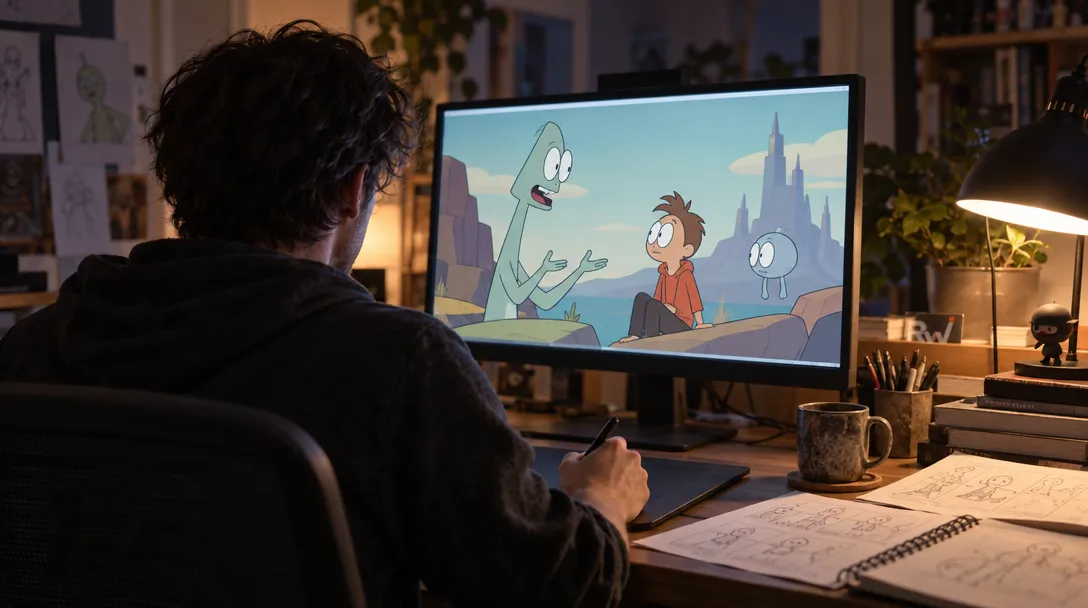
Hugo Blendl, the Mexico City animator whose credits include Rick and Morty and Legend Quest: Masters of Myth, is making Zero to Hero, an animated comedy series, largely on his own with Higgsfield's video-generation tools. A recent 1-minute-20-second episode took about four hours, Blendl told Higgsfield in a case study published October 5th. Higgsfield says he releases episodes every day or two.
His earlier attempt to make an original pilot took two years of work with a small team and produced eight minutes, about half of it still at the animatic stage, according to Higgsfield's interview. The new workflow shifts the production bottleneck. Blendl still writes the scripts, designs the main characters and directs the shots; generative video takes on much of the motion work that would otherwise require frame-by-frame animation.
From TikTok clips to a series
Blendl has spent more than a decade working in animation, including on Rick and Morty through Bardel Entertainment and directing episodes of Legend Quest: Masters of Myth at Mexico's Ánima Estudios. He studied classical animation and 3D animation and visual effects at Vancouver Film School. A 2019 profile by his former school, Tecnológico de Monterrey, recounts that he turned in comics instead of essays in high school and nearly flunked out.
His path to Zero to Hero ran through another original character. Blendl hand-animated Cheese, a TikTok mascot, making clips of roughly eight to ten seconds. Higgsfield's September interview puts his output at about one clip per day, taking six hours each, and reports 75,000 followers and seven million to ten million views for top videos. Those figures come from Higgsfield's interview, rather than independent audience analytics.
Making short animation by hand takes time, and a longer original show needs a production model that can sustain regular releases. Blendl has said he learned from the unfinished pilot that committing to a large project does not guarantee an audience will find it. Zero to Hero is a smaller, faster test: a comedy about an academy for young superheroes with deliberately impractical powers, including barely controlled fire and telekinesis in a wheelchair.
AI handles the motion, Blendl directs the show
Higgsfield's case study says Blendl was initially skeptical of generative AI, after trying it for background art and then stepping away during early criticism of the technology. His current use is selective. He writes each script, draws the main cast by hand, and describes shots in detail before generating footage. For character consistency, he saves character references in Higgsfield and reuses them across generations.
He generates scenes as clips of up to 30 seconds with Seedance 2.5, then edits, grades and composites in Premiere Pro. When a shot needs a specific correction, he sometimes draws frame by frame in Toon Boom Harmony. The finished episodes run one to three minutes, according to Higgsfield; Blendl's longer-term plan is a ten-episode season of roughly ten minutes per episode.

Blendl makes the creative decisions in this AI-assisted production. He draws on skills from studio animation, including staging, timing, camera choices and character acting. Higgsfield's case study quotes him arguing that directing generated animation still requires understanding animation and cinematography.
Higgsfield says its Creator Partnership Program has covered Blendl's plan and generation credits since September 2026, allowing him to move from 480p output to 720p and make more variations per shot. The reported four-hour production time excludes the value of Blendl's labor, and the platform is subsidizing generation expenses. RuntimeWire has examined how Higgsfield credit usage translates into costs in a separate workflow.
Higgsfield's creator program as a product showcase
Blendl joined the Creator Partnership Program on September 3rd, Higgsfield says. The program provides a monthly plan, generation credits, early access to models and direct support. His series gives Higgsfield a visible example of its tools in a production workflow. The credits remove a near-term expense for Blendl and let him test more shots, though his production cadence remains tied to his own time and the tool's output.
The case study also describes a separate eight-minute comedy-horror episode, The Zero Slasher, submitted to Higgsfield's Global Film Festival. Its project page lists 65 generations and 1,884 credits and, according to Higgsfield's case study, more than 21,000 views in its first month. The figures offer a partial record of the resources used to make a finished piece; Higgsfield covers the credits for Blendl's current work.
Higgsfield's production comparisons should be read as one creator's account, not a controlled measure of the industry. Higgsfield cites a traditional-animation pace of three to five finished seconds per animator per workday and compares it with Blendl's reported output of about three minutes. Those figures do not establish how his workflow would perform across other artists, projects or production requirements. The four-hour figure also comes from a company interview; the story does not break out discarded generations or provide a detailed accounting of every production step.

Blendl is using a new tool to attempt the project that the old pipeline made difficult to sustain: original animation released frequently enough to find an audience. The next test is whether Zero to Hero can keep its characters and comedy consistent over a longer run, while preserving the handmade direction that distinguishes it from a string of generated clips.