ICON says it is nearing completion of 121 printed homes in Austin
The homes are part of Community First! Village, a permanent supportive-housing community run by Mobile Loaves & Fishes; ICON's project page lists a different total.
By Ryan Merket · Published · Updated
Primary source: X
Why it matters
Community First! Village is a long-running deployment of ICON's construction robotics in supportive housing. The reported 121-home count differs from ICON's project-page total. Clear definitions for deployment numbers help readers assess claims about construction speed and scale.
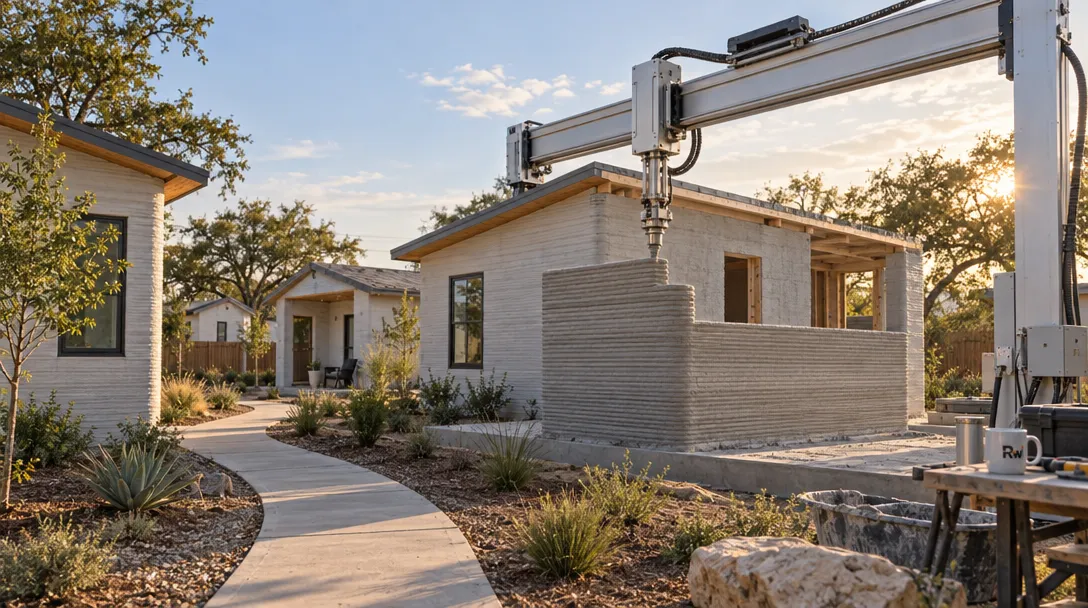
ICON said on October 9th that it is nearing completion of 121 homes built with its robotic construction system at Community First! Village, an Austin supportive-housing community operated by Mobile Loaves & Fishes. The nonprofit and its donors, along with the Lennar Foundation and Wells Fargo Foundation, funded different sections of the homes, ICON said in its X post.
https://x.com/ICON3DTech/status/2108379543446995424
The number needs a clear qualifier. ICON's project page lists 117 structures at Community First! Village, built from 2019 through 2026. The October post refers to 121 homes. The company page does not present the same total as the post, and the figures should not be treated as interchangeable. ICON's 2024 announcement, meanwhile, said construction was underway on 100 additional printed homes at the site.
The village provides permanent, affordable housing for people who have experienced chronic homelessness. In its post, ICON described its printed buildings as one part of the broader community. The project is a continuing deployment for a nonprofit housing operator, not a standalone demonstration or a conventional market-rate subdivision.
For Jason Ballard, ICON's co-founder and CEO, construction technology grew out of work on housing and environmental efficiency. Ballard studied conservation biology, then co-founded TreeHouse, an eco-focused home-improvement retailer, with Evan Loomis. In an interview, Ballard said that after working on thousands of homes he began looking for a way to build that was more affordable and less wasteful; he and Loomis later teamed with Alex Le Roux to start ICON in 2017. That founding thesis sets a test for projects like Community First!: printing walls is valuable only if it fits into the larger job of delivering usable homes.
ICON's system uses robotics to extrude cement-based material in layers to form walls. Its technical description presents the machinery, material and software as a coordinated construction system. That scope is narrower than printing a finished home: the homes still require the work and components that turn printed wall structures into completed housing. A completed project count, by itself, does not show the cost, time or labor saved across the full build.
ICON is also trying to sell construction systems beyond projects it builds itself. In March 2026, ICON announced the commercial rollout of its Titan system for builders. That initiative is a separate offering from the Vulcan equipment named on the Community First! project page, and it reflects the company's effort to put its robotics and software into other builders' operations.
Investors have financed that effort. ICON's February 2025 Series C first close brought in $56 million, co-led by Norwest Venture Partners and Tiger Global, with participation from CAZ Investments, LENX, Modern Ventures, Oakhouse Partners and Overmatch Ventures, according to TechCrunch. The round's stated purpose included developing its next-generation construction technology; it was not funding specifically for the Community First! homes.
Community First! Village provides a measure of ICON's progress beyond printer specifications or fundraising: whether its construction method can contribute homes to an operating supportive-housing community over multiple years. ICON's post gives a fresh completion estimate, while its project page reports a separate cumulative structure count. The two figures document continued work at the site but do not establish a single reconciled total.