Magnific puts GPT-6 Astra at the front of a multi-model brand workflow

The demo uses Astra as coordinator while Seedream 5 Pro and Seedance 2.5 generate mockups and video.

By · Published

Primary source: Magnific on X

Why it matters

Magnific is betting that creative teams will pay for context, model routing and repeatable production while image and video generators rotate underneath. Astra gives that workflow a conversational front end.
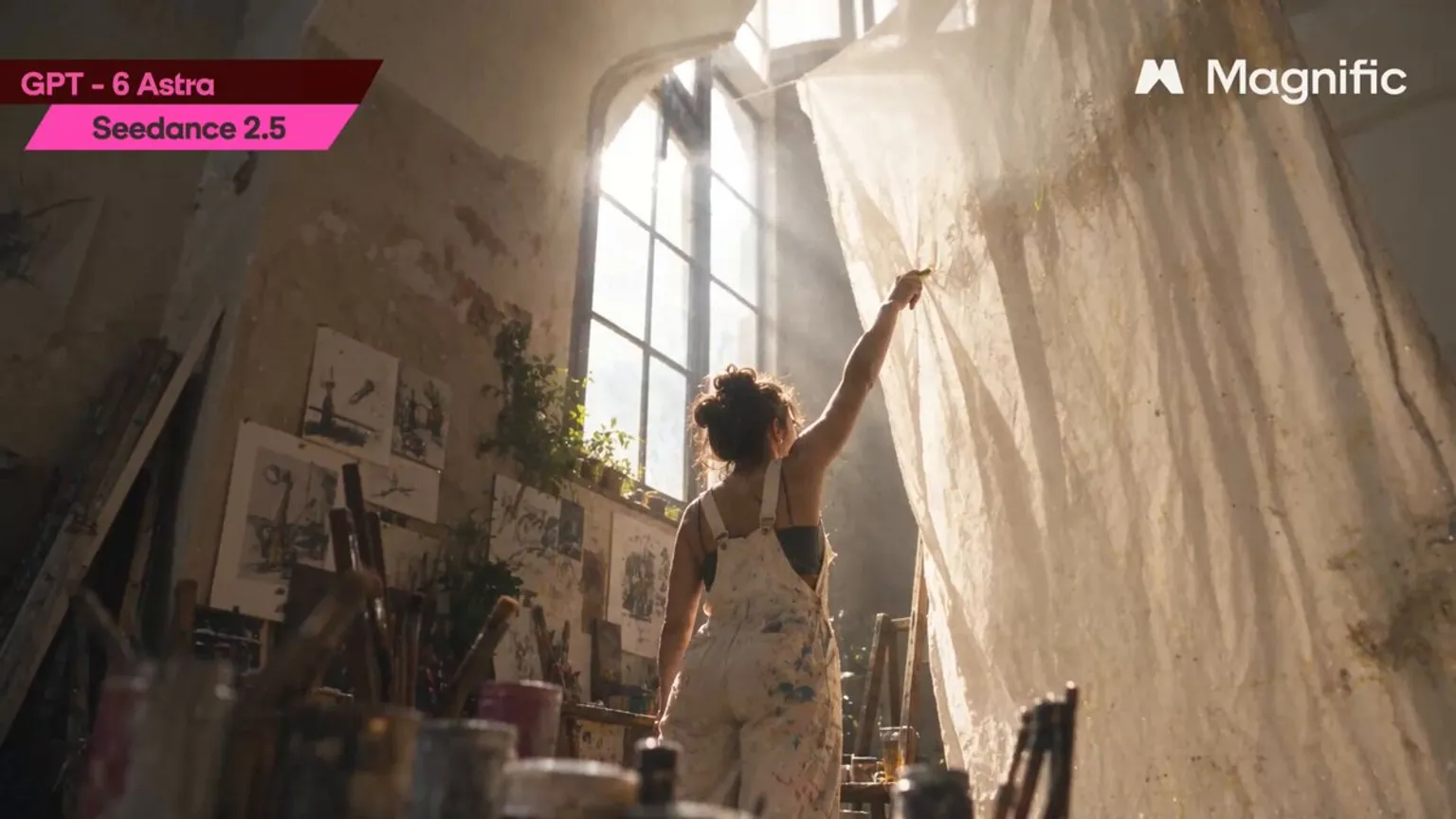
Magnific plugs GPT-6 Astra into a multi-model brand production workflow

Magnific co-founders Javi Lopez (@javilopen) and Emilio Nicolas Riquelme (@emailnicolas) put OpenAI's new GPT-6 Astra at the front of a connected brand-production system, using a chat brief to direct identity work, posters, merchandise, websites, event advertising and music.

Magnific on X

In the thread posted September 7, Magnific showed the workflow building a campaign around "TRAZA - FESTIVAL DE ARTE VIVO," a fictional art festival. The requests covered LED screens, wristbands, wheatpasted posters, a stage, an entrance, kiosks, lanyards and merchandise. Magnific presented Astra as the coordinator, while Magnific provided access to the production tools and asset history.

Magnific's mockup thread on X

At least two other models generated key outputs. Magnific said the campaign mockups were made with Seedream 5 Pro. A separate advertisement used one Seedance 2.5 generation to produce a 20-second film with five shots, an included score and no dialogue.

Magnific's advertising thread on X

The evidence supports Astra's role as the connected interface at the front of the workflow, with Magnific routing work to specialist models for rendering.

That division of labor is central to what Lopez and Nicolas have built since launching the original Magnific AI in November 2023. Their first product focused on enlarging and enhancing images. The current Magnific wants to manage the entire process around those images, including references, variations, video, review and reuse.

Astra directs while other models render

Magnific's Model Context Protocol connector lets ChatGPT and other AI agents call its image, video, audio, 3D and editing tools through natural-language instructions. Users can specify a model or let Magnific choose one automatically based on the task.

The automatic selection creates an attribution wrinkle. Magnific's documentation says the connector does not identify its choice while operating in auto mode; users must inspect the resulting creation afterward. The September 7 thread is unusually specific because it identifies Seedream and Seedance as the generators behind parts of a campaign presented as an Astra workflow.

Magnific laid out the broader product strategy in a September 2 post about its ChatGPT connector. A creative team can develop a brief in ChatGPT, call Magnific to generate or edit assets, organize the work inside a shared Space and save the successful sequence as a reusable Flow. A designer can later change the model, references or individual steps without rebuilding the project from scratch.

For Magnific, the connector also creates a distribution and usage channel inside AI assistants. MCP access is available on its paid plans, and generation or transformation jobs consume Magnific credits. If creative work increasingly begins in a ChatGPT conversation, Magnific needs its production tools callable from that conversation rather than waiting for users to open another application.

Two founders, two acquisitions and a much larger canvas

Lopez and Nicolas had already built and sold one bootstrapped internet business before Magnific. They co-founded Erasmusu, a community and housing platform for international students, and grew it without venture backing. Spotahome acquired Erasmusu in 2018, with the final terms undisclosed.

Their next company moved faster. Magnific AI launched as a two-person operation and reported 725,000 registered users about five months later. That figure came from Lopez and was not independently audited. Freepik acquired Magnific in May 2024, keeping Lopez and Nicolas focused on AI product development. The purchase price was not officially disclosed.

The acquired product eventually supplied the identity for its much larger owner. On April 28, 2026, Freepik rebranded the combined business as Magnific. Freepik had spent 16 years building a stock-content and design platform before adopting the name of the five-month-old AI product it bought.

Joaquin Cuenca, who co-founded Freepik in 2010, is CEO of the combined business, according to a June profile of the company. EQT has held a majority stake in the business since its 2020 investment.

The company currently claims more than 1 million paid subscribers and more than 250 enterprise clients. Those figures have not been independently verified. The scale gives Lopez and Nicolas a far larger customer base for the workflow idea than their original upscaler could have reached alone.

The workflow is the product

Image and video models can change quickly underneath a campaign. Magnific is betting that the lasting commercial layer will hold the brief, references, approved assets, team permissions and repeatable production steps while those models rotate.

The TRAZA demonstration makes that argument cleanly. A user describes one campaign in Astra. Magnific carries the context into mockups, screens, merchandise and an advertisement, selecting different generation systems where needed. The customer remains inside one project even though the underlying models come from several providers.

The demo establishes coordination across media, rather than the harder enterprise requirements surrounding a live campaign. It does not show whether every output arrives as an editable production file, how reliably brand rules survive repeated generations or how much human correction was required between the brief and the polished examples. Magnific separately says its enterprise plans include centralized controls, data protections and legal indemnification, but those services are outside the scope of the demonstration.

The narrower result still matters. Lopez and Nicolas began with a tool that improved one image. Less than three years later, their product name sits on a system designed to direct an entire campaign, with a frontier language model taking the brief and specialist generators doing the production work underneath.

Reader comments

Conversation for this story loads after sign-in.