MiniMax H3 draws local apps and training tools within 48 hours
Maestro added desktop support as developers pushed H3 onto a gaming GPU and offline Macs beyond MiniMax's tested setups.
By Ryan Merket · Published
Primary source: MiniMax
Why it matters
H3's early ecosystem shows how open weights can recruit outside developers to lower hardware costs and expand distribution while MiniMax keeps its advanced 2K workflow tied to paid APIs.
Yan Junjie, MiniMax's founder, chairman, CEO and CTO, saw outside developers run H3 on untested hardware and build new training, optimization and deployment tools within 48 hours of its open-weights release.
On August 4th, a day after MiniMax published H3's downloadable checkpoints, MiniMax said Maestro v1.5.5 had added H3 support. MiniMax also said developers had run the model on hardware it had never tested, spanning a gaming GPU and MacBooks operating fully offline.
The announcement offers an early sign that developers are extending H3 beyond MiniMax's own deployment paths. MiniMax launched H3 as a model that can generate video and synchronized stereo audio from combinations of text, images, video and audio. Publishing the weights transferred part of the deployment work to developers who immediately began lowering memory requirements, packaging interfaces and writing training support.
"We're genuinely glad we opened it up," MiniMax wrote.
Developers fill the deployment gaps
Maestro is a local desktop studio that places a graphical interface and prompt-enhancement layer over open video-generation backends. Maestro v1.5.5 added H3 support through a WanGP backend. Separately, WanGP v12.41 added MiniMax H3 support on August 3rd, 2026. Its desktop installer handles the Git, Python, CUDA and PyTorch setup required to run WanGP on a PC.
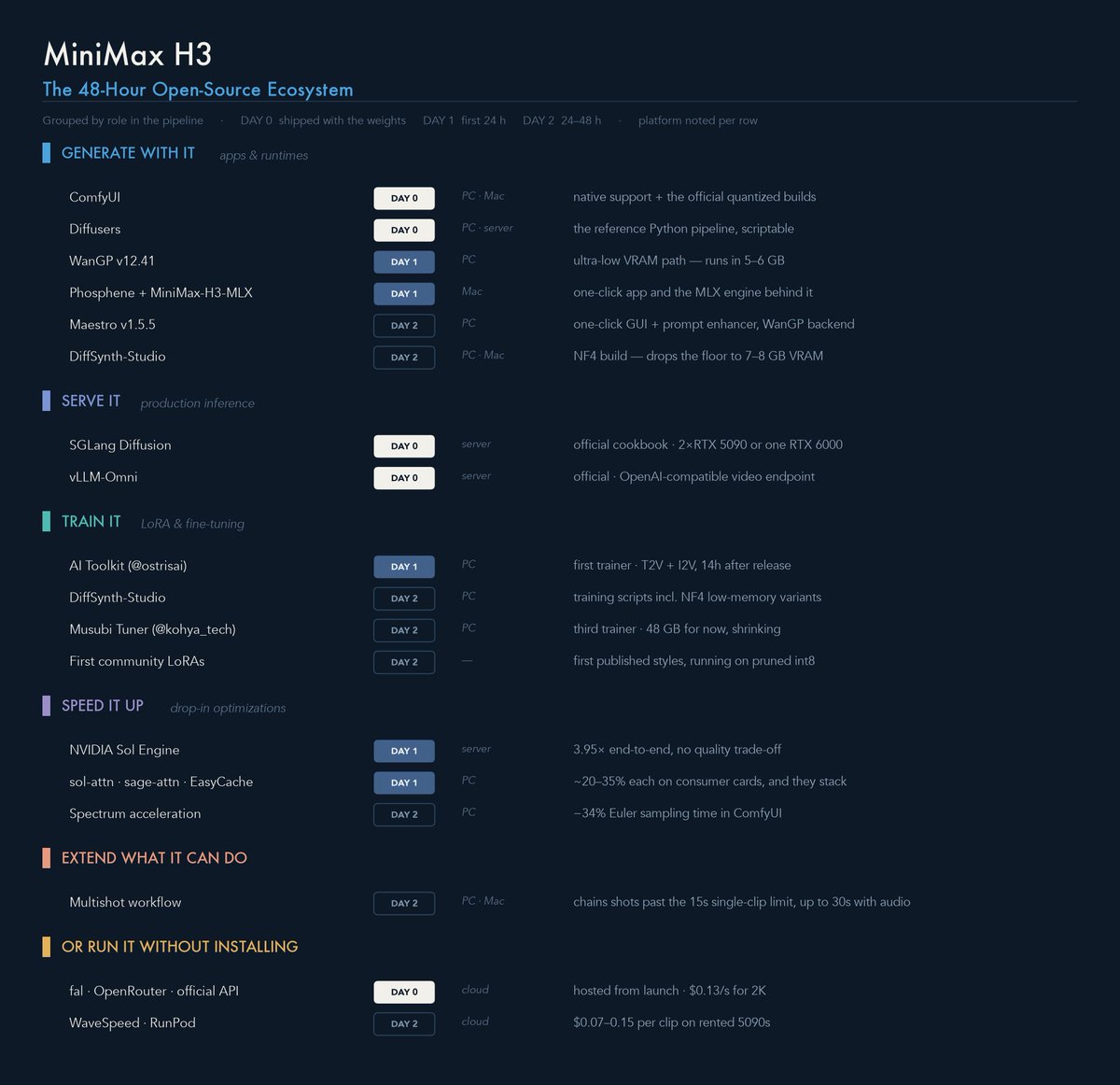
Maestro was one piece of a larger burst of work documented in MiniMax's ecosystem graphic. MiniMax listed native support in ComfyUI and Diffusers on the day the weights shipped. It said WanGP v12.41 followed with a path designed to run in 5 GB to 6 GB of VRAM, while Phosphene and a MiniMax-H3-MLX engine brought one-click local execution to Macs. DiffSynth-Studio added an NF4 build that MiniMax says lowers the requirement to 7 GB to 8 GB of VRAM.
Those memory figures come from MiniMax's own summary rather than reproducible, independent testing. MiniMax did not identify the gaming GPU or MacBook configurations behind its broader claim, leaving generation speed, output resolution and memory use unclear across those machines.
Official server instructions for the full-precision H3 checkpoints describe multi-GPU deployments. The MiniMax H3 release documentation also provides checkpoint-based deployment guidance and points developers to local ComfyUI support. ComfyUI's H3 documentation offers native workflows for text-to-video, image-to-video and reference-driven generation. Community quantization and memory-management work is pushing H3 toward machines owned by individual developers and small creative studios.
MiniMax's graphic also lists three training implementations within the first two days. AI Toolkit added text-to-video and image-to-video LoRA training, followed by DiffSynth-Studio and Musubi Tuner. Developers had also published the first community LoRAs, according to MiniMax. That matters because local inference lets people use a model, while accessible fine-tuning lets them adapt it to recurring characters, visual styles and production formats.
The optimization layer arrived just as quickly. MiniMax credits NVIDIA Sol Engine with a 3.95x end-to-end speed gain and lists sol-attn, sage-attn and EasyCache as providing roughly 20% to 35% improvements apiece on consumer cards. Those are MiniMax performance claims without disclosed test conditions in the announcement. Hardware, resolution, clip duration and baseline settings can materially change video-generation results.
H3 remains partly tied to MiniMax's servers
The community activity expands what developers can do with H3 locally, though the downloadable release is still a subset of MiniMax's complete production system.
As RuntimeWire reported when MiniMax published the checkpoints, the open release contains two base-model packages for first-and-last-frame generation and multimodal reference generation. Together, they occupy roughly 288 GB before community compression. They can produce 768p video and audio locally.
MiniMax's full 2K workflow adds two components that have not been released as downloadable weights. H3-Context-IR interprets and restructures complex multimodal prompts through hosted models and services. H3-Regenerate-2K then uses the base output and original context to produce the higher-resolution result. MiniMax's model card says both components remain API-dependent, although developers can build their own prompt-processing systems around the open base model.
That split gives MiniMax two routes to adoption. Local tools can put H3 in front of developers who prefer offline execution, experimentation or control over inference. MiniMax can still sell access to the hosted workflow through its video-generation API, particularly when users want MiniMax's prompt orchestration and 2K regeneration process.
Community work can therefore widen the funnel for MiniMax's paid infrastructure. A developer may first encounter H3 through ComfyUI, Maestro or an MLX build, then use MiniMax's hosted services for the parts of the workflow that remain difficult to reproduce locally. The open release also encourages third parties to solve deployment problems that would otherwise consume MiniMax's engineering time.
Yan's research background meets an open distribution model
Yan built MiniMax after spending more than six years at SenseTime, where he rose to vice president and vice-head of its research institute. MiniMax's management biography says he studied mathematics at Southeast University, earned a doctorate in artificial intelligence from the Chinese Academy of Sciences and conducted postdoctoral research at Tsinghua University. It credits him with about 200 academic papers and more than 30,000 citations.
That background places a researcher at the center of a commercial decision about distribution. H3 competes with both hosted video systems and downloadable models. Keeping the entire stack behind an API would give MiniMax tighter control, but it would require MiniMax to build every integration, optimization and training path itself. Opening the base model recruits developers to do some of that work while MiniMax retains hosted components around the most elaborate workflow.
The first 48 hours produced evidence that developers were willing to participate. MiniMax's ecosystem graphic names local applications, server frameworks, trainers, acceleration projects, cloud providers and early LoRAs. It also describes a multishot workflow that chains clips beyond H3's 15-second single-generation limit, reaching as long as 30 seconds with audio.
The speed of that work is a stronger result than a download count alone. It shows developers treating H3 as infrastructure they can alter rather than a fixed application they can only call. The next test is whether those projects hold up across repeatable hardware benchmarks and mature into maintained tools. Within two days, developers had expanded H3's deployment surface beyond the paths MiniMax shipped with the weights.