MintNeuro raises $5M to put neural-device chips into customer programs
MintNeuro says working silicon and a multi-year Motif Neurotech supply agreement put it beyond chip validation and into customer adoption.
By RuntimeWire Staff · Published
Primary source: PR Newswire
Why it matters
MintNeuro is trying to turn specialized neural-interface silicon into shared infrastructure across device makers. The $5 million round backs that commercial test, with a multi-year Motif supply agreement providing an early customer pathway.
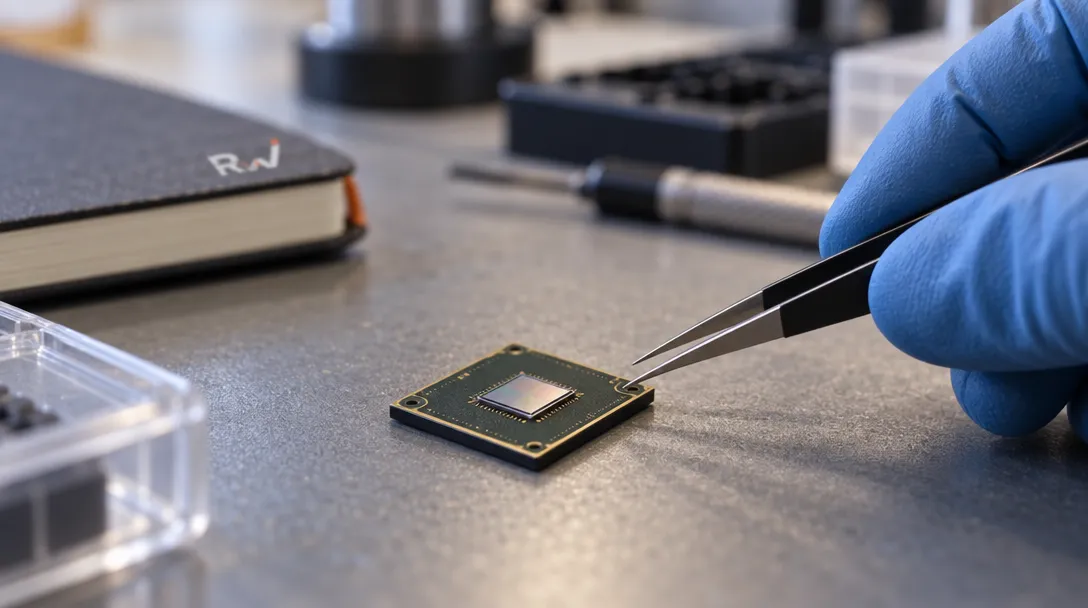
MintNeuro raised $5 million on October 7th to take its neural-device chip platform from working silicon toward commercial supply, a move that puts founder and CEO Dorian Haci at the point where a research spinout must prove that other companies will build around its hardware. PR Newswire reported that Odyssey Ventures led the round, with 33East, JSK Investments and Alumni Ventures participating, alongside returning investors Empirical Ventures and Jumpspace Ventures.
Haci came to MintNeuro by way of Imperial College London's neural-interface research group, where he joined as a research assistant in 2015 and pursued a PhD. He had wanted to build an implantable neurotechnology company, but his first venture concept involved using radar to monitor vital signs and movement remotely. After Imperial's MedTech SuperConnector accelerator, he shifted toward implantable devices, where the research group's expertise and his own experience aligned. That founder's pivot is now reflected in MintNeuro's pitch: supply the semiconductor components that developers need to make small, low-power devices that interact with the nervous system.
The three co-founders brought complementary academic experience to the spinout. Haci leads the business; Imperial bioelectronics professor Timothy Constandinou is CTO, and Newcastle University neural-interface professor Andrew Jackson is chief scientific officer. MintNeuro began as an Imperial spinout in 2022. Odyssey Ventures' portfolio profile describes Haci and his co-founders as building chips for devices that connect with the nervous system.
From research silicon to customer programs
MintNeuro's platform is designed to combine neural sensing, signal processing and electrical stimulation, with power management and wireless data transfer. These functions have to fit within strict constraints on size, power use, safety and signal quality when a device is implanted. MintNeuro says its modular chip platform can help developers avoid adapting general-purpose components or paying for custom silicon development. Its claimed advantages in performance, cost and development time remain the company's case for adoption; the funding announcement provides no independent comparison of those measures.

There is already a commercial test of that proposition. In April, MintNeuro and Motif Neurotech announced a multi-year chip supply agreement tied to Motif's minimally invasive neurostimulator, which is being developed initially for treatment-resistant depression. MintNeuro says it has delivered working silicon and reached integration milestones with Motif and Amber Therapeutics. The round announcement does not quantify chip deliveries or customer programs, so the practical measure of progress will be how many device developers move from evaluation to sustained use.
Purpose-built neural chips already exist. Intan Technologies, for example, sells integrated circuits for recording neural signals, including chips that combine amplifiers, filters and analog-to-digital conversion. MintNeuro's stated bet is broader system-level integration for neural devices: modular components that cover sensing, processing and stimulation, and can be used in devices intended for the body as well as wearables. The opportunity is to become a repeat supplier across different product programs, rather than to sell silicon for one research setup. Whether MintNeuro's design can do that at commercial scale is what this financing is meant to help test.
The bet behind the round
MintNeuro says it will use the capital to expand engineering and commercial teams, launch products, supply more pre-release silicon to partners, support customer adoption and build its US presence. Haci described the round as a transition from technology validation to commercial scale-up. That framing is apt: an implantable chip platform has to clear engineering and integration hurdles before its customers can bring medical devices to market, and a supply agreement is evidence of a customer commitment, not evidence of clinical or commercial success for the eventual device.
The new financing follows a GBP 1 million round announced in November 2024, according to MintNeuro's company news page. The amounts are in different currencies and should not be combined into a single total without conversion. Odyssey Ventures led the new round; the announcement also names four participating or returning investors, but does not assign individual contributions. The investor list gives the company capital and a mix of European and US backers as it tries to build relationships on both sides of the Atlantic.
For Haci, the wager has moved from whether academic chip expertise can become a company to whether a reusable platform can earn a place in other companies' products. Motif's agreement supplies an early commercial pathway, while Amber's reported integration milestones point to another potential application. MintNeuro's challenge now is to turn those programs into repeatable adoption without asking each customer to fund a bespoke chip effort - the very cost and delay MintNeuro says its platform can reduce.