Mistral CEO says new model beats Chinese rivals on cybersecurity
At Abu Dhabi's Ai Everything conference, Mistral CEO Arthur Mensch said the model would be unveiled on October 6th; he gave no benchmark, score or rival model names.
By RuntimeWire Staff · Published
Primary source: Reuters
Why it matters
Mistral is tying its European-supplier pitch to model performance, but the cybersecurity comparison cannot be assessed without named rivals, benchmarks and test conditions.
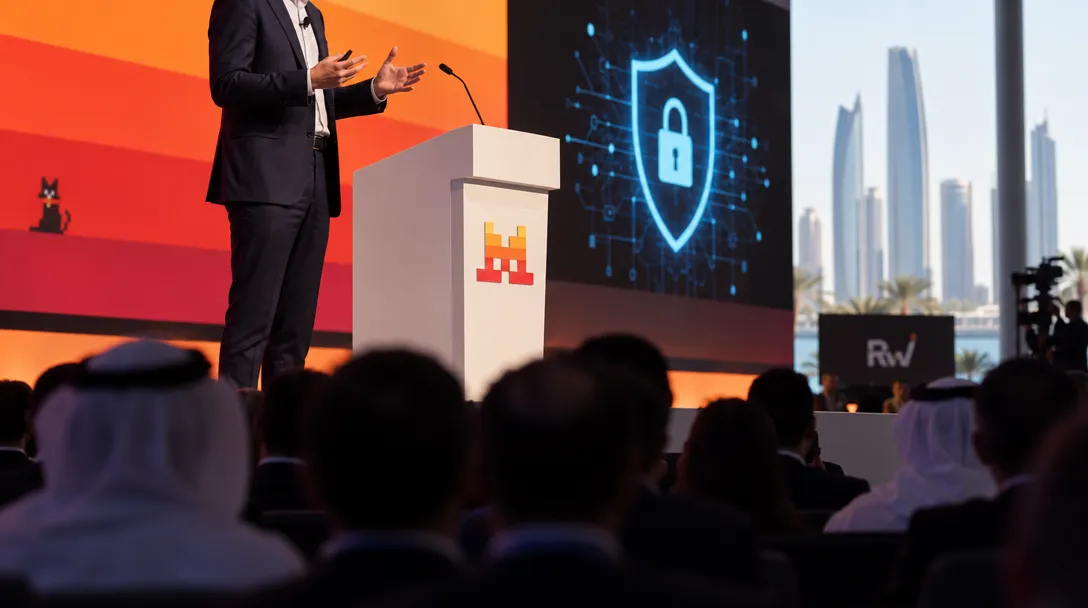
Arthur Mensch (@arthurmensch), co-founder and CEO of Mistral, said Mistral's newest AI model outperforms unspecified Chinese systems on cybersecurity. At the Ai Everything conference in Abu Dhabi on October 6th, Mensch said Mistral would unveil the model later that day, according to Reuters.
Mensch described the model as "above the Chinese models on certain aspects, including cyber." He did not name the competitors or identify the tests, scores or conditions behind that comparison. The claim concerns particular areas, with cybersecurity as one example; it does not establish that the model beats Chinese systems overall.
A claim with a limited scorecard
Mistral's announcement will need to show what Mensch's comparison measures. Without named models, benchmark results and testing details, buyers cannot tell whether the result reflects general cybersecurity skill, performance on a particular task or a tightly defined evaluation. Those details are also needed to compare the result with products from DeepSeek, Alibaba's Qwen or other Chinese developers.
Mensch's background is in research. He studied at Ecole Polytechnique and Telecom Paris, completed a machine-learning PhD at Inria and Universite Paris-Saclay, and joined Google DeepMind's Paris office in 2020 to work on language models. He left in 2023 to start Mistral with Guillaume Lample and Timothee Lacroix, former Meta researchers, according to Slush's speaker profile and Ecole Polytechnique.
Mistral's founding account frames the project as a response to AI innovation becoming more closed. The founders set out to combine frontier research with openness, customization and user control. Mensch's claim connects that pitch to competition: Mistral wants to show that European ownership can go hand in hand with technical performance, including in areas with national-security implications.
Mistral has already released a product related to AI safety, though it is distinct from the model Mensch discussed. On August 4th, Mistral introduced Shieldstral, a 3-billion-parameter open-weight classifier for text and image safety. Its announcement describes content moderation and policy-adaptive scoring. Reuters did not identify the new model, so Shieldstral's release does not establish what model Mensch was referring to or validate his cybersecurity comparison.
Mistral's commercial case
Mistral sells open-weight models alongside developer tools, applications and compute, with deployment options that give organizations more control over where their data and systems run. Its pitch is aimed at institutions that want alternatives to suppliers based in the United States or China. Mensch said at the conference that Mistral's independence from both countries was helping it grow in the Gulf and Asia-Pacific, and that there was "an enormous desire and an enormous need for alternative technology suppliers." Those are the CEO's descriptions of demand, not independently verified growth figures.
Mistral has been building distribution and enterprise examples alongside its models. On September 16th, Mozilla selected Mistral Small 4 for the beta of Firefox's Smart Window feature, while allowing users to switch models, as RuntimeWire reported. A separate Mistral project used AI agents to help migrate 40,000 lines of Fortran, with engineers reviewing the architecture and code before changes merged, in RuntimeWire's reporting. Those efforts show the range of settings where Mistral needs its systems to work; neither substitutes for evidence behind the new model's benchmark claim.
In September, Mistral raised €3 billion in a Series D at a post-money valuation above €21 billion, according to Mistral's funding announcement. Samsung Electronics led the round, with EQT's Scaleup Europe Fund and existing investor PSG Equity as co-leads. Mistral said the financing would expand frontier research and computing capacity. The round gives the company resources to pursue that work, but does not establish that the model's performance will match Mensch's description.
Mensch has framed the competitive challenge as whether Europe can build its own AI suppliers. The new model will offer a test of that claim. Its name, availability, technical specifications and comparative results will determine how much buyers can assess for themselves.