National Compute launches shared AI grid with 760 MW connected or in sight
Anjney Midha's National Compute will pool capacity across providers and chip types, aiming to widen access for startups, universities and public-sector researchers.
By RuntimeWire Staff · Published
Primary source: Bloomberg Technology
Why it matters
National Compute is betting that a software layer can make fragmented AI capacity usable at scale. The launch's 760MW estimate mixes capacity "connected or in sight," so the key test is how much becomes reliable, accessible compute for smaller users.
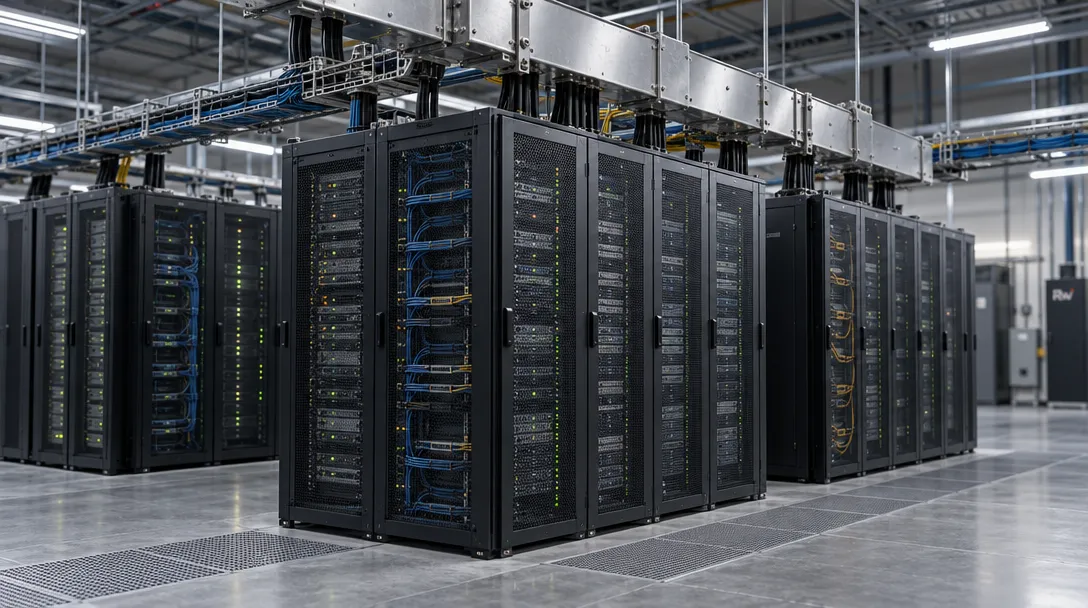
Anjney Midha, the CEO of National Compute, is building a shared market for AI computing capacity that he says already has about 760 megawatts connected or in sight. The National Compute Grid, announced on October 7th, would let startups, universities and public-sector researchers draw on capacity spread across cloud providers, labs and different chip systems. Midha discussed the plan with Bloomberg Technology; Axios reported the grid's initial capacity estimate and operating design.
The pitch is that access to compute depends on coordination as much as on building more data centers. National Compute proposes to connect existing capacity through a shared scheduler, matching jobs with resources listed by chip type, location, price and utilization. The network's stated goal is 2 gigawatts of pooled capacity by 2030.

That 760-megawatt figure deserves careful reading: the consortium describes it as capacity "connected or in sight." The combined wording does not say how much is operational, contractually committed or available to customers now. It is an early measure of potential network scale, not a tally of compute already delivered through the grid.
A founder returning to infrastructure
Midha has moved between company-building and investing throughout his career. He co-founded Ubiquity6, which developed computer-vision and multiplayer technology, and later joined Discord after its 2021 acquisition of the startup. At Discord, he built the company's first developer platform organization, according to his Andreessen Horowitz biography. He then became an a16z general partner focused on AI, backing founders and helping some secure computing access, the firm said when it announced his appointment in 2023.
That history gives Midha a practical reason to focus on the gap between AI demand and access. His previous work put him close to both sides of the problem: founders trying to build products on limited resources and investors helping AI companies obtain the infrastructure they need. The new bet is that a coordination layer can make scattered capacity useful to more of them.
Midha told Axios that the United States has more compute than people expect, but that it needs to be interconnected and coordinated. The grid is an attempt to turn that thesis into infrastructure shared among providers, rather than a single cloud owning and operating every cluster.
The scheduler is the product
National Compute calls its software layer Grid Exchange. The company says members will be able to contribute idle capacity or reserve larger clusters for planned training runs, while the scheduler routes workloads across participating sites and systems. Vultr, a founding consortium member, says the network is intended to pool capacity across NVIDIA, AMD and TPU architectures.
Vultr also says Grid Exchange will price around "goodput": completed, uninterrupted work, rather than simply charging for GPU-hours. The idea targets a real inefficiency. The consortium's paper, as summarized by Axios, says independent single-tenant data centers average less than 15% net computing utilization. That figure comes from the group's own paper, rather than an independently audited measure of all data centers.
The commercial test is whether the system can make fragmented infrastructure behave predictably enough for serious workloads. A shared inventory is useful only if providers can meet jobs' requirements for performance, availability and continuity. Scheduling across different chips and sites adds another layer of complexity; the launch materials describe the intended design, not independently demonstrated results.
Access is the measure
The consortium says the grid is opening access to public-sector employees and teams, including government, education and national laboratory users. For smaller AI companies, the appeal is a route to compute without securing the large, long-term commitments that major labs can negotiate. Sam Sinha, head of AI at robotics company 1X, told Axios that smaller operators struggle to compete with OpenAI and Anthropic for those contracts.
National Compute is asking providers to contribute resources and customers to trust a common allocation system. Its 2030 target sets an ambitious scale for that network, but capacity totals alone will not establish whether it works. The more telling measure will be how much of the capacity is actually available, how reliably workloads finish and whether users who cannot secure large contracts can get access when they need it.