NVIDIA PAIR turns spare PCs into a local AI inference cluster
The open-source beta routes parallel agent requests across Windows, Linux and macOS devices without pooling their GPU memory.
By Ryan Merket · Published
Primary source: NVIDIA RTX Spark on X
Why it matters
PAIR gives local agents a practical way to use idle compute across several machines, but its request-level routing cannot overcome per-device memory limits for larger models.
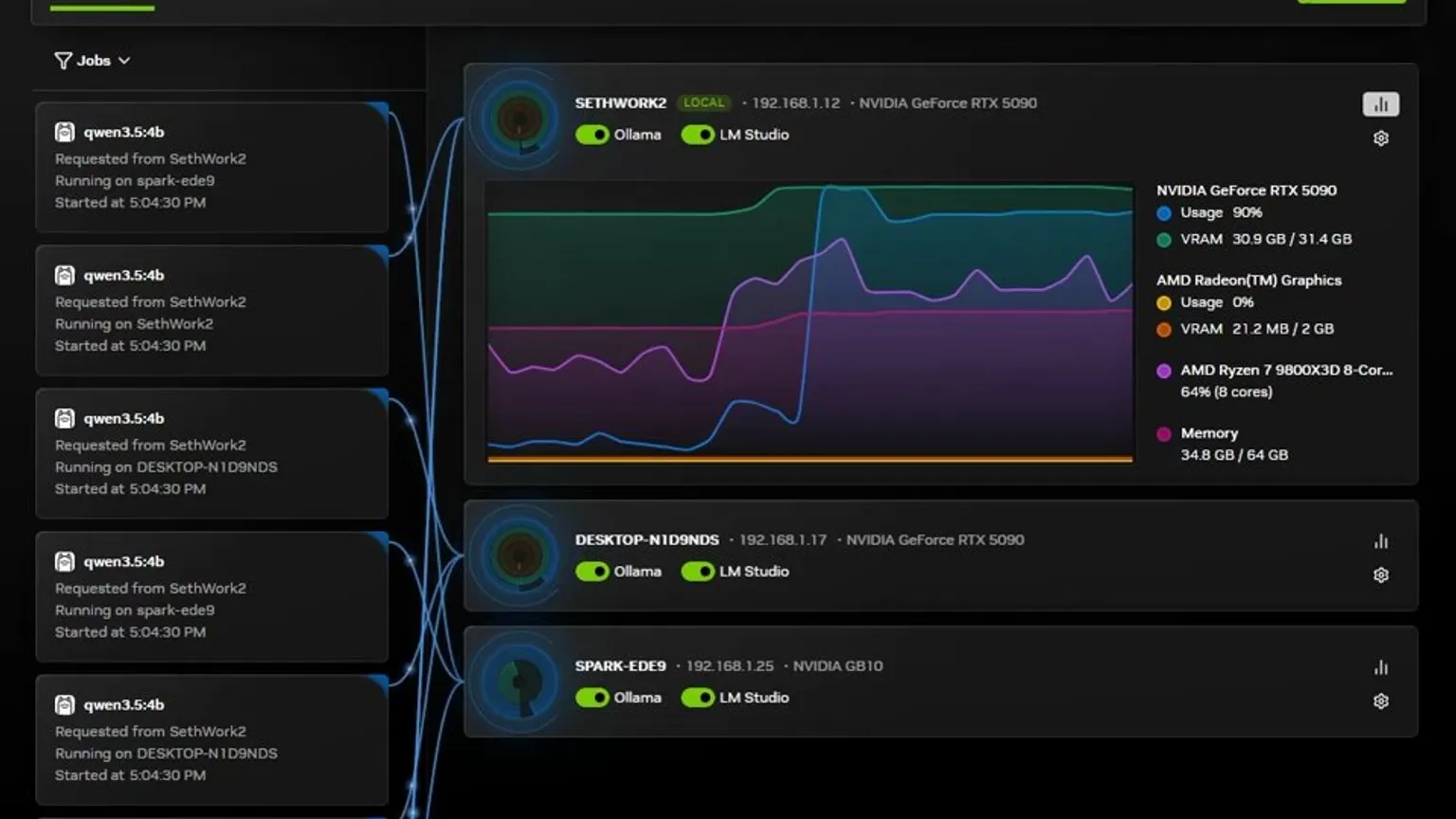
NVIDIA launched PAIR on September 3rd, an open-source inference router that connects compatible computers on a local network and sends each AI request to a machine with available capacity.
https://x.com/NVIDIARTXSpark/status/2095580592704217349
The NVIDIA RTX Spark account introduced the software at IFA 2026 as a way to keep multi-agent workloads from piling up on one GPU. PAIR, short for Personal AI Router, is available in beta for Windows, Linux and macOS through desktop and terminal interfaces.
PAIR targets a specific constraint in local AI: agents increasingly divide jobs among multiple subagents, but those workers often send all their model requests to the same inference server. A nearby gaming PC, workstation or laptop may have usable compute sitting idle while the primary machine builds a queue.
NVIDIA's router discovers participating devices, checks whether they have the requested model and a supported inference engine, and assigns each new request to an eligible node. PAIR currently works with Ollama and LM Studio. It presents compatible proxy endpoints, allowing applications configured for those engines to use the router without adopting a separate cluster API.
Routing requests, not combining GPUs
The practical limit matters. PAIR does not pool GPU memory, join several GPUs into one logical accelerator, shard a model across machines or divide one inference request among multiple nodes. Each request goes to one computer and stays there until completion.
That makes PAIR useful for concurrent workloads with several independent calls. It does not let a developer load a model that is too large for every individual machine in the cluster. Each eligible node still needs enough memory to run the requested model on its own.
NVIDIA demonstrated PAIR with Hermes Desktop, Ollama and the Qwen 3.6 35B A3B model. According to an NVIDIA technical post, a five-subagent task averaged 18 minutes on one RTX Spark laptop. A three-device setup containing that laptop, a DGX Spark and an RTX 5090 system averaged 8 minutes and 48 seconds.
NVIDIA labels the test an unofficial, configuration-specific demonstration rather than a general benchmark. The result depends on how much of the job can run in parallel, along with model configuration, hardware, network performance and node availability. Adding machines will not produce the same improvement for a sequential workload or a single long inference call.
A cluster designed for machines that come and go
PAIR uses mDNS to discover systems on the local network, although users can add a node by IP address. Pairing requires approval, and NVIDIA says node-to-node traffic is blocked until that process is complete. Connections between paired nodes use mutual TLS and generated certificates.
Once connected, nodes can enter or leave the available pool as computers sleep, shut down or take on foreground work. The router considers whether a node is online, whether Ollama or LM Studio is enabled, whether the requested model is present, the active workload and a GPU-utilization signal.
The initial scheduler remains comparatively simple. NVIDIA's PAIR repository says the current policy combines queued work with a coarse, smoothed measure of GPU utilization. It does not yet account for GPU model, available memory, whether a model is already warm or the likely cost of an incoming request. NVIDIA says that makes the beta better suited to clusters of similar machines than sharply mismatched hardware.
Supported devices include systems with GeForce RTX 20 Series or newer GPUs, RTX PRO workstation GPUs based on Turing or newer architectures, DGX Spark and Macs with Apple M4 or newer silicon. Windows, Linux and macOS nodes can be mixed in one cluster, subject to the requirements imposed by the selected engine and model. Windows on Arm support is experimental.
PAIR arrives as NVIDIA pushes local agents as another reason to own multiple AI-capable PCs. The software gives developers a common routing layer across hardware they already have, while preserving Ollama and LM Studio as the engines that actually execute models. It also extends NVIDIA's reach beyond CUDA systems by admitting supported Macs into the same local pool.
For developers, the bet is straightforward: agent workloads will generate enough independent inference calls to make household and small-office compute worth scheduling. PAIR turns that spare capacity into a usable queue. It stops well short of making a pile of laptops behave like one giant GPU.