Oki Home puts local AI and a searchable digital life in a $1,799 PC
Luofei Chen's startup is taking $59 reservations for a compact computer that stores personal files locally and is scheduled to ship in the U.S. in December 2026.
By Ryan Merket · Published
Primary source: X
Why it matters
Oki is testing whether people will pay $1,799 for a home computer pitched around keeping personal data and AI inference local while organizing files and connected services into searchable context. Its privacy claim depends on how users configure those connections, and its core promise depends on users connecting the services and files they want to search.
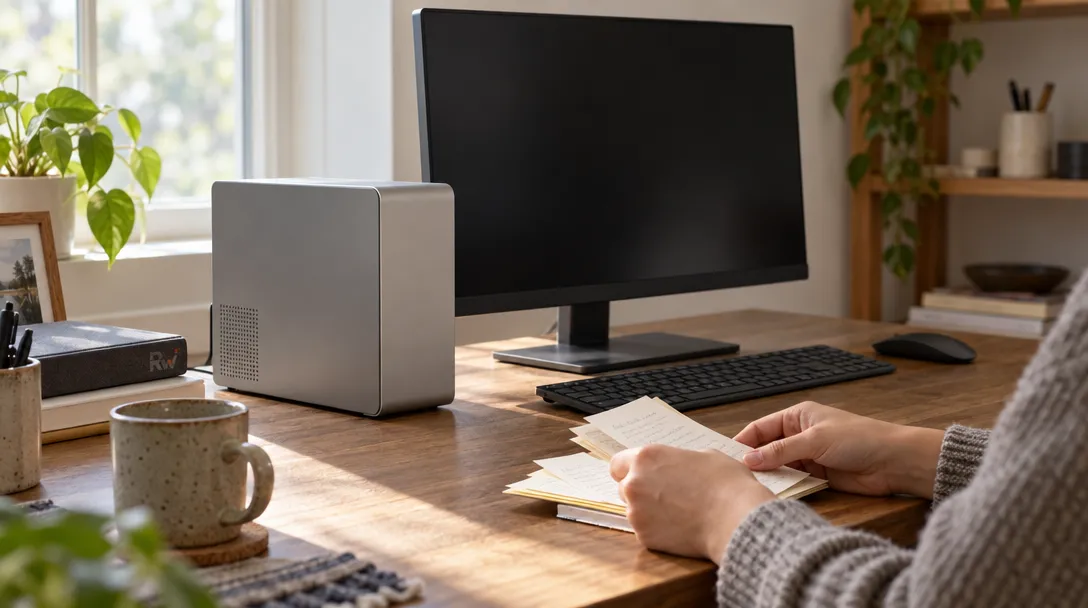
Luofei Chen introduced Oki Home on October 6th, pitching the $1,799 computer as a place to store, search and use personal digital data with AI running on hardware at home. Oki is taking $59 reservations for its launch batch and says U.S. shipping is planned for mid-December 2026.
https://x.com/Luofei_Chen/status/2107504364168597863
Chen and co-founder Aayush Tyagi are moving Oki from workplace software toward a consumer device that combines a home computer, local AI and a searchable archive of a user's digital life. Oki joined Y Combinator's Winter 2025 batch with software aimed at giving company leaders personalized updates from their teams' code, documents and messages. The new product applies a similar organizing premise to personal files and connected apps.
Chen's earlier startup experience also involved physical products. As a UC Berkeley student in the Management, Entrepreneurship, and Technology program, he co-founded Oki Karaoke with Tyagi and Noah Adriany, building soundproof booths intended for malls and public spaces. Berkeley reported in 2019 that the founders were preparing a pilot at Westfield San Francisco Centre. Oki Home is a different kind of hardware bet: a small-form-factor computer designed to sit at home and remain on.
Oki's product site lists a 2TB removable Memchip, expandable to 16TB, an NVIDIA GeForce RTX 5060 Ti with 16GB of GPU memory, 32GB of RAM and a 27-billion-parameter local model. The launch thread identifies the model as Qwen 3.8 27B and the processor as an AMD Ryzen 5 7600. Chen claimed in replies that Oki had optimized the model to generate 106 tokens per second; that performance figure is the founder's claim, not an independently verified test result.
The software is built around a timeline that organizes photos, messages, documents and other connected information, then lets users search in natural language. Oki also describes Oki Desk as an agent that can browse websites, compare options and work through multi-step tasks using the user's stored context. The computer includes a Linux environment for custom applications and user-run models. Oki says there is no cloud subscription for its local AI service.
The privacy promise has a defined boundary. Oki's FAQ says local inference and files can stay on the home device, while also warning that remote access, connected services and optional cloud models may send information outside it when a feature requires that. Remote access requires an internet connection, and Oki Home must remain powered on at home. Its privacy proposition therefore depends partly on which integrations and workflows an owner chooses; the machine is not disconnected from outside services altogether.
The $59 payment is a reservation, not the full purchase price. Oki lists the launch configuration at $1,799, with 2TB included, and says reservations are refundable. Its FAQ puts planned shipping in mid-December 2026, starting in the United States. The company has not disclosed a reservation count or production volume in the launch materials, leaving buyers without a public measure of how many units the first batch will contain.
Oki is entering a category where other companies are also selling dedicated machines for local AI. The pitch is that users can keep data and inference close to home instead of routing every task through a cloud service. Oki focuses on stitching existing personal data into one searchable context, rather than presenting the device chiefly as a general-purpose box for running local models. Whether consumers will pay $1,799 for that persistent context depends on how useful its integrations and search prove in everyday use.
For Chen, the device extends an interest in turning physical computing into a consumer experience, from karaoke booths to a home computer built around personal memory. Oki is asking customers to reserve before the first batch ships, with a substantial upfront device price and a product whose core promise depends on users connecting the services and files that make their digital lives searchable.