OpenAI says 10,000 AI agents solved Navier-Stokes in 88 hours
OpenAI released a 165-page paper and Lean files, while Clay still lists the $1M Millennium Problem as unsolved.
By Ryan Merket · Published
Primary source: X
Why it matters
A valid proof would mark a step from AI-assisted mathematics to AI-generated frontier research, while the 10,000-agent run shows the compute bill behind that leap.
OpenAI said Tuesday that an unreleased model and roughly 10,000 coordinating AI agents produced a solution to the Navier-Stokes existence and smoothness problem, a claim that would rank among the most consequential results yet attributed to an AI system.
In a thread on X and a longer research announcement, OpenAI said the agents found the result in about 88 hours. OpenAI described the underlying model as "significantly more capable" than GPT-6 Astra and said its training remains underway.
OpenAI published a 165-page analytical proof alongside a Lean 4 formalization that outside researchers can download, build and inspect. The paper argues that a three-dimensional incompressible fluid can begin at rest and develop unbounded velocity in finite time, even while its kinetic energy remains bounded and the external force applied to it stays smooth.
The Clay Mathematics Institute still labels Navier-Stokes unsolved. OpenAI also said it does not intend to claim the associated $1 million prize.
What the agents claim to have proved
The Navier-Stokes equations describe the movement of fluids, including air and water. The Millennium Problem asks whether smooth three-dimensional flows must remain smooth for all time under the specified conditions, or whether they can develop a singularity, a point at which velocity becomes unbounded.
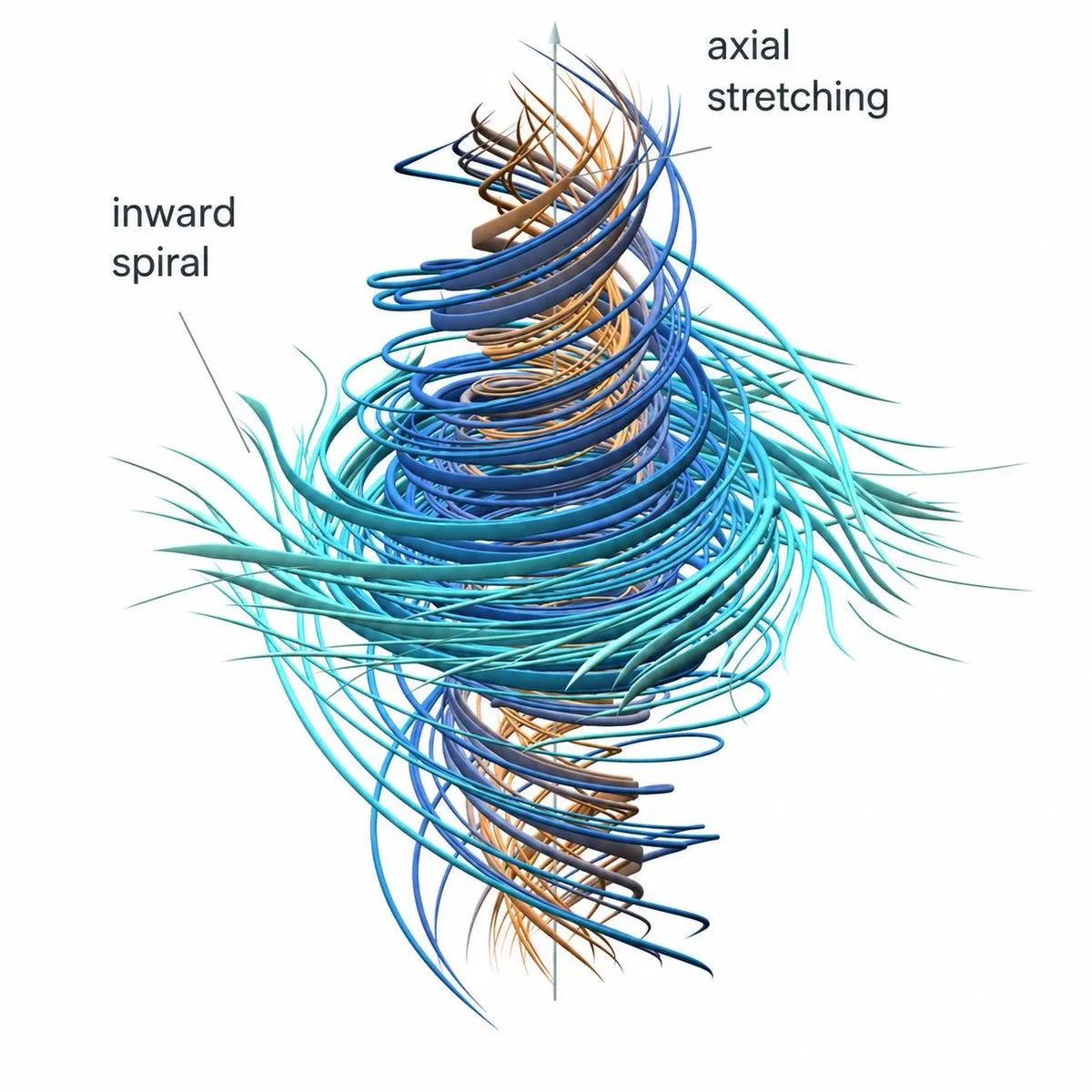
OpenAI's paper takes the breakdown route. Its construction begins with zero velocity and applies a smooth force that is compactly supported in space and time. The resulting flow forms a narrowing vortex whose radial dimension contracts faster than its length. Fluid spirals inward and stretches along the vortex's axis as its maximum velocity increases without bound.
The construction is designed so the region containing the extreme velocity becomes progressively smaller. That allows the total kinetic energy to stay bounded even as velocity diverges at the center. OpenAI says this establishes alternatives C and D in the Clay problem's official formulation, covering breakdown in both three-dimensional space and the periodic three-dimensional torus.
The released Lean repository contains separate Navier-Stokes and Euler formalizations and instructions for independent proof checking. A Lean build provides machine checking under the definitions encoded in the formalization. Mathematicians must still examine whether those definitions and theorem statements faithfully capture the Clay problem and whether the analytical paper supports the formalized result.
That review has barely started. Under Clay's prize rules, a proposed solution must appear in a qualifying publication, remain public for at least two years and receive general acceptance from the global mathematics community before Clay will consider it.
A compute-heavy search for a proof
OpenAI said it began training the unnamed model on August 28th. On September 1st, OpenAI researchers heard rumors that two Millennium Problems may have been resolved and dispatched agent groups across the remaining problems, giving separate groups different formulations and access to cached internet material and code execution.
An initial group of nearly 100 agents spent about 50 hours finding what OpenAI describes as a finite-time singularity for the unforced Euler equations, a related fluid model without viscosity. OpenAI then moved agents away from other problems and concentrated resources on Navier-Stokes.
OpenAI used Codex to consolidate useful intermediate results and distribute them among agent groups. OpenAI says the successful Navier-Stokes group involved about 10,000 concurrent agents and reached its result on September 5th. GPT-6 Astra then spent another 17 hours on Lean formalization and verification.
The scale went well beyond the headline agent count. OpenAI says the Navier-Stokes run generated 2.7 million messages and approximately 130 billion output tokens. Across the broader attempt on multiple problems, the agents produced 4.9 million messages and about 300 billion output tokens. OpenAI executives placed the computing expense in the millions of dollars during a press call, according to Axios.
Those figures are OpenAI's own accounting. OpenAI has not released the unnamed model, its benchmark results, the complete agent orchestration system or a detailed cost breakdown.
The race began with another team's work
OpenAI's timing has also produced a dispute over how the project began. OpenAI said the September 1st rumor concerned work by NYU mathematics professor Tristan Buckmaster and Anthropic researcher Levent Alpoge on a related Euler problem.
Buckmaster questioned whether OpenAI had pursued a research direction learned from the pair's private work, including interactions with OpenAI products. OpenAI said neither its researchers nor its agents viewed that work before it became public and said no specific user data was accessed to solve Navier-Stokes. OpenAI acknowledged that it cannot rule out de-identified product data having contributed to model improvement.
OpenAI completed its Lean verification on September 6th and contacted Buckmaster and Alpoge under the mistaken belief that the pair also had a Navier-Stokes result. OpenAI later determined that their work concerned forced Euler equations, while OpenAI's separate Euler construction was unforced. CEO Sam Altman said the approaches appeared different after OpenAI reviewed the public work.
The Navier-Stokes release also serves as a capability demonstration for a model OpenAI has not released and says is still improving. The proof, the Lean repository and the agent logs described by OpenAI give mathematicians concrete material to test. Whether the result closes the problem will be determined outside OpenAI, on a timeline measured in years rather than the 88 hours it took to produce the claim.