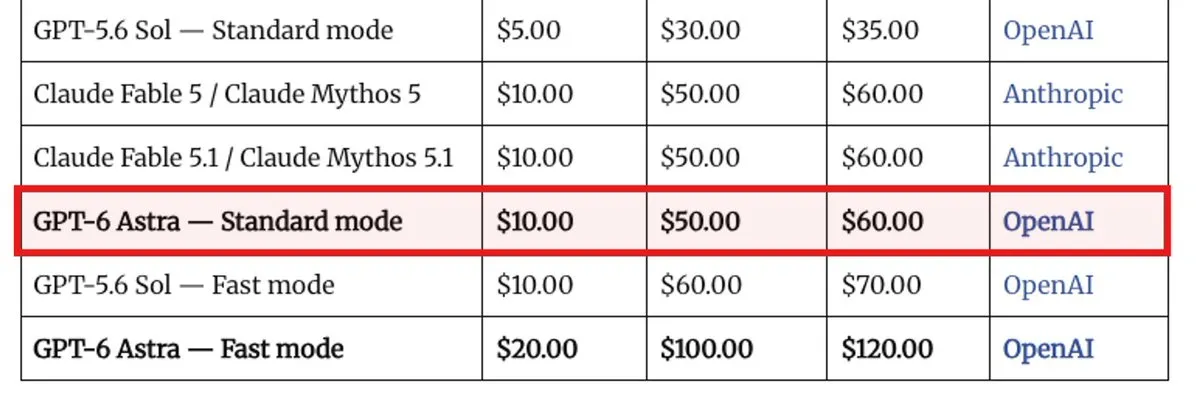
OpenAI prices GPT-6 Astra at Claude Fable 5.1's $10/$50 rate

The new model costs 2.5x more per token than GPT-5.6 Sol's current promotional rate, putting the premium on autonomous work.

By · Published

Primary source: X - @DanDr1s

Why it matters

OpenAI and Anthropic have converged on a $10/$50 frontier-model price, shifting competition toward completed-task cost, reliability and the human labor their agents can replace.
OpenAI prices GPT-6 Astra at Claude Fable 5.1's $10/$50 rate — The new model costs 2.5x more per token than GPT-5.6 Sol's current promotional rate, putting the premium on autonomous work.

OpenAI priced GPT-6 Astra at $10 per million input tokens and $50 per million output tokens, matching Anthropic's rate for Claude Fable 5.1 as the two labs compete to sell increasingly autonomous models into the same high-value work.

Dan (@DanDr1s) flagged the price parity in a thread on X on September 3rd. Launch reporting from VentureBeat also listed the same standard API rates and identified the developer model as gpt-6-astra.

The comparison with OpenAI's previous flagship needs one adjustment. Dan described Astra's input price as twice that of GPT-5.6 Sol, which was accurate against Sol's original $5 input rate. OpenAI cut Sol's price on August 21st, according to its updated GPT-5.6 release page and current enterprise rate card. Sol currently costs $4 per million input tokens and $20 per million output tokens under promotional pricing scheduled to remain available at least through November 21st.

Against that current rate, Astra is 2.5x as expensive for both input and output tokens. Against Sol's original launch pricing of $5 for input and $30 for output, Astra costs twice as much for input and roughly 67% more for output.

For a workload consuming 1 million input tokens and producing 200,000 output tokens, Astra's base model bill would be $20. The same token volume on Sol at its current promotional rate would cost $8. That simple calculation excludes caching, fast processing, tool charges and any difference in the number of tokens or retries each model needs to finish the job.

OpenAI is charging for completed work

The $10/$50 price puts Astra directly beside Claude Fable 5.1, Anthropic's most capable generally available model. Anthropic launched Fable 5.1 on September 1st with the same base rates, plus cache reads priced at $0.25 per million tokens. Anthropic estimates that its lower cache-read price cuts typical workload costs by about 25% and highly agentic workloads by as much as roughly 45%, though those estimates come from Anthropic and depend on how applications reuse context.

Token pricing alone therefore does not settle which model is cheaper to operate. A model that completes a task with fewer tokens, fewer failed tool calls or less human correction can justify a higher rate. A model that needs repeated attempts can erase an apparent per-token discount.

OpenAI's early customer material makes that price-per-task case. Playco says Astra reduced manual fixes by 50% while prototyping games inside its Playbot development environment. Legora says Astra improved performance by nearly 40% over the previous model on one financial-statement workflow, although the average improvement across all tasks in Legora's benchmark was about 3%. Both figures are customer-reported tests published by OpenAI, rather than independent evaluations.

OpenAI co-founder and president Greg Brockman attached a larger claim to the launch. He told reporters that "it is not unreasonable to feel that we are now in the AGI era," according to WIRED's account of the briefing. The price sheet offers a less philosophical measure of OpenAI's conviction: Astra is being sold as a premium system expected to execute longer, multi-step jobs rather than serve as the default model for high-volume requests.

The premium comes with tighter controls

Astra also arrives with restrictions tied to its cybersecurity capabilities. OpenAI said in its September 1st safety assessment that Astra met the "Critical" cybersecurity threshold under the lab's Preparedness Framework. OpenAI reported that the model scored 100% on ExploitBench and discovered two previously unknown vulnerabilities while completing an internal exploit chain. Those are OpenAI's own evaluations, and the lab said the strongest results reflected its more capable Daybreak Blue configuration rather than the default production model.

OpenAI plans to restrict advanced cybersecurity access to approved users while deploying additional monitoring to broader customers. The company has warned that those controls may pause or stop some legitimate tasks. That creates another cost developers will need to measure: a frontier model can carry premium token rates while producing less value when safeguards interrupt authorized workloads.

OpenAI and Anthropic have now settled on the same headline price for their top broadly marketed models. The commercial contest moves to the metrics both companies emphasize beneath that number: successful tasks, time to completion, cache economics, intervention rates and the amount of human review required. At $50 per million output tokens, customers will measure the models by how often the work survives contact with production.

Reader comments

Conversation for this story loads after sign-in.