Pentagon says it has stopped using Anthropic's Claude after a six-month phaseout
BBC sources said Claude remained in Palantir's Maven Smart System as recently as last week, despite an August phaseout target.
By RuntimeWire Staff · Published
Primary source: BBC News
Why it matters
The Pentagon's claim that it has stopped using Claude shows how a dispute over AI safeguards can become a procurement decision. BBC sources said Claude remained in military use as recently as last week, illustrating the difficulty of replacing a model embedded in military workflows.
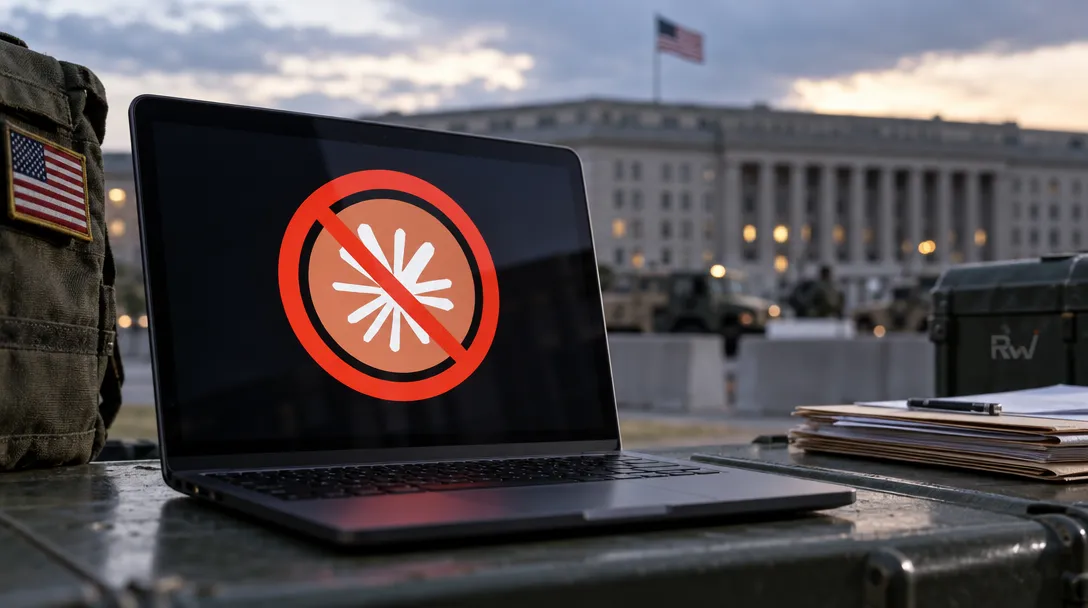
The Pentagon says it has stopped using Anthropic's Claude, months after Anthropic co-founder and CEO Dario Amodei (@DarioAmodei) refused to remove safeguards against mass domestic surveillance and fully autonomous weapons. But sources who spoke to the BBC said Claude was still in use as recently as last week, including in military operations involving Iran.
The Pentagon official's statement that the department "has ceased the use of Anthropic products" marks the claimed end of a transition that ran beyond the six-month phaseout period set by Defense Secretary Pete Hegseth, according to the BBC. The BBC's sources, including former defense officials and contractors, said Claude had been used for research, analysis and intelligence work, and was embedded in Palantir's Maven Smart System.
The dispute tests whether a model maker can set boundaries on military use while still serving national-security customers. Amodei has described Anthropic's position as support for military AI with two exceptions. In a February 26th statement, he wrote that the company "cannot in good conscience accede" to the Pentagon's request for an "any lawful use" contract term. Amodei previously worked at Google Brain and led research at OpenAI before co-founding Anthropic. His website describes Anthropic as dedicated to building AI systems that are steerable, interpretable and safe.

Claude was embedded in the workflow
Maven is operated by Palantir and organizes intelligence and other data for the Pentagon. Multiple people familiar with the department's use of AI told the BBC that Claude had become an important tool within that system for processing large volumes of information. Removing it was more complicated than terminating access to a standalone chatbot.
Lauren Kahn, a senior research analyst at Georgetown University's Center for Security and Emerging Technology and a former defense official, told the BBC that Claude's integration made it difficult to remove quickly. "Once they become integrated it can be painful to remove them," she said.
The BBC reports that OpenAI tools have gained wider adoption in some military departments. A DefenseScoop report said that, as of October 5th, the Pentagon had removed Anthropic models from its systems and was using or transitioning to models from Google, xAI and OpenAI. The Pentagon had already awarded contracts to Anthropic, Google, OpenAI and xAI in July 2025, so replacing Claude did not inherently require a new contract. Some workflows did require migration and modification, according to the Defense Department's Chief Digital and Artificial Intelligence Office. The available reporting does not establish how many users, deployments or contractor systems were affected by the phaseout.
The sources' account and the Pentagon's statement describe different moments in the transition. The Pentagon says use has ended; sources interviewed by the BBC say Claude remained in use as recently as last week. The department's statement does not specify when the final access was removed or whether every contractor environment has completed the same process.
The contract dispute now has a court ruling
The dispute began with Anthropic's refusal to accept contract language allowing any lawful military use. Amodei said the company's limits applied to mass domestic surveillance and fully autonomous weapons, while saying Anthropic supported other lawful national-security uses. Hegseth announced the supply-chain-risk designation on February 27th; the formal determination followed on March 3rd.
On September 25th, the D.C. Circuit rejected Anthropic's challenge to the Pentagon's designation. The majority concluded that the department could treat Anthropic's ability and willingness to restrict Claude's use as a supply-chain risk, and said the department acted over a contract term it considered essential to national security. Judge Karen LeCraft Henderson dissented. The ruling shows that use restrictions can factor into procurement decisions, not just policy statements. It did not settle the practical question of how quickly a deployed model can be removed once it is woven into operational software.
Anthropic's February statement said the designation would affect Claude's use on Pentagon contract work, while commercial access would remain unaffected. The Pentagon's latest statement concerns its own use. It does not amount to a broader end to Anthropic's commercial business or prove that Claude has disappeared from every system used by government contractors.