Safeworld raises $12M-plus to test whether robots can work safely around people
CMU safety researcher Ding Zhao, repeat founder Kyle Wong and engineer Simo Rachidi are building simulation tools for the risks robots encounter on real jobsites.
By RuntimeWire Staff · Published
Primary source: TechCrunch
Why it matters
Safeworld is building a testing layer for robots powered by probabilistic AI. Its commercial case depends on proving that simulated human encounters can help predict safety in real workplaces.
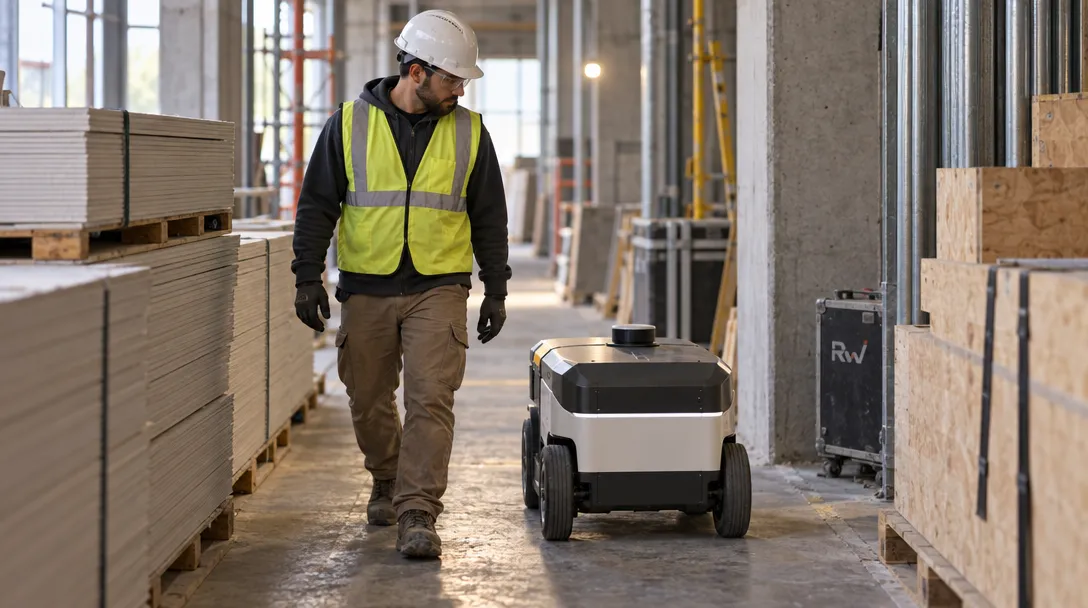
Safeworld emerged from stealth on October 5th with a seed round of more than $12 million to build a safety-testing platform for robots operating around people. Safeworld is betting that as generative AI takes on more control of physical machines, robot makers will need an independent way to test how those systems behave before they put them into workplaces and homes, according to TechCrunch's report.
The founders bring together expertise in three parts of the problem. Ding Zhao, who directs Carnegie Mellon University's Safe AI Lab, has spent much of his research career on trustworthy AI and safety in human-robot interaction. Kyle Wong brings experience building and running a startup: before Safeworld, he co-founded Pixlee, and he became CEO of Stanford's StartX accelerator in 2024. Simo Rachidi, who worked with Wong at Pixlee, brings machine-learning and cybersecurity experience from Salesforce Einstein Cybersecurity, according to his account of joining the startup.
The round was led by Shine Capital and a16z Speedrun, with Box Group, Carnegie Mellon University Endowment, Innovation Endeavors and SV Angel also investing, TechCrunch reported. The announced amount is more than $12 million; the exact total and valuation were not specified in the report. Safeworld was founded in 2025 and is based in Palo Alto, according to a16z Speedrun's company listing.

Testing for the moments a demo misses
Safeworld's proposed workflow starts with a customer's physical environment. Safeworld reconstructs a site in simulation, places a model of the robot and its actual control software inside it, then runs large numbers of scenarios with simulated people. The tests can vary visibility, human movement and other conditions that are difficult or unsafe to reproduce repeatedly with a real machine.
Wong described a factory blind corner as a typical test: how fast can a robot approach, how much stopping distance does it need, and will it detect a person carrying boxes? Safeworld also tests situations such as someone tripping or falling. The task is more complicated than evaluating a vehicle on a road, Zhao told TechCrunch, because robots encounter unstructured settings and each facility can have its own safety requirements.
Carnegie Mellon's profile describes Zhao's research as spanning trustworthy AI, robotics and safety for physical human-robot interaction. The commercial case depends on translating that expertise into usable deployment tests for operators; generating more simulation runs alone would not meet that need. Safeworld's own site describes its offering as safety testing and evaluation for robots working around people, with a focus on generating possible paths, predicting interaction risk and preserving test evidence.
Safeworld is also working with Gritt Robotics, whose robots assist workers installing photovoltaic panels at large solar farms. Gritt CTO Vishal Dugar told TechCrunch that proving a system safe through formal mathematical verification is difficult, making empirical testing necessary. The work puts Safeworld's approach near active industrial operations, though the report does not establish whether the partnership is paid, in production or producing validated safety results.
Trust is the product's harder sale
Robot makers already build internal testing tools. Safeworld's founders argue that a third party can provide a form of validation that in-house systems cannot, and potentially help companies share safety evidence. For robots controlled by probabilistic generative AI, a passing result in one scripted demo says little about what happens when visibility changes or a person unexpectedly enters the machine's path.
Safeworld will also have to show that its simulated people and facilities represent the risks of actual sites, that its results can be repeated, and that passing a test predicts safer behavior outside the simulation. TechCrunch's report describes the testing method and an early Gritt collaboration; it does not provide independent evidence of simulation-to-real-world accuracy or safety outcomes.
Wong's earlier startup experience gives Safeworld a founder who has taken a software business from formation through scale. Stanford Research Park says he founded a company as a Stanford engineering undergraduate and later joined StartX to support other founders. The Safeworld team profile describes Pixlee as having exceeded $20 million in ARR, a company-reported figure. Rachidi's return to building with Wong after years working together at Pixlee gives Safeworld an established working relationship alongside Zhao's safety research.
Safeworld's first commercial pitch is that robot manufacturers build the machines and their control systems while Safeworld aims to provide a repeatable way to look for dangerous interactions before deployment. The more robots move from controlled demos into workplaces where people have no special training to operate around them, the more valuable that evidence could become. Zhao put the deployment challenge plainly to TechCrunch: both the risk evaluation and the trust in the result have to be there before a robot can be deployed.