SpaceX says Grok Bot will use rival AI models for different tasks
Elon Musk named Claude Opus 5.5, Midjourney and Suno, but gave no details on how Grok Bot will choose providers or handle those services' costs and data flows.
By Ryan Merket · Published
Primary source: X
Why it matters
Grok Bot is built to act inside users' connected apps. Routing tasks to outside AI services could widen its capabilities, while making provider choice, data handling and user controls part of the product's trust model.
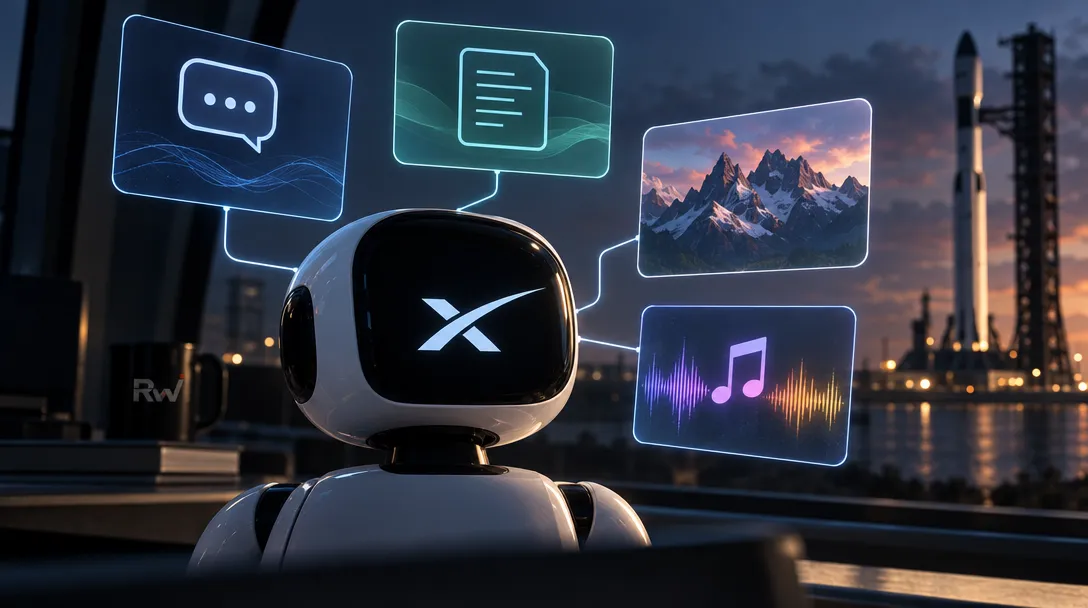
Elon Musk (@elonmusk) said on October 7th that SpaceX will let Grok Bot use outside AI services, including Anthropic's Claude Opus 5.5, Midjourney and Suno, selecting what he called the "best back end model for any given task." His post frames the policy as a way to get users a better result. It describes a direction, not a technical launch: Musk did not identify which tasks go to which provider or explain how the selection works.
The post leaves several product questions open. It connects the policy to Grok Bot, but does not say whether users can choose a model, see which service handled a task, control what information is sent to third-party APIs, or disable external-provider routing entirely. It also does not describe pricing or how SpaceX will measure whether an outside model produced a better outcome. The listed services point to a product spanning text, image and music generation, but Musk did not map them to specific Bot features.
SpaceXAI introduced the beta on August 11th as a service for delegating work to persistent AI agents. Each Bot runs on a cloud computer, can use a browser and workplace tools, and can continue working after a user steps away. SpaceXAI's examples include updating a CRM, processing invoices and reproducing a software bug. Those workflows can involve company records and credentials, so adding outside model providers makes data handling, as well as output quality, part of the routing decision.
SpaceXAI's Grok Bot documentation describes persistent cloud computers and access through paid Cursor plans or a linked SuperGrok subscription. The company's terms say Bots may access websites, execute code, modify files and communicate on a user's behalf. They also say the service may retain customer data, files, browser sessions, credentials, memory and routines in a persistent cloud environment. The terms place responsibility on customers to configure permissions and review consequential actions.
Those terms address what Bots can do and who is responsible for the actions users authorize. Musk's post does not explain how those protections apply when a Bot sends a task to an external model or creative service. An agent may need context from connected tools to complete a job, and model selection can determine which provider receives that context. The post does not specify whether data is filtered, whether customers can restrict providers, or what safeguards apply to the handoff.
Musk's new statement adds provider selection to SpaceXAI's description of Grok Bot as a persistent agent that coordinates work across apps. SpaceXAI would still control the Bot interface and its task execution, while relying on other companies' services for some outputs. That approach could let it match a task to a specialized provider, but the post offers no performance comparisons or evidence that routing improves results.
The corporate context has shifted since Grok Bot's launch. SpaceX's June 2026 prospectus says the company acquired xAI effective February 2nd, 2026, and consolidated its historical results. Musk's post therefore describes an AI product operating inside SpaceX after that acquisition, while naming outside services as potential back ends. It does not say whether the model-routing policy is limited to Grok Bot or will apply across other SpaceXAI products.
Customers still need to know which provider handles a task, what data crosses the boundary, and whether they can opt out of external-provider routing entirely. Musk announced the preference for the best tool per task; the post leaves those implementation choices open.