Startup Spotlight: Mbodi AI builds robot skills from language, demos and smaller agents
Mbodi AI founders Sebastian Peralta and Xavier Chi are betting focused AI agents can make industrial robots easier to adapt and deploy.
By RuntimeWire Staff · Published
Primary source: Y Combinator
Why it matters
Mbodi is testing whether focused AI agents can make industrial robots easier to reconfigure. Reliability and customer economics will determine whether factory pilots become repeatable deployments.
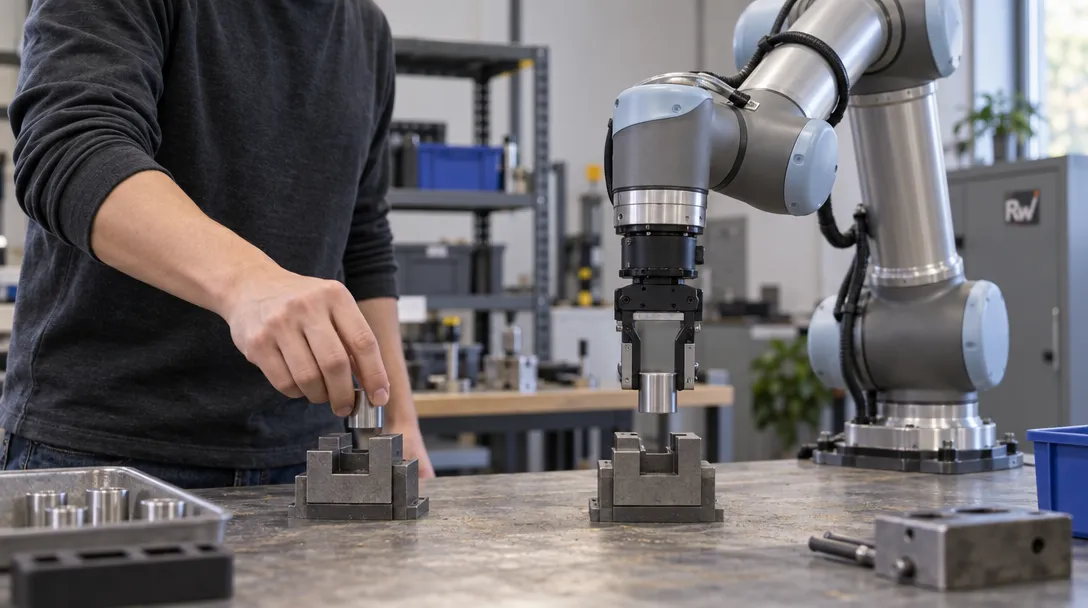
Mbodi AI's founders, Sebastian Peralta (@sebjperalta) and Xavier (Tianhao) Chi (@chitianhao), are building software that lets factory workers teach industrial robots through spoken instructions and demonstrations. The Y Combinator profile lists Mbodi in the Spring 2025 batch; the company's dated milestones since then show the challenge ahead: moving from a teaching interface to repeatable factory work.
Industrial robots can perform precise tasks, but adapting them when products, parts or workflows change often calls for specialist engineering and integration. Mbodi's proposition is that software can lower that adaptation cost by combining language models with conventional robotics tools. It assigns different parts of a job to focused agents instead of relying on one large model to control the entire process.
Two infrastructure founders turn toward physical work
Peralta's path to industrial robotics began with an unusual mix of physics, software and hands-on research. In a company post introducing Mbodi, he and Chi describe meeting as engineers at Google Public DNS. Mbodi says Peralta studied electrical engineering, computer science and physics at the University of Pennsylvania and conducted graduate research at Penn's GRASP Robotics Lab. He worked on Google Public DNS before starting the company.
Chi, whom Y Combinator lists as a founder alongside CEO Peralta, was a technical lead for Google Public DNS and studied electrical and computer engineering at the University of Illinois Urbana-Champaign, according to the founders' account. Their prior work involved internet infrastructure, where reliability and latency are central engineering concerns. Mbodi brings that orientation to a setting where robots must work outside a demonstration video.
Peralta's public biography describes a personal robotics thread alongside his infrastructure work: experimenting with robotics-transformer models and a custom robot at home. In the founders' account, the motivation was seeing robots held back by brittle code and long deployment cycles, even as generative AI improved. Peralta's YC profile gives the thesis a lighter phrasing: he is "Interested in making humans lazier." At Mbodi, the serious version is reducing how much specialist time it takes to teach a machine a changed task.
Language is the interface, not the whole system
Mbodi describes a system that takes a natural-language request or a quick physical demonstration, interprets the task, and coordinates AI agents for perception, reasoning, planning and control. In a May 2025 product account, the founders called it a cloud-to-edge system and said the agents could coordinate across different robot hardware. The company also says skills can be reused and adapted across machines and facilities.

A spoken instruction can make robot programming easier to approach, but it does not solve perception, motion planning, collision avoidance or recovery when the workpiece shifts. Mbodi says it assigns parts of that work to specialized agents and established robotics techniques. Chi described Mbodi's approach as a system built around smaller models and agentic software, rather than a single, opaque model expected to learn every task at once.
That design addresses a problem in physical AI: real-world conditions vary, and an error in production needs to be diagnosed, not simply fed back into a training loop. Chi told the Association for Advancing Automation that when a large model fails, it can be difficult to understand why; collecting more data and retraining may not be a dependable repair strategy. Smaller components may be easier to inspect and adjust, though Mbodi's public material does not establish how its commercial platform handles every failure mode.
The open-source embodied-agents repository offers a more concrete view of the engineering than the broad promise of natural-language robotics. It provides modular language, sensing and motion agents, supports multiple model backends, and includes examples for simulation and robot use. The repository describes itself as research and prototyping software, calls the project experimental, and lists limitations around learning from in-context experience and the cost of data for fine-tuning. Those disclosures apply to the open-source toolkit; they should not be assumed to describe every component of Mbodi's commercial system. They show the gap between integrating models into robot software and proving that a system can learn new work reliably on a factory line.

ABB opened a door; deployment has to earn the next one
Mbodi's first prominent industrial validation came in December 2024, when ABB Robotics named Mbodi and T-Robotics winners of its AI Startup Challenge. ABB said the two were selected from more than 100 applicants to work on conversational AI and adaptive-learning robotics. The winners received $30,000 in project funding and six months of membership in ABB's SynerLeap startup program. ABB said the companies expected to launch their first commercial applications with ABB in 2025.
In May 2025, Mbodi said it had entered a joint commercialization agreement with ABB and was rolling out real-world customer deployments. That is the company's account; ABB's challenge announcement confirms the collaboration and planned commercial application, but the public materials cited here do not establish a named end customer, deployment count or contract value. The partnership gives Mbodi a route to test its software around an established robotics supplier. Its commercial value will depend on how often the system works across jobs and sites, and whether customers pay to keep using it.
The company received another industry signal in 2026. Mbodi won the Automate Startup Challenge, selected over nine other finalists, according to A3's July 7th, 2026 report. That report also said Mbodi was working on a pilot with two large pharmaceutical companies, which Chi discussed without naming the companies. He told A3 that the startup had reached 99.96% accuracy on picking and packing tasks. The report did not define the test set, task conditions or how accuracy was calculated, so the figure is a company-reported performance claim that readers cannot independently compare with other results.
The same interview described a product change shaped by customer input: Mbodi moved its vision system onto edge devices so the system could run locally. Chi said the company was working with collaborative robots and focused on deployment, speed, throughput, flexibility and cost. Factories need a system that fits existing equipment and processes, responds to variation and justifies its integration and operating costs.
The hard part is turning a teachable robot into a product
Mbodi is entering a field where flexible, software-defined automation competes with a long industrial history of purpose-built cells and carefully programmed routines. Its approach could help with high-mix, low-volume work, where frequent changes make custom programming expensive. Those settings are demanding: the variation that makes automation valuable also increases the number of edge cases a system must handle safely and consistently.
The founders have worked on infrastructure where reliability is a core product requirement, and their stated design avoids asking one model to do every job. Production robotics adds physical consequences to software errors. Customers will want evidence about task boundaries, recovery from mistakes, safety controls, uptime and the labor or downtime saved. The company's website claims 99% uptime, while the A3 interview carries a separate 99.96% accuracy claim for picking and packing. Without measurement conditions, neither figure settles the production question.
Mbodi's public financing picture is also partial. Betaworks lists the company in its AI Camp cohort, whose companies received $500,000 each from Betaworks and syndication partners. That establishes cohort-level investment terms, not Mbodi's full funding history, valuation or ownership structure. Y Combinator is another visible institutional connection through its Spring 2025 batch.
The next proof point for Peralta and Chi is whether a worker can teach a robot a new task quickly and trust it to repeat that task as inputs and conditions change. The Automate award and ABB relationship put Mbodi in front of industrial buyers and partners. The pilots and reported accuracy offer early signs of product work, but Mbodi has yet to demonstrate dependable, paid production use at customer scale.