Volvo and Waabi put a supervised autonomous truck into Warp's Texas freight network
The Dallas-Houston operation carries customer freight to third-party facilities, with an observer still in the driver's seat.
By RuntimeWire Staff · Published
Primary source: PR Newswire
Why it matters
The operation tests whether autonomous trucks can serve the coordinated schedules and multi-customer flows of LTL freight. It puts Waabi's driving system into a real customer network while an observer remains onboard. The next measure is whether the service can reliably meet the network's schedules; this is not driver-out operation.
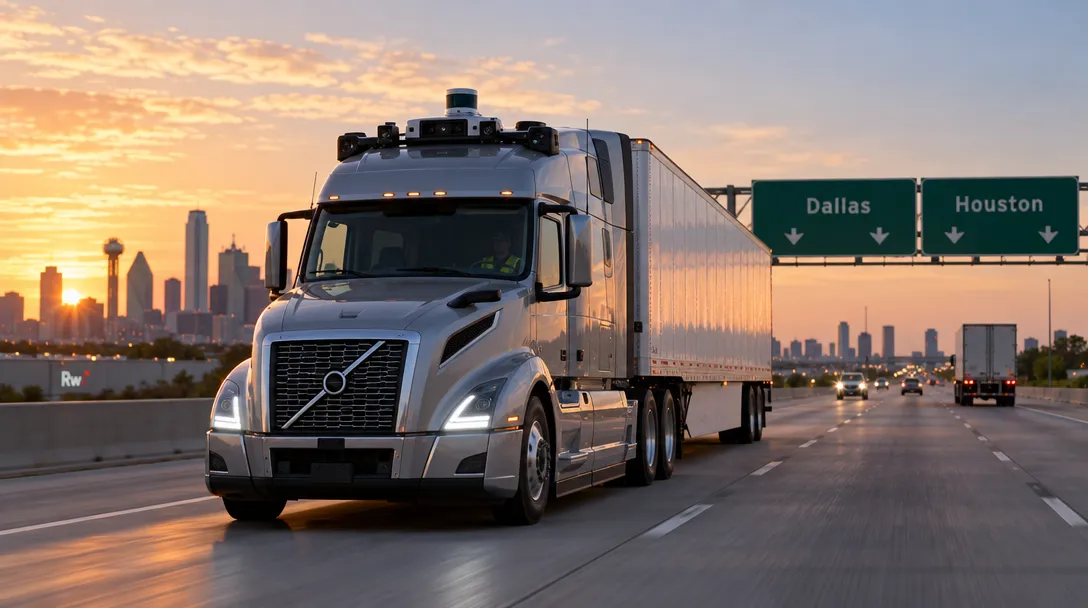
Volvo Autonomous Solutions and Waabi have started carrying Warp customer freight on the Dallas-Houston corridor, putting an autonomous truck into a live less-than-truckload network. Announced October 5th, the operation carries freight to third-party facilities beyond a closed test site. An observer remains in the driver's seat during autonomous hauls, according to the Volvo announcement.
For Raquel Urtasun, Waabi's founder and CEO, the deployment tests a central part of the company's commercial thesis: build an AI driver that can operate in the physical world and connect it to freight businesses that already move goods. Her University of Toronto biography says she led research and development at Uber's Advanced Technologies Group from 2017 to 2021 and co-founded the Vector Institute for AI; she remains a computer science professor there. Waabi describes its approach as combining an AI driving system with simulation. Urtasun has argued that simulation can expose autonomous vehicles to difficult situations that are rare or unsafe to stage on public roads.
The freight network is part of the test
The truck is a Volvo VNL Autonomous using Waabi Driver. Volvo says its autonomy-built platform includes redundancies for six safety-critical systems and is designed to integrate partners' driving systems. Volvo Autonomous Solutions, Waabi and Warp have connected it to Volvo Autonomous Solutions' Autona / freight ecosystem and Warp's network, which handles less-than-truckload (LTL) and full-truckload freight.
LTL shipments combine freight from multiple customers, then consolidate and distribute it through a network of facilities and scheduled routes. That requires more coordination than moving a single full trailer between two points. Warp coordinates shipments, capacity, routes and timing across its network. Its CEO and co-founder, Daniel Sokolovsky, built last-mile delivery company AxleHire before starting Warp. He has described the middle mile, moving goods between regions and facilities, as a constraint on delivery networks. In the company's description of its freight network, Warp presents its software and carrier network as the connective layer for that work. Warp says its network includes more than 38,000 carriers and 70-plus warehouses.

Sokolovsky said the partnership puts advanced technology into everyday freight movement, and that coordinating multiple customers' shipments lets improvements on one lane benefit a broader network. An autonomous truck is useful to a logistics provider when it fits existing pickup, consolidation and delivery schedules and completes the highway run.
The public announcement describes the first customer operation in the Volvo-Waabi partnership. It does not quantify the initial service in trucks, loads, miles or customer facilities. Volvo Autonomous Solutions and Waabi say they will use experience on the Dallas-Houston lane to prepare additional routes. The observer requirement shows that this deployment is still distinct from driver-out trucking: customer freight is moving autonomously, with a person still aboard to observe.
Waabi's financing and commercial plans
The launch follows a financing round for Waabi. In January 2026, Waabi announced a $750 million Series C co-led by Khosla Ventures and G2 Venture Partners, alongside a separate milestone-based $250 million commitment from Uber tied to a robotaxi partnership. Waabi's funding announcement also named investors including NVIDIA and Volvo Group Venture Capital. The October release says Waabi has raised more than $1.3 billion to date; that cumulative figure is the company's claim.
Waabi is pursuing autonomous trucking and robotaxis. This Texas operation puts its trucking technology to work in a partner's freight network. For Volvo, the deployment gives its autonomous truck and transport system a customer-facing use case. For Warp, it introduces autonomy into a network designed around consolidating shipments and managing delivery schedules. The test is whether the operation can keep meeting those schedules as routes and freight volume expand.
Texas already hosts competing autonomous-trucking approaches. Aurora said it began commercial driverless trucking in the state in May 2025. Volvo and Waabi's announcement describes supervised autonomous freight running through an LTL network and delivering to third-party facilities. Volvo and Waabi have yet to say when the observer will leave the cab.