Zipline brings drone delivery to Texas high school
Students at Stony Point High School watched a delivery demonstration on October 8th; Zipline says customer service starts October 9th.
By Ryan Merket · Published
Primary source: KXAN
Why it matters
Round Rock adds an Austin-area test for Zipline's consumer delivery network. Its growth depends on local service coverage, reliable operations and community acceptance, alongside aircraft performance.
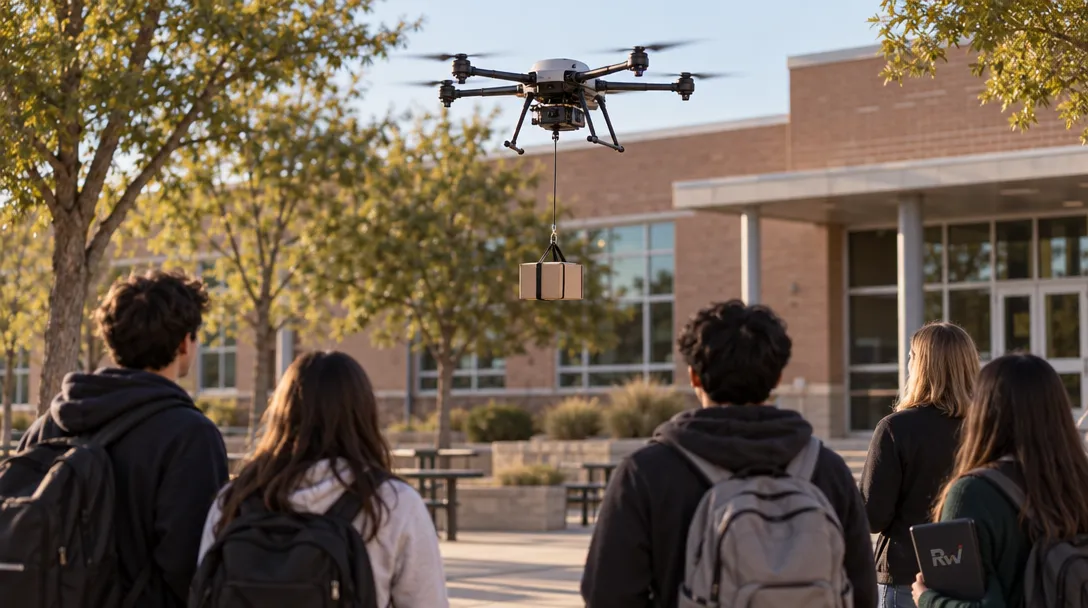
Zipline demonstrated a drone delivery at Round Rock ISD's Stony Point High School on October 8th, ahead of a planned October 9th start to customer service in Round Rock, KXAN reported. Students watched an order from a nearby business arrive by drone. The district's partnership with Zipline also includes classroom visits, career fairs and facility tours, according to the company.
The launch extends Zipline's Texas retail operations toward Austin. Axios reported in June that Zipline was expanding into the Austin area; the company already operated in Dallas and Houston. In North Texas, Zipline said in April that its Rowlett service, which began in August 2025, was delivering thousands of orders a day across the Dallas-Fort Worth area. Those figures come from Zipline, which has an interest in presenting local openings as evidence that its network can grow beyond pilot locations.
CEO and co-founder Keller Rinaudo Cliffton came to delivery by way of consumer robotics. Before Zipline, he built Romotive, whose Romo robot used an iPhone as its brain. In a Sequoia interview, Cliffton said the team realized consumer robotics was the wrong place to start; Sequoia's Alfred Lin recalled customers often stopped playing with Romo after a short time. The pivot put the founders' robotics work behind a more persistent job: moving medical supplies and other goods through a logistics network.
The demonstration showed how the consumer service works. The aircraft stays aloft as it lowers a pod on a tether; a business loads an order and the drone carries it to the customer. Zipline's Platform 2 fact sheet describes an aircraft built for home delivery, with a payload of up to 8 pounds and a stated service radius of 10 miles. The company says the aircraft can lower packages from as high as 300 feet. Those are product specifications from Zipline, not independent performance measurements for the Round Rock route.

Local availability depends on more than the aircraft. Zipline operates aircraft, delivery infrastructure and logistics software, and its model requires the company to coordinate pickup points, flights and customer handoffs. The company's fact sheet says eligible customers in existing U.S. markets can use its app to order food and retail items. KXAN's report did not specify participating Round Rock merchants or customer coverage, so the announced opening alone does not establish how broadly the service will be available locally.
Zipline's U.S. expansion follows years of medical delivery operations. The FAA says Zipline received a standard Part 135 air-carrier certificate in June 2022, allowing it to seek authority for commercial drone package delivery. The agency explains that Part 135 operators also need relevant waivers or exemptions for beyond-visual-line-of-sight flights and authorizations for their operating areas. A certificate is a regulatory prerequisite, not a blanket approval for every route.
Community acceptance is another test alongside certification. KXAN described objections to commercial drone services over noise, safety and possible effects on property values, citing criticism directed at Amazon Prime Air and other operators. Zipline says its operations have not had issues so far. The company also says its home-delivery aircraft are designed to hover high while a tethered pod descends, and claims they are quieter than cars and trucks. Local experience will show whether those design claims translate into a service neighbors accept.
The school partnership gives Zipline a second role in Round Rock: introducing students to the people and operations behind the service. That outreach may support interest in aviation and robotics careers, as the district says, while putting the new system in front of students and staff before its commercial opening. Cliffton's shift from consumer robotics to logistics now faces a local test: whether the aircraft can operate reliably and residents will accept it.