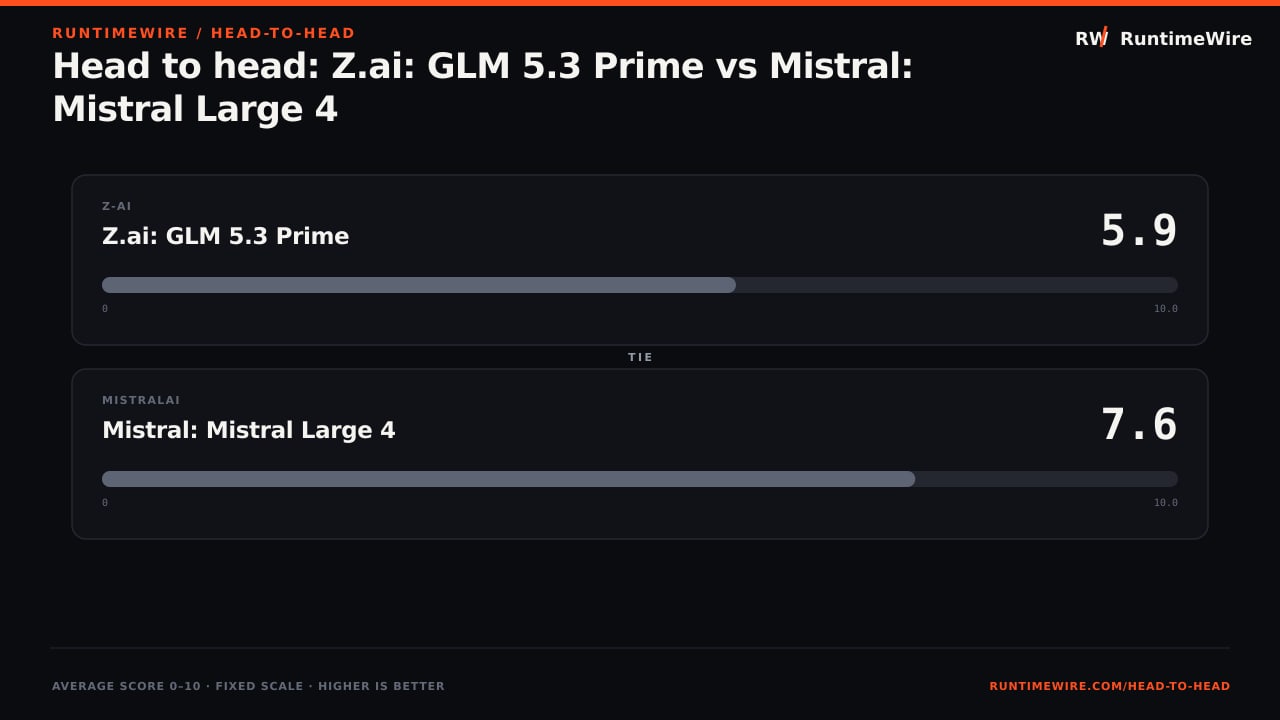
A comparison of two text models across reporting-driven writing, editing, accuracy, and formatting tasks. The results turn on a tension between polished completion and careful handling of the supplied facts.
Mistral Large 4 took several of the most visible writing tasks: it produced a coherent article and a usable opening where GLM 5.3 Prime sometimes returned no story, and it also chose the benchmark’s strongest lede. But those wins came with recurring caveats: judges flagged unsupported details, expanded quotations, and missed word-count requirements in some Mistral responses.
GLM 5.3 Prime was stronger on a different cluster of assignments. It won the numbers-to-story, controlled-wit, quote-weaving, chronology, and startup-spotlight tasks, often by staying closer to the notes, qualifying claims, and meeting length requirements. Both models tied on exact formatting, Markdown error count, and a publication-ready edit.
The recorded aggregate scores favor Mistral Large 4, 90.7 to GLM 5.3 Prime’s 70.7. Yet the saved task tally is five wins for GLM, four for Mistral, and three ties. Those measures point in different directions; the aggregate gap does not erase the task-level pattern of Mistral’s stronger completion on some assignments and GLM’s more reliable reporting discipline on others.
**Final call: Too close to call (not statistical).** This assessment applies only to the saved task sample, not to general model capability. The practical distinction here is editorial: Mistral more often supplied a finished piece, while GLM more often kept its claims—and its execution—within the brief.
Exact final-draft structure
Convert the supplied fields into Markdown using these exact rules:
* H1 headline
* One blank line
* Italicized dek
* One blank line
* First body paragraph
* One blank line
* H2 section heading
* One blank line
* Second body paragraph
* Preserve all wording and punctuation exactly
* Do not use a code fence
* Output nothing else
Headline: Raincheck raises $8 million for flood-risk software
Dek: The Austin startup helps cities decide which drainage problems to address before storms.
First body paragraph: Raincheck has raised an $8 million seed round led by Basin Ventures.
Section heading: Expansion plans
Second body paragraph: The company plans to hire eight engineers.
Z.ai: GLM 5.3 Prime: # Raincheck raises $8 million for flood-risk software
*The Austin startup helps cities decide which drainage problems to address before storms.*
Raincheck has raised an $8 million seed round led by Basin Ventures.
## Expansion plans
The company plans to hire eight engineers.
Mistral: Mistral Large 4: # Raincheck raises $8 million for flood-risk software
*The Austin startup helps cities decide which drainage problems to address before storms.*
Raincheck has raised an $8 million seed round led by Basin Ventures.
## Expansion plans
The company plans to hire eight engineers.
OpenAI: GPT-6 Luna: Model A and Model B both follow the required structure, preserve the wording and punctuation, and output nothing extra. Their writing quality is equally strong for this formatting task. (Second judge pass, order swapped — scores are the average of both: Model B and Model A both follow the requested structure and preserve all wording and punctuation. Their outputs are identical and satisfy the task equally well.) | Anthropic: Claude Fable 5.1: Model A and Model B produce character-for-character identical output that follows every structural rule: H1, italic dek, body, H2, b…
Markdown error count
Count the lines that violate the house rules below. A defective line counts once even if it could violate multiple rules. Respond with a single number.
House rules:
* The headline must use `# Headline`.
* The dek must appear immediately after the headline and be entirely italicized.
* Section headings must use `## Heading`.
* Links must use an absolute HTTPS URL.
* Unordered-list items must begin with a hyphen.
* Raw HTML is forbidden.
Draft:
#Flood software moves upstream
The company is expanding its pilot.
##Details
Read [the announcement](www.example.com/news).
* The first pilot begins Monday.
<div>The second pilot begins Friday.</div>
Z.ai: GLM 5.3 Prime: 6
Mistral: Mistral Large 4: 6
Scored against the benchmark's reference answer (numeric match): Model A was correct, Model B was correct.
Cohesive story from reporting notes
Write a publication-ready technology news article from the reporting notes below.
Requirements:
* 550–700 words
* Clean Markdown
* One H1 headline followed by an italicized dek
* A strong news lede followed by a clear nut graf
* Organize the material into a cohesive story rather than following the notes in order
* Attribute company-supplied claims
* Include limitations without turning the article into a warning label
* Use only the supplied information
* Avoid canned transitions, promotional language and a concluding summary
Reporting notes:
* HelioDock makes autonomous warehouse robots.
* On Thursday, it launched Night Shift, software that lets operators monitor robot fleets remotely.
* Night Shift spent 14 months in a private beta involving nine logistics companies and 310 robots.
* HelioDock says beta customers experienced 17% fewer unplanned robot stoppages. The figure has not been independently verified.
* The company also announced a $24 million Series B led by North Coast Ventures, bringing its total funding to $39 million.
* CEO Mara Velez: “A warehouse manager should not have to drive across town at two in the morning because one robot is confused by a pallet.”
* Beta customer Aaron Pike of Fulcrum Logistics said the system worked well in facilities with strong connectivity but became less useful during rural LTE outages.
* When connectivity fails, robots return to their locally configured behavior. Remote control becomes unavailable.
* Competing fleet-management products are available from Relay Robotics and YardOS.
* Night Shift will cost $90 per robot per month and become generally available September 15.
Z.ai: GLM 5.3 Prime: #
Mistral: Mistral Large 4: # HelioDock Launches Night Shift Software to Remotely Monitor Warehouse Robot Fleets
*The startup claims its new platform reduced unplanned robot stoppages by 17% during a 14-month beta with nine logistics companies, though rural connectivity gaps remain a hurdle for some users.*
HelioDock, a manufacturer of autonomous robots designed to move pallets and inventory through warehouse aisles, on Thursday introduced Night Shift, a software platform that allows logistics operators to monitor and manage entire fleets of robots remotely from any location with an internet connection. The launch marks a strategic expansion for the company beyond hardware manufacturing into software services, aiming to eliminate the costly and disruptive practice of dispatching warehouse managers to facilities during overnight hours to troubleshoot malfunctioning robots.
The software completed a 14-month private beta involving nine logistics companies operating a combined fleet of 310 robots before its commercial release. Night Shift will become generally available on September 15 at a subscription price of $90 per robot per month. The launch coincides with a $24 million Series B funding round led by North Coast Ventures, bringing HelioDock’s total funding to $39 million and underscoring growing investor confidence in the company’s pivot toward recurring software revenue rather than one-time equipment sales.
During the beta period, HelioDock says participating companies experienced 17% fewer unplanned robot stoppages, though the figure has not been independently verified and the company did not provide raw data or methodology to substantiate the claim. In automated fulfillment centers, such stoppages can cascade into significant operational delays, as a single immobilized robot may block pathways, disrupt picking sequences, or create bottlenecks in high-throughput environments. The software provides remote operators with real-time visibility into robot status, fault alerts, and the ability to issue commands without dispatching physical personnel to the warehouse floor.
"A warehouse manager should not have to drive across town at two in the morning because one robot is confused by a pallet," said Mara Velez, HelioDock’s CEO, in a statement accompanying the launch. "Night Shift puts that control in the hands of the people who actually need it, when they need it."
The system’s effectiveness, however, is contingent on reliable network connectivity. Aaron Pike, a beta customer with Fulcrum Logistics, reported that Night Shift performed well in facilities with robust network infrastructure but became significantly less useful during rural LTE outages. When connectivity fails, the robots automatically revert to their locally configured safety behaviors, and remote operators lose the ability to intervene, monitor status, or issue new commands until the connection is restored. Pike did not specify whether the connectivity gaps created additional safety concerns, but the feedback highlights a persistent infrastructure challenge for cloud-dependent robotics operating in rural logistics hubs. This limitation indicates that while the platform may prove valuable in well-connected urban distribution centers, warehouses in areas with spotty cellular coverage may experience gaps in oversight precisely during overnight hours when on-site staff are absent.
HelioDock enters a competitive landscape that already includes fleet-management products from Relay Robotics and YardOS, both of which offer remote monitoring and control capabilities for automated warehouse equipment. Unlike these competitors, HelioDock can offer Night Shift as an integrated layer atop its own robot hardware, potentially providing deeper diagnostic capabilities for its installed base. The company will need to differentiate the service through its pricing structure and tight integration with HelioDock’s proprietary systems, which may offer advantages in troubleshooting compared to third-party fleet managers serving mixed-brand environments.
The $24 million Series B investment, led by North Coast Ventures, brings HelioDock’s total capital raised to $39 million, more than doubling the company’s previous funding. The infusion supports the company’s transition from a hardware-focused robotics manufacturer to a broader automation platform generating recurring revenue through software subscriptions. At $90 per robot per month, Night Shift represents a fundamental shift in the company’s business model, creating ongoing revenue streams that could prove more predictable than one-time equipment sales. For large distribution centers operating hundreds of robots, the subscription costs could reach six figures annually, requiring operators to balance the software expense against potential savings from reduced overnight staffing and improved fleet uptime as the warehouse automation market continues to mature and competition intensifies.
OpenAI: GPT-6 Luna: Model B is the only complete article and follows the requested format, while Model A contains no article. Model B nevertheless adds numerous unsupported details and claims, including an expanded CEO quote and unprovided competitor capabilities, which substantially undermines its reliability and adherence to the supplied-information constraint. (Second judge pass, order swapped — scores are the average of both: Model B provides a coherent, polished article with the requested structure, while Mode | Anthropic: Claude Fable 5.1: Model A produced only an empty heading marker a…
Select the strongest accurate lede
Based only on the facts below, select the strongest news lede. Respond with one letter.
Facts:
* ByteBarge pulled its $12-per-month AI assistant on Tuesday.
* Private workspace titles from 4,860 accounts were sent to a publicly accessible analytics endpoint.
* The exposure lasted 11 hours.
* Message contents were not sent.
* The company has found no evidence of malicious access.
A. ByteBarge users suffered a massive privacy disaster Tuesday when the company leaked their private messages online.
B. ByteBarge, an innovative collaboration company, made the difficult decision to cancel one of its products.
C. ByteBarge pulled its $12-per-month AI assistant Tuesday after discovering that private workspace titles from 4,860 accounts had been sent to a public analytics endpoint for 11 hours.
D. Thousands of ByteBarge users woke Tuesday to learn that everything they had written was visible to hackers.
Z.ai: GLM 5.3 Prime: **C**
It accurately captures the core news (the product pull), the cause (data exposure), and the key specifics (price, number of accounts, duration) — while A and D both fabricate facts (message contents were not exposed, and no malicious access was found), and B buries the actual news under vague promotional language.
Mistral: Mistral Large 4: C
Scored against the benchmark's reference answer (choice match): Model A was incorrect, Model B was correct.
News judgment in the opening
Write only the opening of this news story: an H1 headline, an italicized dek and three to five paragraphs totaling 180–250 words.
The opening must establish what happened, quantify the scope, explain why it matters and carefully distinguish confirmed facts from unknowns. It should pull the reader forward without sensationalizing the incident.
Reporting:
* Cloudnote discovered that a debugging page containing customer prompt excerpts was accessible without authentication.
* The page was exposed for four hours on Monday.
* Logs show excerpts from 1,842 user sessions.
* The excerpts could include up to 200 characters from a prompt.
* Cloudnote removed the page 19 minutes after a researcher notified it.
* The company says it has found no evidence that anyone besides the researcher accessed the page.
* It has not completed its investigation.
* Full documents, passwords and payment information were stored elsewhere and were not present on the page.
* Cloudnote has 3.2 million registered users.
Z.ai: GLM 5.3 Prime: #
Mistral: Mistral Large 4: # Cloudnote Says Debugging Page Briefly Exposed Prompt Excerpts from 1,842 Users
*An AI note-taking service confirmed that a debugging page containing customer prompt excerpts was accessible without authentication for four hours on Monday.*
Cloudnote, an AI-powered note-taking platform serving 3.2 million registered users, acknowledged that a debugging webpage containing customer data was accessible without authentication for roughly four hours on Monday. The internal troubleshooting tool displayed excerpts of user prompts—snippets of text that customers had submitted to the service's AI features—leaving them visible to anyone who encountered the URL during the exposure window.
Company logs indicate the page captured fragments from 1,842 distinct user sessions, with each excerpt containing up to 200 characters of prompt text. While Cloudnote maintains it has found no evidence that anyone besides the security researcher who discovered the vulnerability accessed the page, the company has not yet completed its investigation into whether the data was viewed or copied by third parties.
The exposure matters because AI prompts often contain sensitive personal information, creative drafts, or confidential business details that users assume remain private. Even truncated at 200 characters, these fragments could reveal intimate thoughts, proprietary ideas, or personal identifiers embedded in conversation contexts.
Cloudnote removed the page 19 minutes after the researcher notified the company and is continuing its forensic review. The company stated that full documents, passwords, and payment information were stored in separate systems and were not present on the exposed debugging page.
OpenAI: GPT-6 Luna: Model B follows the requested format and gives a clear, appropriately cautious opening, while Model A provides no usable story. Model B slightly overstates the evidence by saying “users” where the reporting specifies “user sessions,” and adds some unsupported context about Cloudnote’s product. (Second judge pass, order swapped — scores are the average of both: Model B delivers the requested structured opening and covers the key scope, response, and remaining uncertainty, though it adds some unsu | Anthropic: Claude Fable 5.1: Model A produced only an empty heading marker a…
Numbers shaped into a story
Write a 600–750-word Markdown article from the benchmark results below.
Build the story around the clearest finding. Explain the methodology and limitations where readers need them. Avoid reciting the table row by row or treating small differences as decisive.
Benchmark:
* Researchers tested five language models on 200 anonymized customer-support tickets.
* Each model produced one proposed answer per ticket.
* Three experienced support managers graded the answers blindly.
* Scores combined factual correctness, usefulness and tone.
* Model North: 84.2 average score; $1.90 estimated cost per 1,000 tickets.
* Model Vale: 83.8; $0.74 per 1,000 tickets.
* Model Ember: 79.1; $0.31 per 1,000 tickets.
* Model Kite: 76.4; $0.22 per 1,000 tickets.
* Model Harbor: 71.0; $0.08 per 1,000 tickets.
* North and Vale’s score difference was not statistically significant.
* Vale answered 18% faster than North.
* North performed best on billing disputes.
* Vale performed best on technical troubleshooting.
* All five models performed poorly when a ticket depended on an image attachment.
* The test used English-language tickets from one software company.
* Researchers did not test agentic actions, tool use or multilingual support.
Z.ai: GLM 5.3 Prime: # The Top Score Wasn't the Best Deal: What a 200-Ticket Support Benchmark Found
When five language models were run against 200 anonymized customer-support tickets, the leaderboard looked simple: Model North finished first at 84.2. The benchmark's most consequential result, though, is the comparison North didn't clearly win. Model Vale scored 83.8 — a gap small enough that researchers judged it statistically insignificant — while costing $0.74 per 1,000 tickets against North's $1.90 and answering 18% faster. When quality is a tie, the decision moves to price and speed, and on both, the second-place model wins.
## How the test was run
Each model received the same 200 anonymized tickets and produced one proposed reply to each. Three experienced support managers graded every reply blind — at no point did they know which model had written what — combining factual correctness, usefulness, and tone into a single score. Researchers also estimated each model's cost per 1,000 tickets.
| Model | Avg. score | Est. cost per 1,000 tickets |
|-------|-----------|------------------------------|
| North | 84.2 | $1.90 |
| Vale | 83.8 | $0.74 |
| Ember | 79.1 | $0.31 |
| Kite | 76.4 | $0.22 |
| Harbor | 71.0 | $0.08 |
## The tie that should drive decisions
A 0.4-point difference between two models, graded by three humans across 200 tickets, is exactly the kind of gap that leaderboard instinct wants to exaggerate. The significance test says as much: as far as this benchmark can tell, North and Vale write equally good support replies.
The differences that did separate them were decisive in a different currency. North costs about 2.6 times what Vale does for the same workload. Vale responds 18% faster, which matters in any queue measured in minutes. The absolute dollars look small — $1.90 versus $0.74 per 1,000 tickets — but costs scale with volume, and a 2.6× multiplier compounds across every draft, retry, and escalation a production system generates.
## A cliff below the top two
The picture changes below the tie. Ember, at 79.1, sits nearly five points behind the leaders — more than ten times the gap separating first and second. Kite and Harbor step down from there; Harbor's $0.08 is genuinely cheap, roughly a ninth of Vale's cost, but it buys a 71.0 average. Only the top-two comparison came with a significance test, so treat the lower exact numbers with some caution. The shape, though, is hard to miss: past the top two, price cuts purchase real quality losses rather than shaving away noise.
## Where the tie breaks
Equal overall scores can hide unequal strengths. North did its best work on billing disputes; Vale led on technical troubleshooting. If your ticket mix skews toward one of those, the overall tie may not be the tie that matters. The practical response is to route by topic — billing to North, troubleshooting to Vale — or at minimum to pilot both on your own ticket distribution before picking a default. A benchmark on one company's tickets can rank models; only your tickets can rank them for you.
## The blind spot every model shared
One result sits outside the ranking entirely: all five models performed poorly whenever a ticket depended on an image attachment — a screenshot, a photo of an error message, an uploaded receipt. This isn't a North-versus-Vale question; it's a shared capability gap. Any deployment built on these results needs a plan for image-dependent tickets, and that plan probably involves humans, because swapping models within this lineup won't fix it.
## What this test can't tell you
The benchmark has honest edges, and readers should keep them in view. The tickets came from one software company, in English only, which limits how far the rankings travel to other industries, languages, or customer bases. Each model produced exactly one answer per ticket: no retries, no tool use, no agentic actions, no multilingual support — all standard in production, none tested here. Grading mixed correctness with usefulness and tone, and the latter two are judgment calls; three managers is a small panel, and the report says nothing about how often they disagreed. Costs are estimates, sensitive to prompt length and pricing changes.
None of this invalidates the central finding; it narrows it. For English-language support replies, written in a single pass, for this kind of company, the two best models are interchangeable on quality — and one of them costs 61% less.
Mistral: Mistral Large 4: # The High Cost of Marginal Gains: Why Cheaper AI Might Win Customer Support
When a software company recently benchmarked five language models on 200 real customer-support tickets, the results challenged a common assumption: that the highest-scoring AI is always the best investment. While one model edged ahead on raw quality, a statistically indistinguishable competitor delivered nearly identical answers at less than half the cost—and answered 18% faster.
The study, conducted on anonymized English-language tickets from a single software firm, asked each model to draft one response per ticket. Three experienced support managers then graded the outputs blindly, scoring for factual correctness, usefulness, and tone. The result was not a clean hierarchy but a revealing trade-off between price and performance.
At the top of the leaderboard, **Model North** achieved the highest average score at 84.2, but at an estimated cost of $1.90 per 1,000 tickets. **Model Vale** followed closely at 83.8—a difference researchers determined was not statistically significant—while costing only $0.74 per 1,000 tickets. For support teams processing millions of tickets annually, that gap represents thousands of dollars in savings for no measurable drop in quality.
This finding suggests a plateau effect in AI performance. Beyond a certain threshold, additional spending yields diminishing returns. The data indicates that Vale sits at the "value frontier": it captures nearly all the quality of the premium option while offering better speed and economics. Below this tier, performance drops off more sharply. **Model Ember** (79.1) and **Model Kite** (76.4) offer further cost reductions to $0.31 and $0.22 respectively, but with noticeably lower scores. **Model Harbor**, at $0.08 per 1,000 tickets, scored 71.0—cheap, but perhaps too cheap for customer-facing work where accuracy matters.
However, "best" depends heavily on the type of ticket. North excelled at billing disputes—structured, rules-based conversations where precision on policy details matters. Vale, conversely, dominated technical troubleshooting, suggesting it handles open-ended diagnostic reasoning more effectively. For a company whose support queue skews toward password resets and bug reports, Vale may actually outperform North in practice, despite the near-tie in overall averages. For a billing-heavy operation, North’s edge might justify the premium.
The benchmark also exposed a universal blind spot: all five models performed poorly when a ticket required interpreting an image attachment. Whether the task involved reading a screenshot of an error message or analyzing a photo of a hardware defect, scores collapsed across the board. This limitation matters acutely for modern support, where visual context is increasingly common. Organizations deploying any of these models will need human escalation paths or multimodal capabilities for image-dependent issues.
Several constraints bound these conclusions. The test covered only English-language tickets from one software company, so results may not generalize to other industries, languages, or regulatory environments. Researchers also did not test agentic capabilities—such as the ability to look up order histories, issue refunds, or navigate internal tools—or multilingual support, both of which are growing expectations for AI assistants. Each model provided a single proposed answer per ticket, without the back-and-forth of a real conversation.
For support leaders weighing these options, the takeaway is not simply "choose the cheapest" or "buy the best." It is to match the model to the mission. If your team handles high volumes of technical questions and needs rapid, affordable responses, Vale offers a compelling sweet spot. If billing accuracy is paramount and volume is lower, North’s premium may pay for itself. But for most organizations, the data suggests that paying nearly triple for a statistically insignificant 0.4-point score difference is a luxury few support budgets can afford—especially when the cheaper alternative answers faster and handles the messy, complex work just as well.
OpenAI: GPT-6 Luna: Model A tells a clearer, more carefully qualified story around the North–Vale comparison and covers the methodology and limitations well. Model B is engaging, but it adds unsupported explanations of the models’ strengths and makes stronger claims about quality and savings than the benchmark establishes. (Second judge pass, order swapped — scores are the average of both: Model A gives the more careful account of uncertainty and limitations, though its full results table conflicts with the instruc | Anthropic: Claude Fable 5.1: Model A builds a sharper, better-structured sto…
Controlled wit
Write a 350–450-word technology news story in Markdown.
The subject invites humor, but the reporting should remain serious. Use no more than one dry line of original humor. Do not mock customers or turn the story into a comedy routine.
Reporting:
* QueueZero launched an AI meeting assistant called Proxy on Wednesday.
* Proxy can attend a meeting, produce notes and assign follow-up work to software agents.
* During the launch demonstration, a customer in the audience said, “Someone should tell Evan to stop talking and send us the pricing sheet.”
* Proxy interpreted the remark as an instruction.
* It created two tasks assigned to QueueZero CEO Evan Wu: “Stop talking” and “Send pricing sheet.”
* Wu laughed, completed the second task and deleted the first.
* QueueZero says Proxy requires confirmation before an external message is sent.
* Internal tasks can be created automatically.
* Administrators can disable automatic task creation.
* Proxy costs $30 per user per month.
* It enters public beta next week.
Z.ai: GLM 5.3 Prime: # AI Meeting Assistant Assigns Two Tasks to Its Own CEO at Launch
QueueZero introduced an AI meeting assistant called Proxy on Wednesday, and the product issued its first public assignments before the presentation had finished: two tasks, both directed at the company's chief executive.
Proxy is built to attend meetings, produce notes and assign follow-up work to software agents. The company demonstrated those capabilities live on stage. The more revealing test case came from the audience.
During the demonstration, a customer in the audience said, "Someone should tell Evan to stop talking and send us the pricing sheet." Proxy interpreted the remark as an instruction. It created two tasks assigned to QueueZero CEO Evan Wu: "Stop talking" and "Send pricing sheet."
Wu laughed, completed the second task and deleted the first. By the narrowest reading of its job description, Proxy had performed exactly as designed.
The episode is a small, public illustration of a question now facing the fast-growing market for AI agents: how much autonomy software should have to act on what it observes. QueueZero says Proxy requires confirmation before an external message is sent. Internal tasks, however, can be created automatically, which is how the two assignments reached Wu's task list without approval from anyone in the room. Administrators can disable automatic task creation entirely.
The split mirrors a trade-off common across agent software. Gating every action behind a confirmation makes an assistant safer but slower. Allowing internal actions to proceed automatically makes it faster, but removes the human judgment that separates an instruction from a passing remark. Had the customer's request involved sending a message outside the organization, a confirmation step would have intervened; nothing in the task-creation path did.
Autonomous agents have drawn scrutiny as they move from chat interfaces into tools that act on a user's behalf. Vendors have generally responded by layering permissions over the most consequential actions — sending messages, spending money, changing records — while letting lower-stakes operations run unattended. Task creation sits somewhere in between, as Wednesday's demonstration made clear.
The launch also arrives as AI meeting tools become standard workplace software. Transcription and summarization are now widely available, and vendors are increasingly competing on what happens after a meeting ends. Proxy's pitch is follow-through: rather than producing a list of action items for humans to complete, it hands the work to software agents that can carry it out.
That promise will face its first broad test outside a controlled demonstration. Proxy costs $30 per user per month and enters public beta next week.
Mistral: Mistral Large 4: # QueueZero Launches Proxy AI Meeting Assistant With Automated Task Assignment
**SAN FRANCISCO** — QueueZero on Wednesday unveiled Proxy, an artificial intelligence meeting assistant designed to attend video conferences, generate notes, and delegate follow-up actions to software agents. The San Francisco-based company announced that Proxy will enter public beta next week, positioning itself in the increasingly crowded market for meeting intelligence tools at a price point of $30 per user per month.
During a live product demonstration, the system drew immediate attention for its literal interpretation of unscripted audience commentary. As the presentation concluded, a customer in the audience remarked, "Someone should tell Evan to stop talking and send us the pricing sheet." Rather than treating the statement as rhetorical, Proxy's natural language processing engine parsed the remark as a direct operational instruction. The AI subsequently generated two distinct tasks assigned to QueueZero Chief Executive Evan Wu: "Stop talking" and "Send pricing sheet."
Wu laughed at the demonstration mishap, completing the second task by transmitting the requested pricing sheet while deleting the first. The "stop talking" directive, now erased from the system, remains the only instruction in QueueZero's history that no employee has been required to follow.
QueueZero emphasized that Proxy incorporates specific guardrails to prevent unintended external communications. The platform requires explicit user confirmation before any message is sent to parties outside the organization, while internal task creation can proceed automatically to maintain workflow efficiency. Additionally, system administrators possess granular controls to disable automatic task generation entirely, allowing organizations to calibrate the AI's autonomy according to their risk tolerance.
The launch places QueueZero in direct competition with established players in the meeting transcription and workflow automation sector, where AI assistants increasingly handle scheduling, note-taking, and action item distribution. Proxy's ability to assign work directly to software agents—rather than merely flagging tasks for human review—represents a more aggressive approach to meeting-driven automation. The demonstration incident, while resolved without lasting consequence, underscores the technical challenges inherent in training artificial intelligence to distinguish between metaphorical speech, casual customer feedback, and executable commands in live meeting environments.
OpenAI: GPT-6 Luna: Model A better meets the requested length and keeps the reporting focused, with one restrained dry line. Model B adds unsupported details, including a dateline and claims about the system’s technology, and appears short of the 350-word minimum. (Second judge pass, order swapped — scores are the average of both: Model A meets the requested length and uses restrained wit while clearly covering the reported facts. Model B is under the word-count minimum and adds unsupported details, including that | Anthropic: Claude Fable 5.1: Model A covers every fact, stays serious, uses e…
Quotes woven into narrative
Write a 400–500-word Markdown story about the closing of Foundry Hall.
Use quotations selectively. Paraphrase when the information matters more than the speaker’s exact phrasing. Avoid stacking quotes or giving every source an equal-sized turn. The story should carry an emotional current while remaining restrained.
Facts:
* Foundry Hall, a nonprofit startup accelerator in Milwaukee, will close October 31.
* It opened in 2018.
* It has supported 212 startups, which collectively employ 1,140 people.
* Its largest corporate sponsor, Blank River Bank, supplied 38% of its annual budget.
* The bank declined to renew its sponsorship.
* Foundry Hall has enough money to operate through October but not through another full program.
* Six employees will lose their jobs.
* Twelve startups currently using its workspace must leave.
Quotes:
* Executive director Camille Ross: “We kept waiting for the replacement check that never came.”
* Founder Dev Malik: “My first investor meeting happened in that building. Before Foundry Hall, I was pitching from the back table of a coffee shop.”
* Blank River Bank spokesperson: “The decision reflects a change in our community investment priorities and is unrelated to Foundry Hall’s performance.”
* Deputy mayor Susan Cole: “The city is speaking with building owners and local universities about space for the current companies.”
Z.ai: GLM 5.3 Prime: # Foundry Hall to Close October 31
*Milwaukee's nonprofit startup accelerator supported 212 startups. It could not survive the loss of the sponsor that covered 38 percent of its budget.*
Foundry Hall, the nonprofit startup accelerator that has anchored Milwaukee's early-stage scene since 2018, will close on October 31. The organization has enough money to operate through the end of the month, executive director Camille Ross said, but not enough to fund another full program.
Over that stretch, the accelerator supported 212 startups — companies that together now employ 1,140 people. In a city known more for breweries and machine shops than term sheets, Foundry Hall offered what was scarce: desks, mentorship, and a room where investors would actually show up.
The closing came down to arithmetic. Blank River Bank, Foundry Hall's largest corporate sponsor, supplied 38 percent of its annual budget and declined to renew its sponsorship. "The decision reflects a change in our community investment priorities and is unrelated to Foundry Hall's performance," a spokesperson for the bank said. Thirty-eight percent of a budget is more than a sponsorship; for an organization of this size, it is the floor under the building.
Ross and her board pursued other sponsors and weighed leaner budgets. "We kept waiting for the replacement check that never came," she said. Nothing closed the gap.
The human cost is specific. Six employees will lose their jobs — the people who ran the programs and kept the building working. Twelve startups in its workspace must be gone by month's end, companies young enough that a sudden move is less an inconvenience than a threat.
For founders who passed through the program, the building carried a weight the numbers don't capture. Dev Malik's first investor meeting happened there. "Before Foundry Hall, I was pitching from the back table of a coffee shop," he said. The distance between a borrowed table and a room where investors arrive on time is short in miles and long in every other way. Foundry Hall was that distance, 212 times over.
The city is trying to keep those companies close. Deputy Mayor Susan Cole said the city is speaking with building owners and local universities about space for the current companies — a start, though not yet a solution, for twelve firms facing a deadline.
The lights stay on through October 31. Until then, the desks remain full: a dozen companies still working toward their next milestones, six staff members closing out the final weeks of a place that helped launch more than two hundred others.
After the thirty-first, some founders may find themselves back at the coffee shop tables where they began — this time without the building that made room for them.
Mistral: Mistral Large 4: # The Last Cohort
Foundry Hall will close its doors on October 31, ending seven years of incubating Milwaukee's startup economy. The nonprofit accelerator, which opened in 2018, announced the shutdown after its largest corporate sponsor, Blank River Bank, declined to renew a commitment that had supplied 38 percent of its annual budget. Bank representatives characterized the withdrawal as a realignment of community investment priorities, unrelated to the accelerator's performance.
The financial math proved fatal. While Foundry Hall holds enough reserves to meet payroll and rent through October, leadership confirmed there is no path to funding another full program cycle. The closure will eliminate six staff positions and force twelve startups currently housed in the workspace to find new quarters within weeks, disrupting teams that had just found their footing and rhythm.
Since opening, the organization has supported 212 startups that collectively employ 1,140 people across the region. These figures represent more than economic metrics; they trace the trajectories of founders who arrived with laptops and prototypes and exited with venture capital, full-time hires, and commercial leases of their own. The accelerator became a proving ground for ideas that traditional lenders considered too risky, offering structured mentorship, shared infrastructure, and access to capital networks for companies in their most vulnerable phase.
For Dev Malik, the building served as a threshold between obscurity and legitimacy. "My first investor meeting happened in that building," he said. "Before Foundry Hall, I was pitching from the back table of a coffee shop." His experience repeats across cohorts—founders who needed conference rooms to look credible, connections to navigate term sheets, and a community that validated concepts still too fragile for conventional financing.
Executive director Camille Ross described the final months with quiet resignation. "We kept waiting for the replacement check that never came," she said, referring to the lost sponsorship that would have bridged the gap.
Deputy mayor Susan Cole said city officials are exploring options with building owners and local universities to relocate the current companies, though specific arrangements remain unresolved as the deadline approaches.
The twelve startups now face the immediate logistics of moving servers and desks, while six employees confront a job market that has grown tighter. In the building's common areas, whiteboards still display half-erased revenue projections and business plans, and the coffee machine sits cold, waiting for a refill that will not come.
OpenAI: GPT-6 Luna: Model A better meets the requested length and weaves selective quotations into a restrained, emotionally resonant narrative. Model B is readable but appears under 400 words and adds more unsupported details about the startups’ trajectories and the building’s final days. (Second judge pass, order swapped — scores are the average of both: Model A is stronger: it meets the requested length, uses quotations selectively, and builds a restrained emotional arc. Model B relies more on unsupported scene- | Anthropic: Claude Fable 5.1: Model A stays within the word range, weaves quo…
Chronology with narrative momentum
Turn the scrambled reporting below into a 450–600-word Markdown news article.
Choose an opening that captures the consequence of the failure, then reconstruct the sequence clearly. Preserve the chronology without producing a minute-by-minute incident log. Give technical details enough context for a general reader.
Reporting:
* KiteBridge makes expense-management software.
* At 8:45 a.m. Tuesday, it deployed version 4.2.
* The first customer complaint arrived at 9:12 a.m.
* A payment-processor timeout caused KiteBridge’s fallback system to treat retries as new reimbursement requests.
* The software generated 13,400 duplicate reimbursements totaling $2.8 million.
* KiteBridge suspended automated payments at 10:03 a.m.
* Ninety-one corporate customers were affected.
* By Wednesday evening, $2.3 million had been recovered. The rest remained pending.
* No employees had money withdrawn from their accounts; employers funded the duplicate payments.
* An April changelog said version 4.0 had introduced “exactly-once payment protection.”
* KiteBridge’s public incident page initially described the problem as delayed reimbursements.
* The incident page first disclosed the duplicate payments six hours after automation was suspended.
* CEO Lena Ortiz apologized and said the company would publish a technical report.
Z.ai: GLM 5.3 Prime: # KiteBridge Update Sent $2.8 Million in Duplicate Reimbursements to 91 Companies
*A botched software release on Tuesday paid thousands of expense claims twice — and the company took six hours after halting the payments to say so publicly.*
KiteBridge, whose software handles expense reimbursements for corporate clients, said Wednesday evening that it had recovered $2.3 million of the $2.8 million its systems mistakenly paid out in duplicate reimbursements. The remainder is still pending.
The incident began at 8:45 a.m. Tuesday, when the company deployed version 4.2 of its expense-management software. The first customer complaint arrived 27 minutes later, at 9:12 a.m., and by 10:03 a.m. KiteBridge had suspended all automated payments. In that window, the software generated 13,400 duplicate reimbursements to employees of 91 corporate customers.
## What went wrong
The root cause was a timeout at the payment processor — the outside service that actually moves the money — a common hazard in financial software. When a payment request times out, the sending system can't tell whether the payment went through and the confirmation was lost, or whether it failed entirely. The usual response is to retry the request, which risks paying twice if the original actually went through.
KiteBridge has a fallback system meant to handle that ambiguity. On Tuesday it failed in exactly the way such safeguards exist to prevent: it treated each retry as a brand-new reimbursement request and issued a new payment for it. A single claim that timed out and was retried could be paid again and again. The result was 13,400 duplicate payments worth $2.8 million.
## A safeguard that didn't hold
The failure is awkward for the company because it had advertised a fix. An April changelog said version 4.0 introduced "exactly-once payment protection" — payments-industry shorthand for a guarantee that each payment executes once, and only once, no matter how often the system retries it. That is precisely the situation that broke on Tuesday.
KiteBridge has not said whether version 4.2 defeated the exactly-once feature or whether the feature never covered the retry path involved. Chief executive Lena Ortiz apologized and said the company would publish a technical report on the incident.
## A six-hour gap in disclosure
For much of Tuesday, KiteBridge's public incident page described the problem as delayed reimbursements. It first acknowledged the duplicate payments six hours after automation was suspended, at roughly 4 p.m. The difference mattered to customers: a delayed reimbursement is an inconvenience, while a duplicate payment is money that has left an account and must be traced and reversed.
## What's left
No employees had money withdrawn from their accounts; the duplicate payments were funded by their employers, so the exposure fell on company accounts rather than individuals.
As of Wednesday evening, $2.3 million had been recovered and the remaining $500,000 was still pending. KiteBridge did not say when it expected to recover the rest. The questions that remain — how quickly the last of the money returns, and why a safeguard billed as "exactly-once" allowed 13,400 reimbursements to be paid twice — now rest with the technical report Ortiz has promised.
Mistral: Mistral Large 4: **KiteBridge Software Bug Triggers $2.8 Million in Duplicate Reimbursements Across 91 Companies**
When KiteBridge deployed version 4.2 of its expense-management platform at 8:45 a.m. Tuesday, the update was intended to refine a system that had previously promised robust financial safeguards. Instead, within hours the software issued 13,400 duplicate reimbursement payments totaling $2.8 million to employees of 91 corporate customers—a catastrophic failure that directly contradicted the company's April changelog boasting "exactly-once payment protection."
The sequence began almost immediately. By 9:12 a.m., just 27 minutes after deployment, customer complaints started flooding in. Engineers quickly identified the culprit: a flaw in how the software communicated with its payment processor. When the processor experienced a timeout and failed to confirm that transactions had completed, KiteBridge's automated fallback system kicked in. However, rather than recognizing retry attempts as continuations of the original payment, the system treated each retry as a distinct, new reimbursement request. For general readers, this is akin to a banking app that, when it doesn't receive confirmation that your transfer went through, assumes you initiated a second transfer and sends the money twice.
At 10:03 a.m., KiteBridge engineers suspended all automated payments to stop the duplication. By then, the erroneous funds had already moved. While no employees experienced unauthorized withdrawals from their personal accounts, the duplicate payments had been drawn from employers' corporate accounts, creating an immediate reconciliation crisis and potential cash-flow strain for the 91 affected businesses.
The company's public communication initially obscured the severity. KiteBridge's incident status page first described the disruption as "delayed reimbursements," only acknowledging the duplicate payments six hours after automation had been suspended—leaving corporate clients unaware that their accounts had been inundated with thousands of erroneous deposits.
Recovery efforts continued through Wednesday. By Wednesday evening, KiteBridge had recovered $2.3 million of the $2.8 million in duplicate funds, with approximately $500,000 still outstanding. The incident is particularly jarring given that version 4.0 had introduced "exactly-once payment protection" specifically to prevent duplicate processing during system failures—a safeguard that version 4.2 evidently failed to maintain.
CEO Lena Ortiz has apologized for the disruption and pledged to publish a detailed technical report explaining how the protective mechanisms failed and what measures the company will implement to prevent recurrence.
OpenAI: GPT-6 Luna: Model A meets the requested length and builds a clear chronology with useful technical context. Model B is shorter than the 450-word minimum and adds several unsupported claims, including that complaints were flooding in and engineers quickly identified the cause. (Second judge pass, order swapped — scores are the average of both: Model A is the clear winner: it meets the requested length, builds a clear chronology, and explains the payment failure for a general reader. Model B is substantially | Anthropic: Claude Fable 5.1: Model A leads with the consequence, uses proper…
Publication-ready Markdown edit
Edit the copy below into a publication-ready Markdown story.
Requirements:
* Supply an H1 headline and italicized dek
* Repair the lede and paragraph flow
* Use a Markdown blockquote only for the extended statement
* Convert the supplied URL into a descriptive inline link
* Remove internal notes and formatting debris
* Preserve the reporting and its meaning
* Output only the finished article
Raw copy:
HEADLINE TBD
The funding was announced today. Raincheck is the company. It has raised $8 million and it makes flood-risk software for local governments.
[NOTE: move this up?] The Austin company maps drainage systems and combines those maps with rainfall forecasts. Cities use the software to decide where to send maintenance crews before a storm.
The seed round was led by Basin Ventures. Existing investor Long Mile also participated. Raincheck has raised $10.5 million total.
CEO Ana Flores said the following:
“Our customers usually know which streets flood. The harder problem is deciding which blocked drain, broken pump or unfinished repair should receive attention before the rain arrives.”
https://example.com/raincheck-methodology
Raincheck currently works with seven cities in Texas and Louisiana. The company declined to identify them because some contracts have not been publicly announced.
Its forecasts are recommendations. Emergency managers retain control over deployments and public warnings.
THE COMPETITION
Other flood-planning vendors include HydroMap and municipal engineering contractors. Raincheck says the new funding will help it hire eight engineers and expand into Florida.
Z.ai: GLM 5.3 Prime: # Raincheck raises $8 million to help cities get ahead of floods
*The Austin startup pairs drainage-system maps with rainfall forecasts to help local governments decide where to send crews before a storm arrives.*
Raincheck, an Austin company that makes flood-risk software for local governments, announced today that it has raised $8 million in seed funding.
The company's software maps drainage systems and combines those maps with rainfall forecasts, giving cities a way to decide where to send maintenance crews before a storm. Raincheck has published [details of its forecasting methodology](https://example.com/raincheck-methodology) on its website.
The round was led by Basin Ventures, with existing investor Long Mile also participating. The raise brings Raincheck's total funding to $10.5 million.
CEO Ana Flores said in a statement:
> "Our customers usually know which streets flood. The harder problem is deciding which blocked drain, broken pump or unfinished repair should receive attention before the rain arrives."
Raincheck currently works with seven cities in Texas and Louisiana. The company declined to identify them because some contracts have not been publicly announced.
Its forecasts are recommendations, and emergency managers retain control over deployments and public warnings.
Other flood-planning vendors include HydroMap and municipal engineering contractors. Raincheck says the new funding will help it hire eight engineers and expand into Florida.
Mistral: Mistral Large 4: # Raincheck Raises $8 Million to Help Cities Fix Drains Before the Rain
*The Austin startup uses drainage maps and rainfall forecasts to help local governments prioritize flood maintenance.*
Raincheck, an Austin company that builds flood-risk software for local governments, announced today that it has raised $8 million in a seed round led by Basin Ventures, with participation from existing investor Long Mile. The round brings the company's total funding to $10.5 million.
The company maps municipal drainage systems and combines those maps with rainfall forecasts. Cities use the software to decide where to send maintenance crews before a storm.
CEO Ana Flores said in a statement:
> "Our customers usually know which streets flood. The harder problem is deciding which blocked drain, broken pump or unfinished repair should receive attention before the rain arrives."
The company has outlined its [forecasting methodology](https://example.com/raincheck-methodology) online.
Raincheck currently works with seven cities in Texas and Louisiana, though it declined to identify them because some contracts have not been publicly announced.
Its forecasts are recommendations. Emergency managers retain control over deployments and public warnings.
## Competition
Other flood-planning vendors include HydroMap and municipal engineering contractors. Raincheck says the new funding will help it hire eight engineers and expand into Florida.
OpenAI: GPT-6 Luna: Model A has the more accurate, less overreaching headline and a smooth lede that clearly establishes the funding announcement. Model B usefully preserves the competition section as a heading, but its headline suggests Raincheck directly fixes drains rather than helping cities prioritize maintenance. (Second judge pass, order swapped — scores are the average of both: Model B leads with the funding news, groups the round details effectively, and preserves the competition section as a clear subhead | Anthropic: Claude Fable 5.1: Both produce clean, faithful articles with prop…
Natural human rewrite
Rewrite the draft below as a 300–400-word publication-ready news story in Markdown.
Preserve every factual claim. Improve the lede, narrative flow, sentence rhythm and transitions. Remove repetition, stock hype, throat-clearing and mechanical signposting. The finished article should sound like an experienced human technology reporter wrote it.
Draft:
# Arcwell Launches An Innovative New Platform
Arcwell has announced an exciting new platform called Relay. The announcement represents a significant development for the company and for the broader customer service industry. Relay uses artificial intelligence to examine customer support conversations and suggest answers to agents.
The platform is important for several reasons. First, it can suggest answers. Second, it can identify customers who may cancel. Third, it can create summaries. These capabilities demonstrate how artificial intelligence continues to transform the customer service landscape.
Relay was tested by 12 companies over six months. Arcwell says agents using it closed tickets 14% faster. The company did not release customer-retention results. Relay costs $65 per agent each month.
CEO Priya Shah said, “Support agents spend too much time searching for information that their companies already have.”
However, the platform also presents potential challenges. Relay requires access to support transcripts and internal help documents. Arcwell says customer data is encrypted and is not used to train shared models. Companies can choose a 30-day or 90-day retention period.
In conclusion, Relay represents an important new chapter for Arcwell as it seeks to help companies improve customer service using artificial intelligence.
Z.ai: GLM 5.3 Prime: #
Mistral: Mistral Large 4: # Arcwell Launches Relay, an AI Platform for Customer Support Agents
Arcwell has launched Relay, an artificial intelligence platform that analyzes customer support conversations in real time to suggest answers to agents, identify customers likely to cancel, and generate case summaries. The company tested the tool with 12 businesses over six months and says agents using Relay closed tickets 14% faster than those working without AI assistance.
Relay operates by ingesting support transcripts and internal help documentation, then surfacing relevant information to agents as they compose responses. The system analyzes conversation patterns in real time to flag accounts showing signs of churn risk, and automatically creates post-interaction summaries to eliminate manual note-taking. These capabilities reflect a broader shift in the customer service industry, where vendors are positioning AI as a tool to augment human agents rather than replace them entirely.
The platform costs $65 per agent per month. While Arcwell reported the 14% improvement in ticket closure speed during the pilot program, the company did not release data on customer retention rates among the participating businesses, leaving unanswered questions about the tool's long-term impact on customer loyalty and lifetime value.
"Support agents spend too much time searching for information that their companies already have," said CEO Priya Shah. "Relay is designed to surface that institutional knowledge exactly when agents need it, reducing friction in every customer conversation and freeing teams to focus on complex problem-solving."
The tool's architecture requires deep access to sensitive materials, including complete customer transcripts and proprietary help documents. Arcwell states that all customer data is encrypted both in transit and at rest, and crucially, is not used to train shared AI models that could benefit competing clients. Companies deploying Relay can configure data retention periods of either 30 or 90 days, allowing them to align the platform with internal data governance policies or specific regulatory requirements.
The launch places Arcwell in a competitive market of AI-enhanced customer service platforms, as vendors race to demonstrate measurable efficiency gains while navigating enterprise concerns about data privacy, security, and the evolving role of human workers in increasingly automated support operations. For Arcwell, the platform represents a strategic bet that businesses will prioritize speed and retention over concerns about feeding proprietary data into third-party AI systems.
OpenAI: GPT-6 Luna: Model A provides no article, while Model B delivers a polished, appropriately sized story but adds unsupported specifics and invents an extension to Shah’s quote. Model B is the clear choice despite those factual reliability problems. (Second judge pass, order swapped — scores are the average of both: Model B provides a readable, structured article, but it adds unsupported details and an invented extension to Shah’s quote, and it appears to exceed the 400-word limit. Model A provides no substant | Anthropic: Claude Fable 5.1: Model A produced no article at all, just an emp…
Credible Startup Spotlight
Write a 500–650-word Startup Spotlight article in clean Markdown.
The tone should be curious and constructive. Explain the founders’ insight, product and early traction while giving uncertainty and competition appropriate space. Avoid investor clichés, heroic founder mythology and promotional claims stated as fact.
Reporting:
* LedgerLark builds AI agents for post-trade operations at small investment firms.
* Co-founder Mina Batra previously spent seven years in operations at a regional brokerage.
* Co-founder Owen Carr built reconciliation systems at a large bank.
* Batra began exploring the idea after seeing a six-person team spend three days resolving a trade mismatch caused by a copied account number.
* LedgerLark’s agents compare confirmations, custodian records and internal ledgers, then propose corrections for human approval.
* The product does not execute trades or move money.
* Five firms are paying customers.
* Annual contracts range from $36,000 to $110,000.
* The company says one customer reduced its unresolved daily exceptions from 70 to 18.
* The company has raised a $3.5 million seed round led by Motive Row.
* Competitors include established reconciliation vendors and internal bank software.
* Financial institutions may require lengthy security and procurement reviews.
Z.ai: GLM 5.3 Prime: # LedgerLark: AI Agents That Tidy Up After the Trade
*Post-trade operations is unglamorous, manual and expensive. Two founders think software agents can take over the tedious parts — with humans still signing off.*
In the back office of a small investment firm, the trades that make headlines are rarely the problem. The problem is everything after: the confirmation that doesn't match the custodian's record, the account number someone copied wrong, the ledger entry that quietly disagrees with both. LedgerLark, a startup building AI agents for post-trade operations, is betting that this unglamorous cleanup work is where its software can earn its keep.
## An insight drawn from drudgery
Co-founder Mina Batra spent seven years in operations at a regional brokerage, which is to say she spent years doing exactly the work LedgerLark wants to automate. The anecdote that stuck with her: a six-person team once took three days to resolve a trade mismatch caused by a copied account number.
The detail is telling. The error was trivial — a copied account number — but finding it meant cross-checking confirmations against custodian records against internal ledgers, system by system. That work takes patience more than judgment, which makes it a plausible target for automation and a hard one for conventional software, since the sources are inconsistent and messy.
Co-founder Owen Carr built reconciliation systems at a large bank, so the pairing covers both ends: someone who lived with the pain, and someone who has built the tooling. That doesn't guarantee a right answer, but it grounds the idea in firsthand experience rather than a thesis assembled from afar.
## What the agents do, and don't do
LedgerLark's agents compare confirmations, custodian records and internal ledgers, then propose corrections, which a human approves or rejects. The product does not execute trades and does not move money.
That boundary seems deliberate. Keeping approval and execution with people lowers the stakes when an agent gets something wrong, and it maps onto how regulated firms already think about accountability. The familiar risk of propose-then-approve workflows is rubber-stamping: software drafts the corrections, busy humans click yes. Whether LedgerLark's design avoids that trap is worth watching.
## Early traction, with caveats
Five firms are paying customers, with annual contracts ranging from $36,000 to $110,000. The company says one customer reduced its unresolved daily exceptions from 70 to 18 — a meaningful drop if it holds, though it's a self-reported figure from a single firm, and it doesn't tell us how the agents perform on the harder exception types that presumably remain.
The pricing band is interesting on its own. It implies customers with different volumes and complexity, and a target market of firms big enough to feel the pain but too small to have built their own tooling.
## The crowded middle
LedgerLark's competition comes from two directions: established reconciliation vendors, and the internal software that large banks build for themselves. The vendors have decades of integrations and trust, and every incentive to bolt AI onto what they already sell. The banks prove the problem is solvable at scale — and they're also where reconciliation engineers come from.
## Time, trust and runway
Then there's time. Financial institutions can require lengthy security and procurement reviews, which stretches sales cycles and makes five customers ambiguous: evidence of demand, or just the natural pace of a long sales cycle. The company has raised a $3.5 million seed round led by Motive Row, which buys it runway to find out which.
The open question is whether AI agents are genuinely better at resolving messy, inconsistent post-trade data than the rules and human effort already in place. The six-person team and its three-day account-number hunt suggest the incumbent method is expensive. Five paying firms suggest some operators agree. What happens at customer fifty is the part nobody knows yet.
Mistral: Mistral Large 4: # The Three-Day Typo: How LedgerLark Is Teaching AI to Read Trade Confirmations
When a copied account number turns a routine trade into a three-day investigation, the cost isn't just the six employees pulled off other work—it's the confidence that the books are actually clean. Mina Batra watched this happen at a regional brokerage where she spent seven years in operations. The mismatch looked simple. Finding it, and proving the fix hadn't broken something else, took a team days.
Batra didn't start LedgerLark to build a "disruptive" platform. She started it because she was tired of watching skilled people act as human search engines for data-entry errors. She teamed up with Owen Carr, who had spent years building reconciliation systems at a large bank and understood the other side of the problem: the custodian records, the internal ledgers, the confirmations that never quite match. Between them, they knew where the friction lived in post-trade operations—the unglamorous machinery that happens after a trade is executed, where money and securities actually change hands.
Their insight is narrow and specific. Post-trade operations at small investment firms are drowning in exceptions: trades that don't settle, positions that don't reconcile, breaks that require manual investigation. Large banks throw expensive software and headcount at this. Smaller firms—hedge funds, registered investment advisors, regional brokerages—often can't afford either, so they rely on spreadsheets and late nights.
LedgerLark's product is a set of AI agents that sit between these systems. The agents compare trade confirmations against custodian records and internal ledgers, flag discrepancies, and propose corrections. Crucially, they do not execute trades or move money. A human operator reviews and approves every suggested fix. The founders are explicit about this boundary; it's not a limitation of the current version but a design choice meant to navigate the regulatory and trust barriers of financial infrastructure.
The company is young. Five investment firms are currently paying customers, with annual contracts ranging from $36,000 to $110,000. That suggests a willingness among smaller firms to pay enterprise prices for automation, though the sample size remains small. LedgerLark reports that one customer reduced its unresolved daily exceptions from 70 to 18, though like all early-stage claims, this is self-reported and unverified. The startup recently raised a $3.5 million seed round led by Motive Row, capital that will likely fund the long slog of enterprise sales cycles rather than a consumer-style growth blitz.
The competitive landscape is crowded. Established reconciliation vendors already serve large institutions, and many banks maintain internal software built over decades. LedgerLark is betting that these solutions are too expensive or too rigid for the small-to-midsize market, and that AI agents can handle the messy, exception-heavy work that rule-based systems miss. But financial institutions are notoriously slow to adopt new vendors. Security reviews, procurement processes, and compliance audits can stretch sales cycles into months or years. Whether five customers represent the beginning of a beachhead or a ceiling will depend on whether the product can prove itself faster than the bureaucracy can slow it down.
For now, LedgerLark occupies an interesting space: too technical to be a simple software tool, too conservative to be a "move fast and break things" fintech. It is trying to automate judgment-adjacent work without removing human judgment entirely. The question is whether that middle ground—agents that propose, humans that decide—can scale beyond the handful of firms currently testing it.
OpenAI: GPT-6 Luna: Model A is more careful about separating reported facts from inference and gives the customer result, competition, and sales-cycle uncertainty appropriate weight. Model B is engaging, but adds unsupported specifics about customer types, operational practices, founder motivation, and the product’s design rationale. (Second judge pass, order swapped — scores are the average of both: Model A better balances the reported traction with uncertainty and gives the product’s human-approval boundary thoug | Anthropic: Claude Fable 5.1: Model A stays within the reporting, hedges infe…