Danu Robotics takes its recycling robot to market after six years of development
TechCrunch reported on October 9th that Danu Robotics is moving H.E.R.O. toward market, with $500,000 in signed contracts and $5 million in late-seed funding; the report does not date either figure.
By Ryan Merket · Published
Primary source: TechCrunch
Why it matters
Danu's bet is that retrofit design and measurable successful picks can help recycling operators justify automation. The reported contracts offer an early commercial signal; repeat deployments and verified site economics will show whether the robot's business case holds.
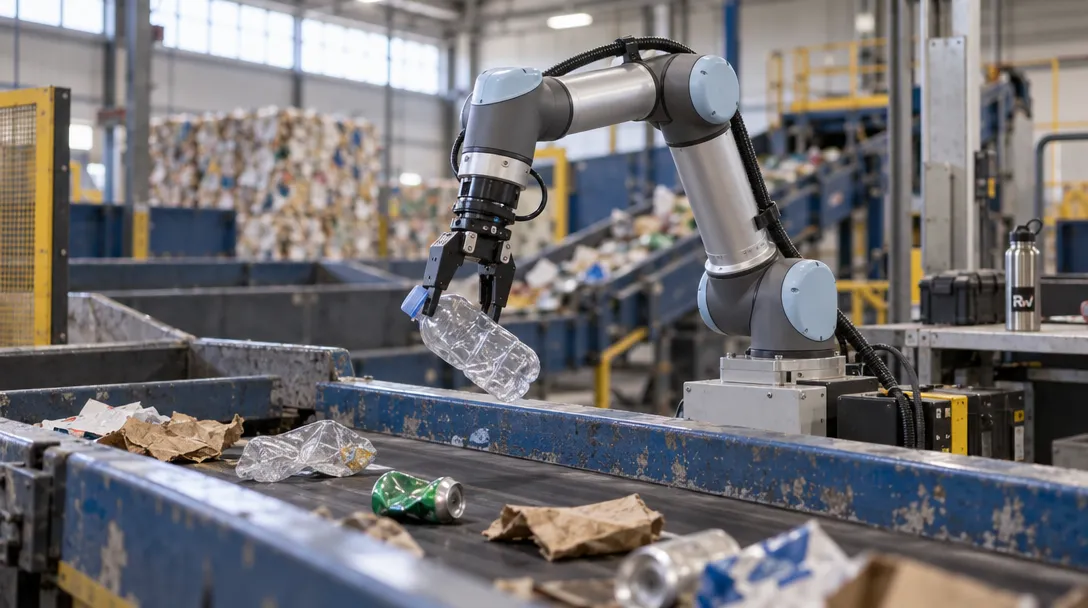
Danu Robotics is bringing its H.E.R.O. recycling sorter to market after six years of development, according to an October 9th, 2026 TechCrunch report. The report says Danu Robotics has $500,000 in signed contracts and has raised $5 million in late-seed funding, but does not date either development. For founder Xiaoyan (Amy) Ma, the commercial push follows a software developer's frustration with office recycling.
Ma's starting point was a London bank where she worked as a software developer. The building had separate recycling bins, but she saw their contents end up in the same place. "All these different recycling bins that just end up in the same place," she told TechCrunch.
Looking into why, she found a sorting process that still depended heavily on people separating mixed waste by hand. The problem connected Ma's software experience with an engineering challenge on the factory floor. She founded Danu in Edinburgh and built a team spanning robotics, hardware, computer vision and AI. Ma earned an MSc in High Performance Computing with Data Science in 2021, according to the University of Edinburgh's Danu Robotics profile. The university's EPCC centre later provided computing and software support to Danu, according to its case study.
The business case is the product
Danu's H.E.R.O. system uses computer vision to identify material on a conveyor, then robotic arms and a pincer-style gripper to pick it. Danu says its Series 2 system can be retrofitted into an existing sorting facility using less than a metre of conveyor space. Its design is aimed at operators who want to add automation to a working plant rather than rebuild the line around a new machine.

That practical constraint shapes the product. Danu says grippers can be replaced in 20 minutes and installation takes less than a day. Its software records a pick only once an item reaches the intended bin, rather than counting an attempted grab as a successful sort. That gives customers a measure closer to usable recovered material, though it does not by itself establish how accurately the system sorts at commercial scale.
The differentiation is partly mechanical. TechCrunch describes Danu's pincer claw as an alternative to suction-based arms sold by competitors including Glacier and Recycleye. Danu's larger pitch is that its software and AI can improve as the system processes more material and receives additional vision data. The hardware is custom-built for mixed recyclables; Danu says it licenses the software separately so it can be updated as the technology develops.
That split also reflects the adoption problem Ma is trying to solve. A sorting robot has to work inside a facility built for people, handle inconsistent material and justify its cost to an operator whose business depends on what can be recovered and sold. Danu's compact retrofit design is meant to lower the disruption required to test automation. The National Robotarium and Glasgow City Council's Blochairn depot have been among Danu's development connections, according to Glasgow City Council records.
Contracts are a start, not proof of payback
TechCrunch reports letters of interest from two large customers, $500,000 in signed contracts and more than 200 prospects in Danu's sales pipeline. The report does not specify when the contracts were signed. The figures describe different stages of a sale: signed contracts carry more weight than letters of interest, while prospects do not establish orders, deployments or recurring revenue. Danu's current customer count, revenue and number of operating units are not established by those figures.
Ma estimates that a site with a Danu robot could generate $485,000 in additional annual revenue, against a $160,000 initial investment and $24,000 in annual maintenance, according to TechCrunch's interview with her. That is her estimate of added revenue, not independently verified customer savings or profit. The calculation's value to buyers will depend on what materials the machine can consistently recover, the site's volume and the cost of running the whole sorting operation.
TechCrunch puts the sorting opportunity across Europe and North America at $20 billion. That market estimate is broad; Danu's immediate opportunity depends on winning individual facilities and proving the robot can deliver the recovery and uptime its buyers need. Danu's description of H.E.R.O. emphasizes measurable successful picks and fitting into existing operations, two practical requirements for turning a large market estimate into repeat purchases.
Danu's website describes its partners, stakeholders and investors without naming them. Sustainable Ventures separately described its investment in Danu in 2023 and said it would support Danu's commercialisation and engineering work. TechCrunch reports the $5 million late-seed total but does not connect that amount to particular participants. The reported funding gives Danu capital to develop and sell the system; customer performance will determine whether it can build a repeatable business.
Ma's longer-term ambition extends beyond material-recovery facilities. She told TechCrunch she wants a smaller, standalone version for places such as events, shopping centres, hospitals and airports, so packaging can be sorted closer to where it is discarded. That would expand the product's reach, but it also raises the engineering bar: a machine that works on a controlled conveyor must become compact and reliable enough for less standardized settings.
For now, the test is narrower and more useful. Danu has to show that its robot can work alongside manual sorting, recover valuable material at a predictable rate and make the economics hold at a real customer site. Ma's original complaint was that recycling bins could create the appearance of a system without changing what happened to the waste. H.E.R.O. will have to demonstrate the opposite, one verified pick and one paying facility at a time.