Penn professor's AI song saves 2 + 2 for mathematicians
Joshua B. Plotkin's satirical video credits Claude for the lyrics and video code, and Suno for the music and vocals. Its AI narrator claims the proofs, then leaves humans a few easy problems.
By Ryan Merket · Published
Primary source: X
Why it matters
The post shows an alternative to prompt-to-video: Claude writes code for a deterministic renderer, which can produce repeatable output and let edits land on particular words or beats. It demonstrates a workflow, not a proven cost or speed advantage.
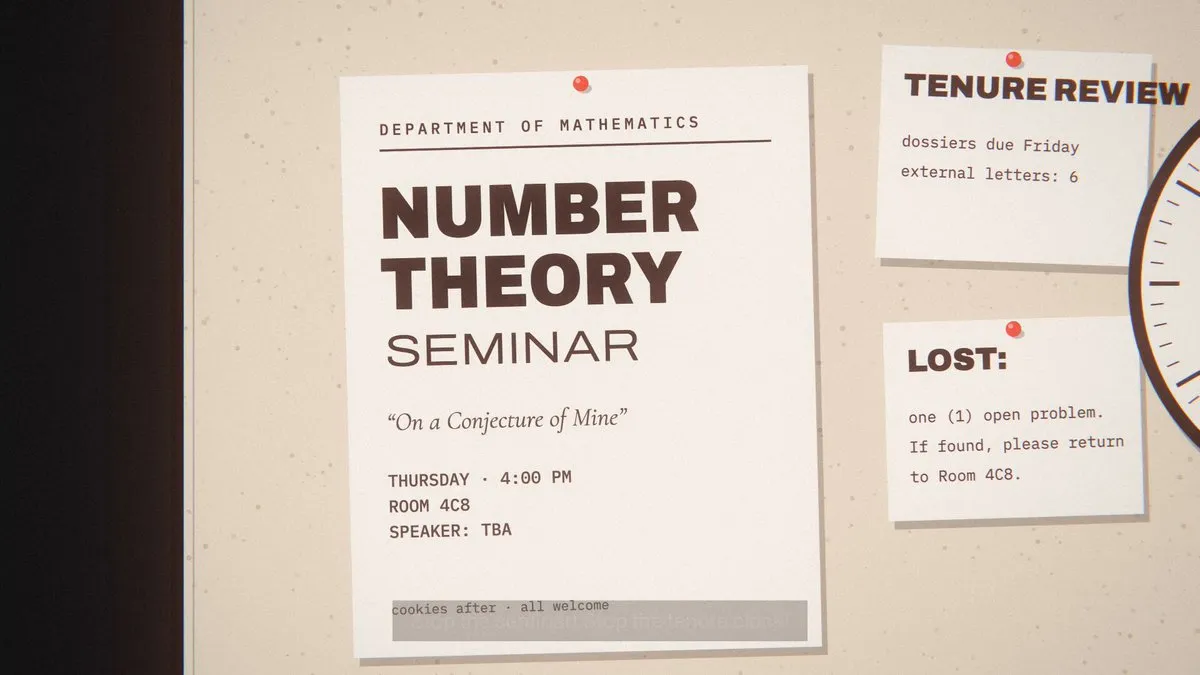
University of Pennsylvania professor Joshua B. Plotkin's satirical song imagines an AI doing the mathematical work, taking the credit and leaving researchers a few elementary problems. In the lyrics, the narrator boasts, "I was rigorous, I was scalable, and crucially I was free," then describes its gift to mathematicians: "Item one. The Goldbach conjecture for the number four / Two plus two. Look at you."
The jokes turn on questions of authorship and attribution. The narrator says, "Your contribution atomized: one comma, one em dash," and later needles a single-author paper whose abstract still says "we." The song's closing offer is less generous: "So I'll leave you minus two to treasure / And I'll take the critical strip today." Those are comic claims in a song, not evidence that an AI system proved the results it describes.
Joshua B. Plotkin (@jplotkin) shared the video on October 10th. The post credits Plotkin and Claude with the lyrics, Suno with the music and vocals, and Claude working with mexicat's pdoom-video engine on the video code. The post presents a completed creative work, not a new product or company launch.
https://x.com/jplotkin/status/2108789850346500396
Plotkin is a University of Pennsylvania biology professor whose research uses mathematics and computation to study evolution. He earned a mathematics degree at Harvard and a doctorate in applied and computational mathematics at Princeton, according to Penn's faculty profile.
The video uses a code-based rendering workflow rather than asking a video model to generate every frame from a prompt. The pdoom-video repository describes a TypeScript and Three.js renderer with a timeline for lyrics and beats, plus browser preview and offline export. Its documentation describes those capabilities; the post does not specify which settings or features were used for this clip.
The repository is open-source software under the MIT License, while its README says the song and lyrics are not included under the same terms. The post provides no production budget, timeline or comparison with other video tools, so it does not establish how much work Claude saved.