SafeWorld raises $12.2M to test robots before they work around people
Kyle Wong, Ding Zhao and Simo Rachidi are building software that runs robots through simulated encounters with people, including rare and hazardous scenarios.
By Ryan Merket · Published
Primary source: X
Why it matters
As robots take on work around people, SafeWorld is betting enterprises will pay for repeatable safety tests that expose failures simulation can uncover before deployment.
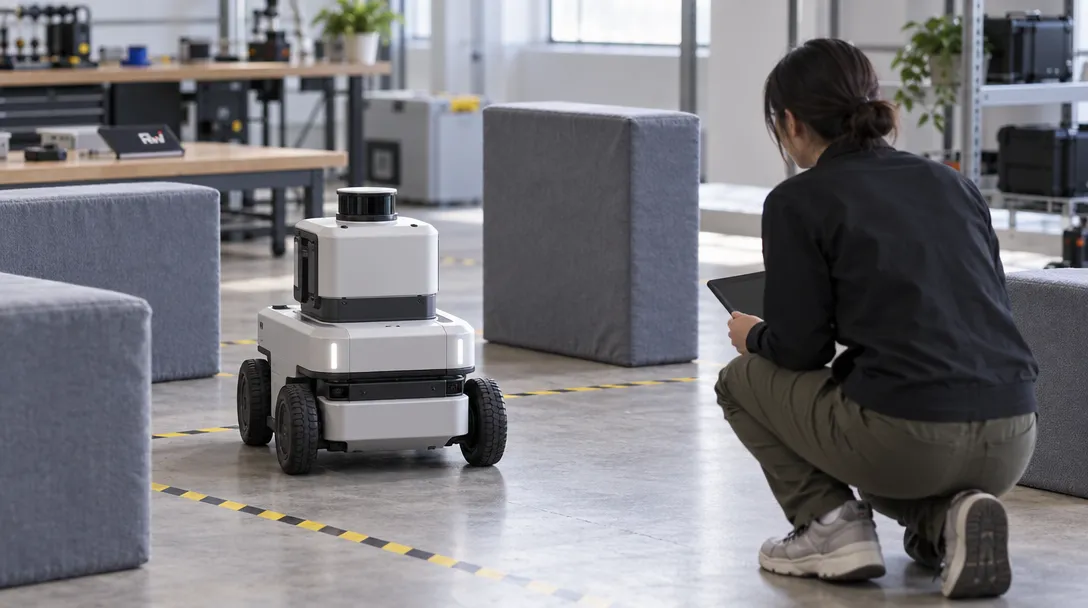
SafeWorld emerged from stealth on October 5th with $12.2 million in seed funding to test how autonomous robots behave around people. Co-founders Kyle Wong (@kwong47), Ding Zhao (@zhao__ding) and Simo Rachidi (@Sim0Rachidi) are pitching simulation software as a way for robotics companies to find dangerous edge cases before deploying machines into workplaces. Wong announced the launch and funding in a thread on X.
https://x.com/kwong47/status/2107112277010989215
Shine Capital and a16z Speedrun co-led the round. BoxGroup, Carnegie Mellon University Endowment, Innovation Endeavors and SV Angel also participated, according to the company. The $12.2 million figure comes from SafeWorld's announcement; TechCrunch independently reported the round as more than $12 million. The company says it is already working with robotics companies and public companies deploying robots, without giving a customer count.
SafeWorld's premise is that robot safety testing gets harder as machines move beyond predictable, controlled tasks. A robot operating around people may encounter a worker emerging from a blind corner, carrying a load, crouching or falling. SafeWorld says its software can model those situations and evaluate a robot's responses without staging potentially dangerous physical tests.
TechCrunch reported that SafeWorld plans to recreate a workplace in simulation software such as Genesis or MuJoCo, run the robot's actual control software in that environment, and test it against thousands of simulated human encounters. The tests are meant to probe questions such as whether a robot detects someone carrying boxes and how quickly it must stop near a blind corner. SafeWorld's website describes a workflow for generating possible paths, predicting interaction risk and preserving evidence for deployment decisions.

The first named partner is Gritt Robotics, whose robots assist workers installing solar panels at large solar farms. Gritt CTO Vishal Dugar told TechCrunch that proving such systems safe through formal mathematical verification is difficult, making empirical testing important. A construction-site robot must account for workers in different positions and motions, not just a standard upright figure moving through an empty demo area.
Wong, a Stanford engineering graduate, founded Pixlee as an undergraduate and led it as CEO. Emplifi acquired Pixlee TurnTo in 2022. Wong then became CEO of Stanford's StartX accelerator in January 2024, before turning to SafeWorld. His co-founder Rachidi was Pixlee's founding engineer and later a principal engineer at Salesforce Einstein, where he says he worked on systems processing more than 10 billion events per day. Zhao directs Carnegie Mellon University's Safe AI Lab and researches trustworthy AI and safety in human-robot interaction; CMU lists him as a recipient of its NSF CAREER Award.
The founding team is betting that simulation evidence can become a trusted part of enterprise deployment decisions, including when robot makers already run their own internal tests. The case for a separate provider depends on whether buyers value outside evaluation and whether results from modeled scenarios help answer the safety questions specific to each facility. SafeWorld's early partner, Gritt, gives it a concrete industrial use case, while the company describes its broader customer base only in general terms.
SafeWorld's business model is still unsettled. TechCrunch reported that the company is weighing a self-serve software platform against a services-led model or a combination. For now, its website invites companies to request access and speak with the team; it does not list pricing. The $12.2 million seed gives SafeWorld capital to build the product and test demand for repeatable robot-safety evaluations, while the business model and the role of any third-party validation remain to be proven.