Tesla opens Cybercab fleet interest list, leaves the economics for later
The form asks about fleet purchases and deployment regions but gives no price, delivery schedule or Robotaxi revenue-sharing terms.
By Ryan Merket · Published
Primary source: X - Brian Roemmele
Why it matters
Outside buyers could finance Tesla's Robotaxi expansion, but pricing, operating costs and Tesla's share of ride revenue will determine whether a Cybercab fleet is investable.
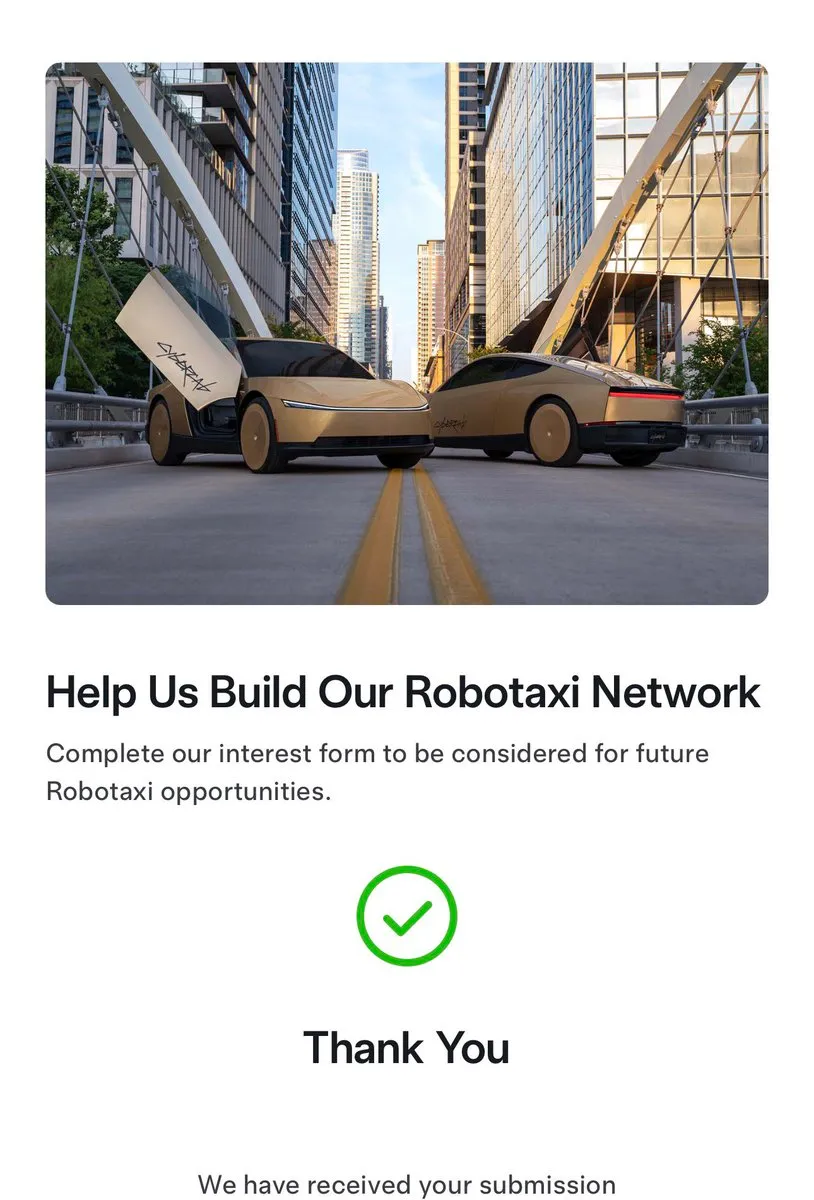
Tesla opened an interest list on September 3rd for businesses that want to purchase Cybercab fleet vehicles, creating its first direct intake channel for prospective outside owners of the purpose-built robotaxi.
The Tesla form asks applicants for a company name, deployment region and additional information. Users can select "Cybercab fleet vehicle purchasing," "mobility hubs and infrastructure," "event collaboration" or "other" as their area of interest.
Brian Roemmele (@BrianRoemmele), the founder of technology publication ReadMultiplex, surfaced the page on X, describing it as an opportunity to become one of the first owners of a Cybercab network. Tesla's language is narrower: completing the form means an applicant may be considered for future Robotaxi opportunities.
The page does not accept a deposit or vehicle order. It lists no Cybercab price, minimum fleet size, delivery window, financing structure, operating requirements or formula for splitting ride revenue between Tesla and a vehicle owner.
Musk's private-owner plan gets an intake form
The form advances a business model Elon Musk (@elonmusk) has discussed for years: combining vehicles owned by Tesla with cars supplied by customers, while Tesla controls the software and ride-hailing network.
Musk, Tesla's co-founder and chief executive, has led the automaker's product design and engineering strategy since its early years. Tesla's 2025 proxy materials said a future Robotaxi program may allow owners to place personal vehicles into the fleet and share the resulting income with Tesla. The filing described that model as a future possibility rather than an available commercial program.
Tesla's second-quarter update filed on July 22nd showed why outside ownership matters to the company's expansion strategy. Tesla said vehicle deployment would depend partly on how it allocates production between customer sales and its owned and operated fleet. The same filing listed installed annual Cybercab manufacturing capacity of more than 125,000 vehicles at Gigafactory Texas, while warning that installed capacity does not equal current output.
Tesla reported that Cybercab production began during the second quarter. Engineering vehicles had started public-road testing, and employees began taking rides on the Gigafactory Texas campus in July. Those vehicles were precursors to deployment in Tesla's own Robotaxi fleet, according to the filing.
The new form is the first visible bridge between that manufacturing ramp and prospective fleet customers. It lets Tesla measure where buyer demand exists before committing to prices, allocation volumes or operator contracts.
The missing terms decide whether there is a business
Outside ownership could reduce the amount of capital Tesla must commit to vehicles, depots and local fleet expansion. Buyers would finance the cars while Tesla could collect software, dispatch or network fees. The structure could also distribute vehicle maintenance, cleaning, charging and storage responsibilities among local operators.
That strategy requires economics strong enough to compensate owners for vehicle depreciation, financing, insurance, downtime and local operating costs. Tesla has not published those economics on the interest page. It also has not specified whether buyers would be allowed to operate Cybercabs exclusively on Tesla's network or whether Tesla would control fares, service areas and vehicle availability.
Tesla currently says its Robotaxi service offers autonomous Model Y rides in Austin, Dallas and Houston, Texas, and Miami, Orlando and Tampa, Florida. The company says Cybercab service will reach additional areas in the future.
Opening the fleet-purchase form gives Tesla a list of potential buyers as Cybercab production expands. It does not yet give those buyers a fleet, an order or a financial model. The next consequential disclosure will be the contract: who owns the vehicle, who controls its working hours, and how much revenue remains after Tesla takes its share.