Type One Energy raises $200M to see if its stellarator works as advertised
Type One Energy's Series B, co-led by Breakthrough Energy Ventures and Clutterbuck Capital, will fund an engineering prototype and Project Infinity in Tennessee.
By Ryan Merket · Published
Primary source: Reuters
Why it matters
Type One's round backs a shift from university stellarator research to prototype engineering and industrial partnerships. Siemens Energy Ventures adds strategic weight, but the financing is still funding a long path to a plant that has yet to generate power.
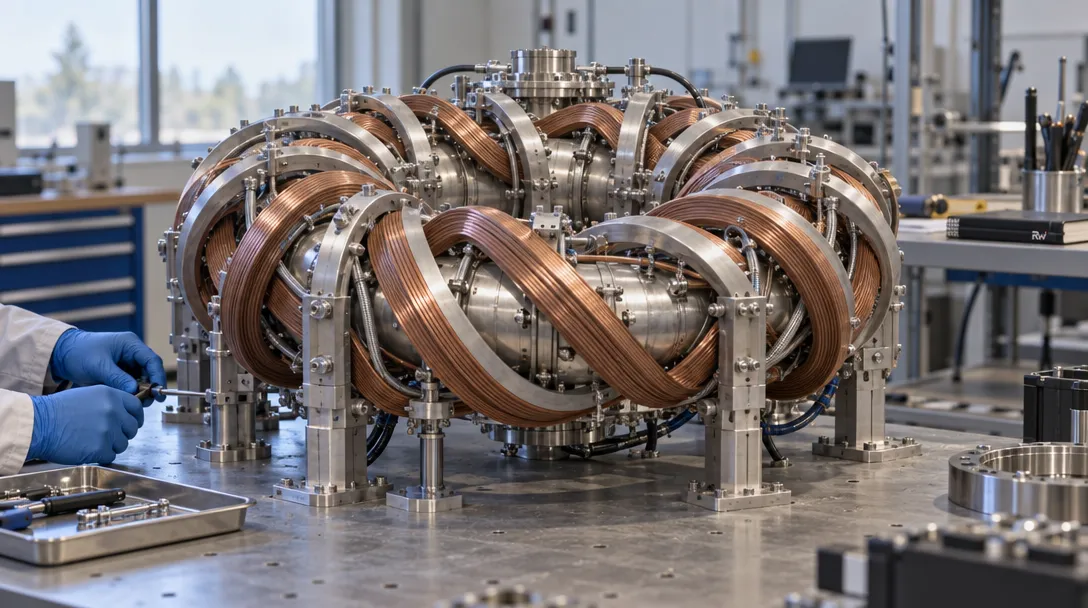
Type One Energy raised $200 million in a Series B on October 6th. Co-founded by University of Wisconsin-Madison researcher David Anderson, the fusion company will use the capital to develop its stellarator technology and engineering prototype, Infinity One, while pursuing a commercial plant at Tennessee's Bull Run site.
Anderson and fellow University of Wisconsin-Madison researchers built and ran the Helically Symmetric eXperiment, or HSX. Anderson led the university's Department of Energy-funded project for decades; the experiment drew $47 million in outside research funding. Type One grew out of that work, carrying an academic research program into a private company developing a stellarator power plant.
Breakthrough Energy Ventures and Clutterbuck Capital co-led the round, according to Type One. New investors include Lowercarbon Capital, Siemens Energy Ventures and SiteGround Capital. Reuters cited PitchBook in describing it as the third-largest Series B in the fusion sector over the previous five years. The round brings Type One's total funding to more than $400 million, Reuters reported.
From university physics to industrial delivery
A stellarator confines superheated plasma with complex magnetic fields. Type One's plan depends on engineering and industrial capacity alongside plasma physics. Type One says it will work with established energy, engineering and construction partners to bring those capabilities to the project.

Siemens Energy Ventures is an investor, and Reuters reported that Type One aims to work toward a manufacturing partnership with Siemens. The companies have not announced a manufacturing agreement.
Type One CEO Christofer Mowry brings more than research experience to the project. Before joining Type One in 2023, he led General Fusion and founded Generation mPower, which pursued small modular fission reactors. He also held energy leadership roles at Babcock & Wilcox and GE.
Mowry told Reuters the funding would support Infinity One and described the goal as testing whether the power-plant design works as intended. "It's not an experimental science project... the only thing that we want to learn is that our design for the fusion machine in the power plant works as advertised."
Infinity One is an engineering prototype. Infinity Two is the planned commercial plant at Bull Run, which Type One hopes to launch within a decade, Reuters reported.
A large round, with a long technical runway
Type One is still developing its first commercial plant and has not demonstrated commercial fusion power. The Series B gives it capital to advance the prototype and project design; engineering and deployment risks remain.
Type One says the financing follows the initial operating license for Project Infinity at Bull Run. The licensing step establishes a regulatory path for the project, but the plant is not built or generating power.
For Anderson and the other researchers who helped create the technical foundation, Type One now faces a different test: whether a design developed from stellarator research can be engineered, manufactured and deployed as a power plant. Mowry's commercial track record and the new industrial investor make that test more tangible. Type One still has to build the machine.