Hilt raised $4.2M to spot breaches hiding behind valid access
Founder William Cielen says a hedge fund paid six figures before Hilt had built its security product for latency-sensitive trading systems.
By RuntimeWire Staff · Published
Primary source: Crunchbase News
Why it matters
Hilt's early bet is that kernel-level visibility can catch misuse of valid access without slowing sensitive systems. The seed funds the test of whether a demanding trading use case can become a repeatable security product.
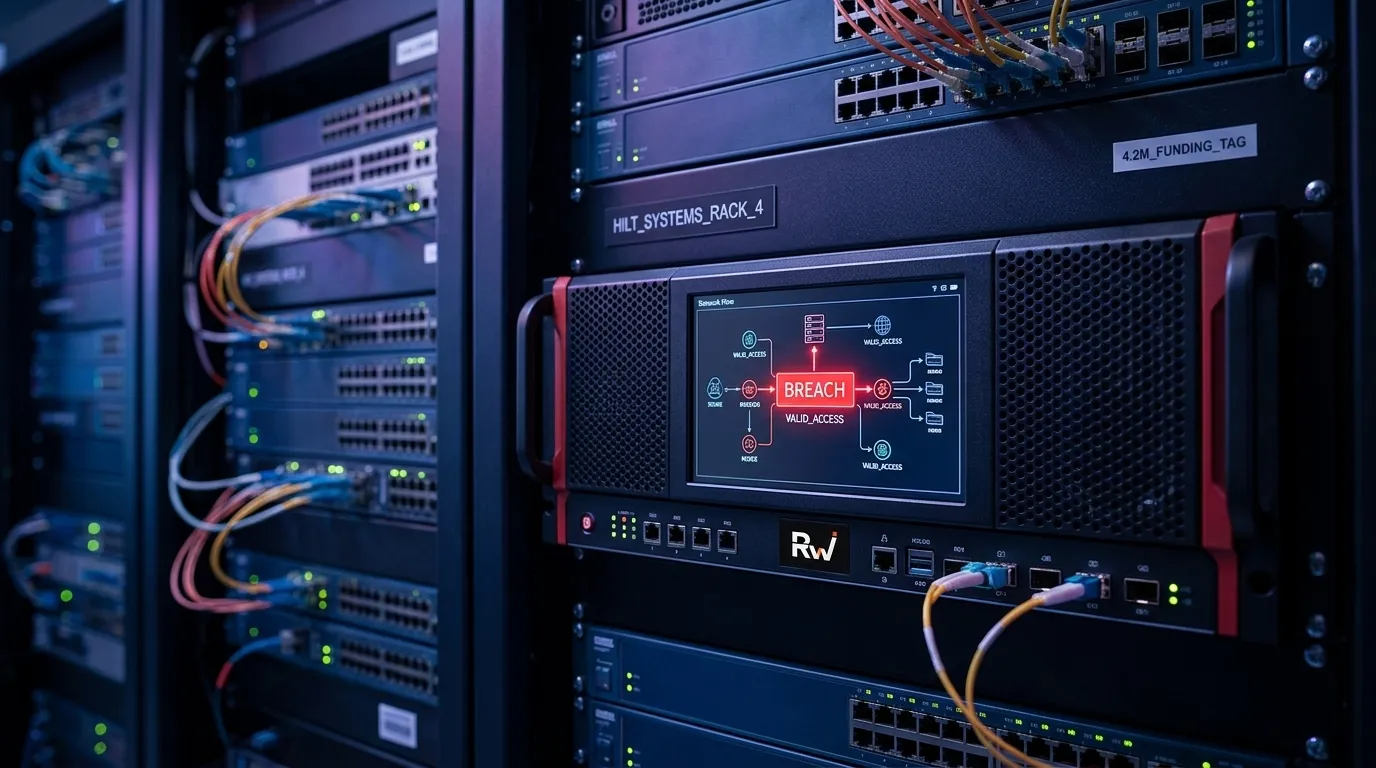
Hilt raised $4.2 million in seed funding to build cybersecurity software that looks for suspicious data movement even when the people or systems involved have permission to access it. The funding gives William Cielen, Hilt's co-founder and CEO, capital to hire and take the product beyond its first market: high-frequency trading. Crunchbase News reported the round, led by Array Ventures, with participation from Verdict Capital, Base10 Partners, Brickyard, Liquid 2 Ventures, Sequel, the Sarah Smith Fund and Alumni Ventures.
Cielen's route to cybersecurity ran through a family magic act, ballet and algorithmic trading. The son of a magician and an acrobat, he spent his first five years living on a cruise ship and the next five in Las Vegas. After moving to Montreal at 10, he joined an intensive ballet program. By 15, he had skipped two grades, started college and launched a website design and development business. Later, while studying at Concordia University and interning in algorithmic trading at the National Bank of Canada, a hackathon in Waterloo introduced him to venture investors. Cielen said he left school and the internship that same week and moved to San Francisco to start Hilt.
Cielen told Crunchbase News that broad customer discovery helped him choose a specific opening in cybersecurity rather than build without a clear buyer. In January, a hedge-fund CTO described security needs in high-frequency trading, where systems operate in microseconds and added latency can affect the work they are designed to do.
A first customer before the product was built
The hedge fund offered a potential contract worth $1 million to $2 million if Hilt could solve the problem, according to Cielen. In the interview, Cielen also said the fund paid a six-figure amount upfront before Hilt had built the solution. The potential contract was conditional; the upfront payment, as Cielen described it, had already been made. Cielen said Hilt continues to work with the fund and has added another high-frequency trading firm. He did not name either customer.

The product's premise is that access controls and conventional security tools can miss abuse that travels through legitimate permissions. An employee, vendor or software agent might be authorized to reach sensitive data; a change in the timing or pattern of that access can still be suspicious. Hilt says its software monitors activity across cloud infrastructure, computers and networks, establishes behavioral baselines, and flags unusual combinations for investigation or containment.
Hilt's approach is to observe activity at the operating-system kernel, below individual applications, and analyze activity data with graph neural networks. On Hilt's website, Hilt describes its collector as metadata-only and says it runs in a customer's own cloud environment without reading the underlying data. Those are Hilt's descriptions of the product, not independent performance findings. Cielen told Crunchbase News that one customer's measurements showed its cloud systems ran faster after deployment, but the report did not include a benchmark or methodology.

The product is designed to observe enough of a system's behavior to spot a breach without slowing down the workloads it protects. That requirement is especially visible in trading, where latency is part of the customer's operating requirement. Hilt's early sales test whether customers want the detection and whether the software can stay out of the way.
Capital to turn a narrow opening into a market
The seed brings Hilt's reported total funding to $4.7 million, including a $500,000 pre-seed led by Pear VC in October 2025. Hilt said it will use the new capital mainly for hiring and building a market presence. Hilt had 11 employees at the time of the Crunchbase News report, including CTO Alexandre Genest and founding engineer Zin Bitar. Hilt's team moved from San Francisco to Chattanooga, Tennessee, alongside investor Brickyard.
Cielen said Hilt's customer count doubled in the month after it began a more concerted marketing push, but did not give the starting number or the total. Hilt also has interest from neobanks, healthcare providers and professional services firms, according to the report. Hilt charges an annual fee per data collector, a model that ties expansion to the number of monitored systems, though the price and customer count were not reported.
Array general partner Shruti Gandhi framed Hilt's opportunity around the gap between tools that try to identify sensitive data in advance and products that reconstruct what happened after information is gone. Verdict Capital founder Niko Bonatsos said the founding team and its ability to sell into financial institutions helped draw him to the deal. Investors' endorsement is clear; how broadly Hilt's early product can transfer from trading firms to other sectors remains a commercial test.
Cielen told Crunchbase News that one financial customer paid upfront before the product existed and continued working with Hilt as it built a latency-sensitive system. Hilt still has to show it can turn that first use case into repeatable deployments and customers across industries while maintaining the speed and visibility that drew the first buyer.