Kapta Space raises $24M to scale radar payloads for classified tracking missions
Founder Milton Perque says Kapta Space will use the round to fund production and flight qualification after securing multiple classified contracts earlier in 2026.
By RuntimeWire Staff · Published
Primary source: PR Newswire
Why it matters
Kapta's Series A finances the costly transition from radar design to production and flight qualification. The classified contracts offer a mission foothold, while orbital demonstrations and independent performance evidence remain ahead.
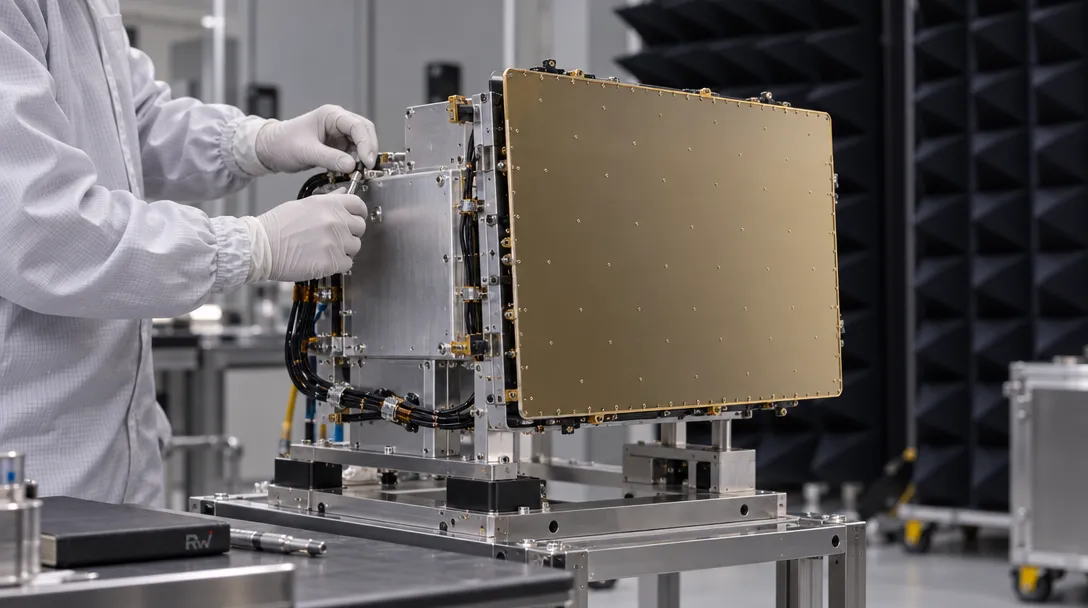
Kapta Space raised $24 million on October 9th to scale its radar payloads for multiple classified moving-target tracking contracts, giving founder and CEO Milton Perque capital to take the hardware from development toward flight qualification and orbital demonstrations. Washington Harbour Partners led the Series A, with Bison Ventures co-leading; MetaVC, MYDA Capital, Entrada Ventures, Aurelia Foundry and Fitz Gate Ventures also participated, according to Kapta's announcement.
Perque's bet rests on a problem he has worked on for decades: radar that can keep track of moving objects is difficult to make affordable and compact enough for broad use in orbit. Before co-founding Kapta, he was an engineering leader at Echodyne, the Seattle radar company, and also worked at Metacept and Intellectual Ventures, according to GeekWire's 2025 reporting. Kapta co-founder and CTO Adam Bily also came from Echodyne; before Kapta, he led the antenna team at satellite company Astranis and worked as an antenna engineer at Apple, StoryHouse Ventures says.
The founders bring experience in radar and antenna engineering to a market where tracking a moving object over time requires more than detecting it once. Perque described the mission in the announcement as persistent awareness across air, sea and land. Kapta's challenge is to turn that thesis into a payload that can be built in quantity, qualified for spaceflight and operated in actual missions.
From radar design to flight hardware
Kapta's modular Metamaterial Electronically Scanned Array, or MESA, uses electronic beam steering to search and revisit areas without mechanically turning the radar. Kapta says its software-defined architecture is designed to reduce cost, power use and manufacturing complexity compared with traditional active electronically scanned array systems. Those are company claims; the public materials do not provide independent performance testing or a cost comparison.

The immediate financing purpose is concrete. Kapta says it secured multiple classified moving-target indication contracts earlier in 2026, and that the Series A will support production for those programs. It has not named the customers or disclosed contract values, schedules or terms, so the announcement establishes a government-backed use case without showing the size of the resulting business.
In a separate interview with Payload, Perque said Kapta is executing two demonstration missions and expects flight heritage in 24 to 36 months. The October announcement describes flight qualification and preparation for a first orbital demonstration as next steps. Those milestones remain ahead: the funding announcement does not establish that a Kapta payload has flown.
Kapta is moving from engineering work and contract awards into manufacturing and qualification. The payload must meet mission requirements before it can establish flight heritage. The contracts provide a near-term mission context; planned demonstrations could test the hardware in orbit. Neither establishes that Kapta can produce the system at the scale its business case requires.
Investors are backing the scale-up
The investor roster includes returning early backers and firms that led this round. MetaVC led Kapta's $5 million seed, announced in February 2025, with Entrada Ventures and Blue Collective also participating, GeekWire reported. The Series A's lead, Washington Harbour Partners, is led by Mina Faltas, who described Kapta's modular design as a path to more manufacturable electronically steered radar. Bison Ventures co-led the round.
Kapta says the Series A brings its total funding to $30 million. Its previously announced $5 million seed and the new $24 million round add to $29 million; the announcement does not explain the remaining $1 million. It also does not disclose a valuation. The ownership terms and the round's implied price remain undisclosed.
Perque has framed the underlying market problem in terms of scale: conventional radar payloads, he said, were too costly and complex for the large satellite constellations persistent tracking could require. Kapta is trying to change those economics through its payload design. Commercial applications such as radar imaging are also part of Kapta's stated product ambitions, but the newly announced contracts and financing are centered on national-security missions.
The next test is whether Kapta can deliver flight-qualified hardware on the timetable it has described. Its Series A funds that push, and the contracts provide mission work to support. Technical and commercial proof will depend on hardware reaching orbit and performing as intended; the architecture's stated advantages alone do not establish that.