Ultra raises $50M to put warehouse robots on more floors
Ultra says its robots have packed more than 500,000 orders; Framework Ventures led the Series A, bringing Ultra's announced funding to $62M.
By Ryan Merket · Published
Primary source: X
Why it matters
Ultra's round backs a deployment-first approach to warehouse robotics: recurring service revenue and real customer workflows, paired with AI supplied by a specialist partner. Its order-volume claim offers a glimpse of usage, while the company has not tied it to deployment counts or per-robot economics.
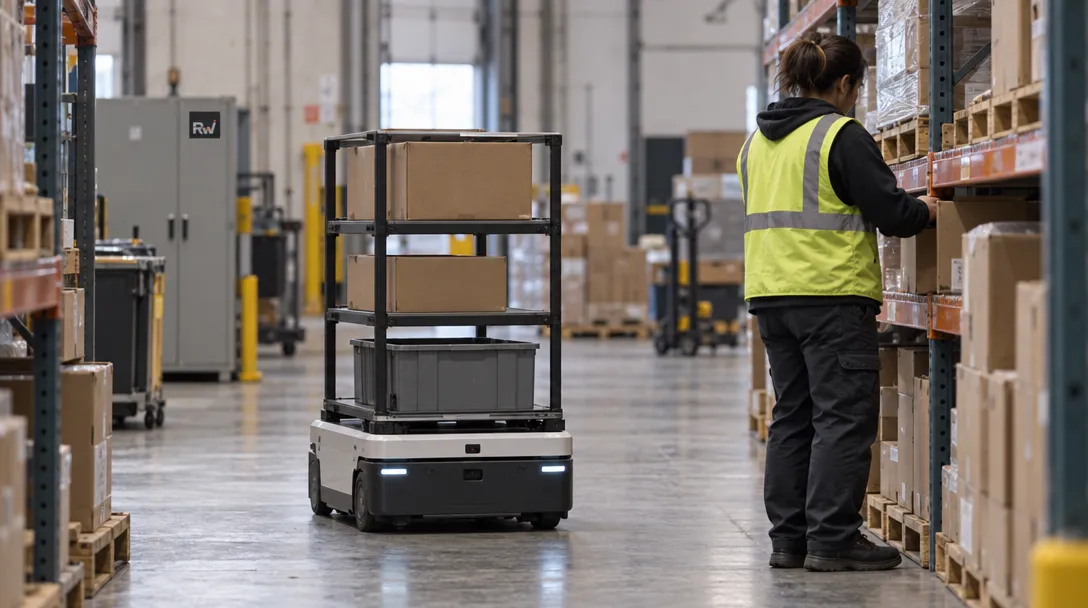
Ultra announced a $50 million Series A on October 9th, led by Framework Ventures, bringing its announced funding to $62 million. Co-founder and CEO Jon Miller Schwartz is raising around a deployment strategy: put robots to work in customer warehouses, then use what happens there to make the operation repeatable.
Schwartz and co-founders Max Friefeld, Oliver Ortlieb and Chetan Parthiban spent the previous two and a half years deploying robots with customers, Ultra said. Ultra describes warehouse floors as its training environment and test bench. That experience informs its central bet: getting robots into everyday operations, keeping them useful and earning worker trust are the hard parts of industrial robotics.
The four founders have worked together on manufacturing and robotics before. Y Combinator's company profile lists Schwartz and Ortlieb as co-founders of Layer By Layer and Voodoo Manufacturing, and Friefeld as a co-founder of both as well. Schwartz later worked at Body Labs and Arena AI; Ortlieb built software and systems for Voodoo's 3D-printing factory. Parthiban, Ultra's chief scientist, previously worked as a machine-learning scientist at Arena. Ultra joined YC's Summer 2024 batch.

The product is Operator, or OP1, a stationary robot for warehouse packing, sorting and kitting. Ultra says the machine can be installed in hours, works from a standard 120-volt outlet and fits within a roughly 5-by-5-foot footprint. Its work area extends up to 10 by 10 feet, with a stated payload limit of 10 pounds. The form factor targets existing workstations rather than requiring warehouses to rebuild around a large fixed automation system.
Ultra's model also changes the customer's upfront commitment. Fortune reported that customers pay an integration fee, followed by monthly charges for hardware and software support, rather than buying a system outright. Schwartz told Fortune the model has generated significant revenue and enabled Ultra to raise prices; he did not give a revenue figure. Ultra says its robots have packed more than 500,000 orders across U.S. warehouses. That is a company-reported cumulative count, not a disclosure of how many robots are deployed or how much revenue each generates.
The Series A follows a $12 million seed round led by Y Combinator and NextView, according to Fortune's report. Ultra also named Wing VC and M13 among its investors. The funding announcement does not break down how much of the $62 million is newly raised versus the earlier seed; Fortune reports the $50 million Series A and $12 million seed as the two rounds making up the total.
Ultra is also working with Physical Intelligence, which supplies robotic AI models while Ultra provides the hardware and customer deployments. In a February 2026 account of the collaboration, Physical Intelligence reported its model ran on an Ultra robot packing customer orders for a full shift at 96.4% autonomy. The same account says human intervention steps in when the model stumbles, helping ensure orders are completed while producing data for later model training. That figure is a partner-reported result from a described deployment, not evidence that every Ultra robot or customer workflow achieves the same autonomy.
That division of work places Ultra's bet on physical deployment and customer access, while an outside model provider supplies a layer of robotic intelligence. The financing gives Ultra capital to expand its field operation; the commercial test is whether installations, support and model-assisted performance can scale without erasing the economics of recurring service fees. Ultra named early customers Manifest, Highline Commerce and ShipsaLot, but did not provide deployment counts alongside its funding announcement.