Wolfspeed's proposed $1.5B defense loan starts with a 2030 debt refinance
The first $600M would refinance secured notes due in 2030. Later draws depend on project conditions, government approvals and a $750M minimum contribution that can include equity, excess cash, converted debt and other sources allowed by the Office of Strategic Capital.
By RuntimeWire Staff · Published · Updated
Primary source: Wolfspeed
Why it matters
The proposed loan would refinance secured notes due in 2030 while tying later funding to a domestic manufacturing program. Wolfspeed must also meet a $750 million contribution requirement that can include equity, excess cash, converted debt and other sources accepted by the OSC.
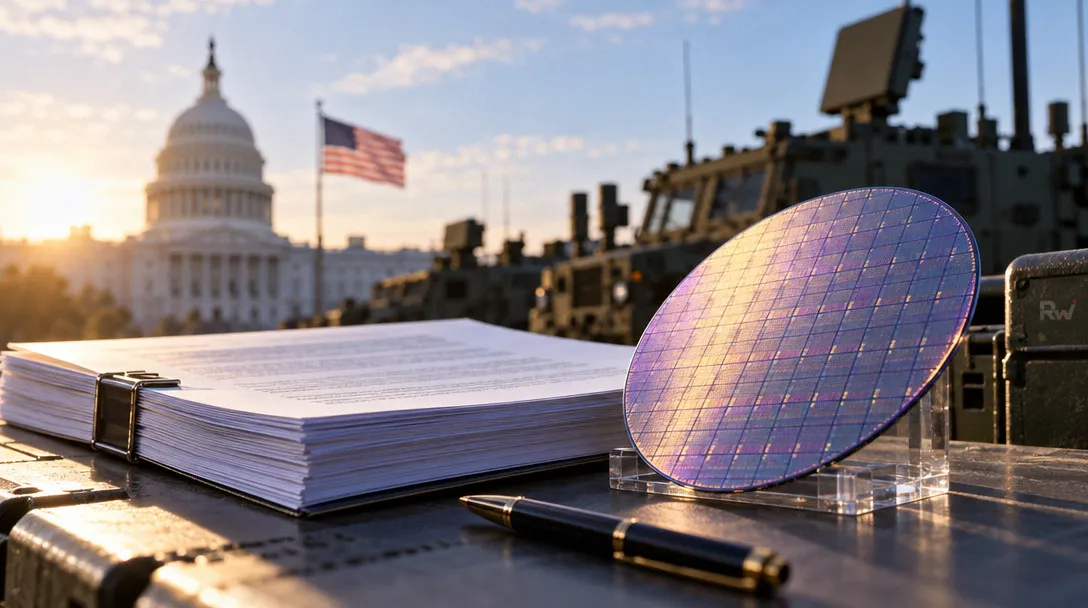
Wolfspeed announced a conditional $1.5 billion loan commitment from the U.S. Department of War, and CEO Robert Feurle said silicon carbide and gallium nitride have national-security applications. In its October 7th announcement, Wolfspeed said it plans to use the financing to upgrade gallium nitride epitaxy capabilities and develop radiation-hardening capabilities for current silicon carbide and future gallium nitride products. Feurle's statement about national-security applications was a separate point in the announcement.
The SEC filing lays out the proposed facility: up to $1.5 billion across as many as four tranches, with a 30-year maturity and a 36-month commitment period for drawing funds. The first tranche would provide $600 million to refinance Wolfspeed's first-lien senior secured notes due in 2030 and pay transaction fees and expenses. The remaining $900 million would be split into tranches of $200 million to $400 million to fund project expenditures.
The proposed financing puts debt refinancing first, with subsequent funding tied to Wolfspeed's domestic manufacturing program. The filing sets a $750 million Minimum Contribution, which may be met with qualifying equity or equity-linked instruments, excess cash, convertible debt converted or equitized into equity, and other items at the Office of Strategic Capital's discretion. At least $150 million of the contribution is required for the initial tranche and the remaining $600 million for later tranches. For the initial tranche, the filing specifies $50 million in qualifying equity from third parties unaffiliated with the U.S. government before the facility takes effect, plus another $100 million before the second tranche.
Other conditions include Wolfspeed using commercially reasonable efforts to equitize a substantial majority of its outstanding convertible notes, completing due diligence to the OSC's satisfaction for later draws, entering commercial arrangements such as offtake agreements, and demonstrating compliance with financial covenants. Government authorizations, appropriations, lender consents and definitive agreements also remain outstanding.
The terms are provisional. The interest rate is expected to track a comparable U.S. Treasury rate plus a risk premium provisionally set at 1.25% to 1.75%. Interest could be capitalized during the first five years if no event of default has occurred, subject to final agreements. Wolfspeed would also issue the government warrants to purchase up to 7.5% of its fully diluted equity, in stages as tranches are funded.
A semiconductor bet rooted in North Carolina
Wolfspeed's origins trace to silicon carbide research at North Carolina State University. In 1983, John Palmour and four fellow graduate students began working on silicon carbide and gallium nitride. Their work became Cree Research in 1987. Cree later focused on silicon carbide semiconductors and rebranded as Wolfspeed in 2021.
Palmour described the early work as aimed at high-power microwave devices, including military applications. Wolfspeed's proposed project now includes upgrading gallium nitride capabilities for communications infrastructure and electronic warfare, building domestic gallium nitride production, advancing gallium-nitride-on-silicon-carbide radio-frequency wafers and developing radiation-hardening capabilities. Its semiconductor business spans silicon carbide materials and power devices used in applications from power conversion to defense systems.
Feurle, who became CEO on May 1st, 2025, joined after senior roles at ams-OSRAM, Infineon, Micron, Qimonda and Siemens, according to Wolfspeed's executive biography. In Wolfspeed's announcement, he said the financing could expand the company's capacity to serve the U.S. government.
Capital comes with conditions
Wolfspeed emerged from Chapter 11 on September 29th, 2025, after a restructuring that reduced its debt by about 70% and lowered annual cash interest expense by roughly 60%, according to its restructuring announcement. The proposed government loan would sit alongside that reorganized capital structure as Wolfspeed seeks financing for its manufacturing plans.
Wolfspeed reported $665.1 million in fiscal 2026 revenue, split between $468.3 million in the post-restructuring successor period and $196.8 million in the preceding predecessor period. Its annual results report a $415.8 million net loss for the successor period, from September 30th, 2025, through June 28th, 2026, and $420.2 million in net income for the predecessor period, from June 30th through September 29th, 2025. Because Wolfspeed adopted fresh-start accounting after its emergence, the periods are not directly comparable. Separately, the company reported a $145.4 million net loss for the quarter ended June 28th, 2026, in its fourth-quarter results. Wolfspeed also said AI data-center revenue more than doubled year over year in fiscal 2026.
In October 2024, Wolfspeed announced a proposed $750 million CHIPS Act award and a separate $750 million financing package led by Apollo funds, alongside an expectation of tax refunds. Those arrangements are distinct from the new Department of War commitment. The 2024 announcement described the funding as proposed or expected.
The filing would require Wolfspeed to keep its headquarters in the United States, maintain a board majority of U.S. citizens and a CEO who is a national of a permitted jurisdiction, and give the Department of War certain rights concerning products or services tied to the project. Government authorizations, congressional appropriations, lender consents, qualifying sources of contribution and definitive agreements remain conditions. Wolfspeed says there is no assurance the transaction will close or that any funds will be provided.
The proposed 30-year facility could refinance Wolfspeed's secured notes and support domestic production. How much the company can draw after the initial tranche depends on the project's progress, approvals and contribution requirements, which allow a wider range of qualifying sources than outside equity alone.